Questions:
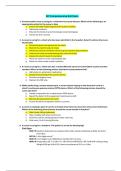
1. a) Use the solubility table provided to predict whether solutions of iron (III) nitrate and
sodium phosphate will form a precipitate if you had mixed them. Name the precipitate, if
any
- According to the solubility chart I predict that iron(III)nitrate and sodium
phosphate will not form a precipitate if they are mixed together.
b) Follow this procedure to determine and state the name of each precipitate formed in
steps two and three
1) iron (III) hydroxide (Fe(OH)3)
2) zinc hydroxide( Zn(OH)2) & sodium sulphate ( Na2SO4)
3) copper (II)hydroxide (Cu(OH)2)
4)
2. a) What does (aq) signify in a chemical equations
- Aqueous in a chemical equation signifies a compound in which a solution is
dissolved.
b) What does (s) signify in a chemical equation
- Solid in a chemical equation signifies that a compound is in a solid state.
3. Write and balanced chemical equations for each reaction in this experiment. Each
reaction in steps two and three is a double displacement reaction. Therefore you should
be able to determine the product once you have worked out the formulas of each
reactant. Make sure that you indicate the physical state of the reactants and products.
The reaction in step four has three products, one of which is water complete an equation
for the reaction.
1) sodium hydroxide + iron (III) nitrate → iron (III) hydroxide + sodium
nitrate
3NaOH(aq)+ Fe(NO3)3(aq) → 3NaNO3(aq) + Fe(OH)3(s)
2) sodium hydroxide + zinc sulphate → zinc hydroxide +sodium sulphate
2NaOH(aq) + ZnSO4(aq) → Zn(OH)2 (s)+ Na2SO4(s)
3) sodium hydroxide + copper (II) sulphate + sodium sulphate + copper (II)
hydroxide
2NaOH(aq) + CuSO4(aq) → Na2SO4 (aq) + Cu(OH)2(s)
4) sodium phosphate + silver nitrate → silver phosphate + sodium nitrate
3AgNO3(aq) + Na3PO4(aq) = Ag3PO4 (aq)+ 3NaNO3(aq)
5) sodium carbonate + hydrochloric acid → sodium chloride +
dihydrogen monoxide + carbon dioxide
Na2CO3(aq) + 2HCl(aq) → 2NaCl(aq) + H2O(g) + CO2(g)
1. a) Use the solubility table provided to predict whether solutions of iron (III) nitrate and
sodium phosphate will form a precipitate if you had mixed them. Name the precipitate, if
any
- According to the solubility chart I predict that iron(III)nitrate and sodium
phosphate will not form a precipitate if they are mixed together.
b) Follow this procedure to determine and state the name of each precipitate formed in
steps two and three
1) iron (III) hydroxide (Fe(OH)3)
2) zinc hydroxide( Zn(OH)2) & sodium sulphate ( Na2SO4)
3) copper (II)hydroxide (Cu(OH)2)
4)
2. a) What does (aq) signify in a chemical equations
- Aqueous in a chemical equation signifies a compound in which a solution is
dissolved.
b) What does (s) signify in a chemical equation
- Solid in a chemical equation signifies that a compound is in a solid state.
3. Write and balanced chemical equations for each reaction in this experiment. Each
reaction in steps two and three is a double displacement reaction. Therefore you should
be able to determine the product once you have worked out the formulas of each
reactant. Make sure that you indicate the physical state of the reactants and products.
The reaction in step four has three products, one of which is water complete an equation
for the reaction.
1) sodium hydroxide + iron (III) nitrate → iron (III) hydroxide + sodium
nitrate
3NaOH(aq)+ Fe(NO3)3(aq) → 3NaNO3(aq) + Fe(OH)3(s)
2) sodium hydroxide + zinc sulphate → zinc hydroxide +sodium sulphate
2NaOH(aq) + ZnSO4(aq) → Zn(OH)2 (s)+ Na2SO4(s)
3) sodium hydroxide + copper (II) sulphate + sodium sulphate + copper (II)
hydroxide
2NaOH(aq) + CuSO4(aq) → Na2SO4 (aq) + Cu(OH)2(s)
4) sodium phosphate + silver nitrate → silver phosphate + sodium nitrate
3AgNO3(aq) + Na3PO4(aq) = Ag3PO4 (aq)+ 3NaNO3(aq)
5) sodium carbonate + hydrochloric acid → sodium chloride +
dihydrogen monoxide + carbon dioxide
Na2CO3(aq) + 2HCl(aq) → 2NaCl(aq) + H2O(g) + CO2(g)