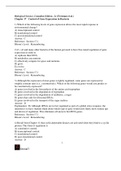
1 DroneIT Biological Science, Canadian Edition., 2e (Freeman et al.) Chapter 17 Control of Gene Expression in Bacteria 1) Which of the following levels of gene expression allows the most rapid response to environmental change? A) transcriptional control B) transl ational control C) post -translational control Answer: C Reference: Section 17.1 Bloom's Level: Remembering 2) E. coli and many other bacteria of the human gut need to have fine -tuned regulation of gene expression in order to A) replicate their DNA. B) metabolize any nutrient. C) effectively compete for space and nutrients. D) grow. E) evolve. Answer: C Reference: Section 17.1 Bloom's Level: Remembering 3) Although the expression of most genes is tightly regulated, some genes are expressed at roughl y constant rates (i.e., constitutively). Which of the following genes would you predict to be constitutively expressed? A) genes involved in the biosynthesis of the amino acid tryptophan B) genes involved in the degradation of tryptophan C) genes involved in the degradation of arabinose, a sugar D) genes that code for ribosomal RNAs E) genes involved in the transport of the sugar maltose Answer: D Explanation: D) Although rRNAs are in fact regulated as part of a global stress response, the intention is to have students think about which type of gene would most likely show routine ups and downs of regulation. This eliminates all answers but rRNA genes. Reference: Section 17.1 Bloom's Level: Remembering 4) Recall from Chapter 11 that cyclin -dependent kin ases are activated when they bind to a cyclin protein. This form of regulation is A) constitutive control. B) transcriptional control. C) translational control. D) post -translational control. Answer: D 2 DroneIT Reference: Section 17.1 Bloom's Level: Remembering 5) Full induction of the lac operon occurs when A) lactose levels are low and glucose levels are low. B) lactose levels are low and glucose levels are high. C) lactose levels are high and glucose levels are low. D) lactose levels are high and glucose lev els are high. Answer: C Reference: Section 17.1 Bloom's Level: Remembering LOs: Chp17 -4. Discuss the importance of the operon model in understanding the control of gene expression. 6) Bacterial and eukaryotic cells primarily control gene expression at the level of transcription. If instead cells exerted control of gene expression primarily at the post -translational level, what would be different? A) The ability to rapidly respond to environmental change would be reduced. B) Cells would expend significa ntly more energy. C) Genes would no longer be transcribed. D) Translation of mRNA into protein would not occur. Answer: B Reference: Section 17.1 Bloom's Level: Comprehension/Remembering LOs: Chp17 -2. Explain the role of repressors and inducers in nega tive control of gene expression. 7) Imagine that you've set up a genetic screen to identify E. coli mutants that cannot metabolize the amino acid tryptophan. Beginning with a master plate containing many colonies, you prepare replica plates on medium with glucose or tryptophan as the only energy source. You would look for colonies that A) cannot grow on either type of media. B) can grow on both types of media. C) can grow only on the plates with tryptophan. D) can grow only on the plates with glucose. Answer: D Reference: Section 17.2 Bloom's Level: Remembering 8) In the first step of their experiments, Jacob and Monod treated E. coli cells with UV light or X-rays in order to A) decrease the number of viable cells. B) induce DNA repair enzymes. C) inc rease the frequency of mutations in all genes. D) selectively mutate the lac operon, leaving all other genes unmutated.
Exam (elaborations)
BIOLOGICAL SCIENCE 2Ed-Canada by Scott Freeman Ch17-Control of Gene Expression in Bacteria.
Rating
Sold
-
Pages
14
Uploaded on
17-08-2021
Written in
2021/2022
BIOLOGICAL SCIENCE 2Ed-Canada by Scott Freeman Ch17-Control of Gene Expression in Bacteria.BIOLOGICAL SCIENCE 2Ed-Canada by Scott Freeman Ch17-Control of Gene Expression in Bacteria.BIOLOGICAL SCIENCE 2Ed-Canada by Scott Freeman Ch17-Control of Gene Expression in Bacteria.BIOLOGICAL SCIENCE 2Ed-Canada by Scott Freeman Ch17-Control of Gene Expression in Bacteria.
Show more
Read less
Institution
Rasmussen College
Course
Biological Sciences
Whoops! We can’t load your doc right now. Try again or contact support.
Written for
- Institution
-
Rasmussen College
- Course
-
Biological Sciences
Document information
- Uploaded on
- August 17, 2021
- Number of pages
- 14
- Written in
- 2021/2022
- Type
- Exam (elaborations)
- Contains
- Unknown
Subjects
-
biological science 2ed canada by scott freeman ch17 control of gene expression in bacteria
Content preview
$5.99
Get access to the full document:
100% satisfaction guarantee
Immediately available after payment
Both online and in PDF
No strings attached

Also available in package deal
Package deal
BIOLOGICAL SCIENCE 2Ed-Canada by Scott Freeman-Test Bank-reviewed for 2021 with all chapters and rationals.
1
58
2021
$ 845.62
More info