Capacity, duration and coding
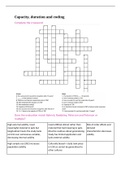
Complete the crossword
Does the evaluation match Bahrick, Baddeley, Peterson and Peterson or
multiple?
High external validity. Used Used artificial stimuli rather than Risk of order effects and
meaningful material to ppts but material that had meaning to ppts. demand
longitudinal means the study lacks Must be cautious about generalising . characteristics decreases
control over extraneous variable, Study has limited application and validity
decreasing internal validity lacks external validity.
High sample size (392) increases Culturally biased—study took place
population validity in USA so cannot be generalised to
other cultures
,The multi-store model (MSM)
Complete the diagram (fill in the gaps and empty boxes)
Stimulus from the environment
________ _______
Duration: milliseconds
Capacity: very high
Attention
Short-term memory
Capacity: ________
Duration: ________
Coding: acoustically
__________ _______
Capacity: limitless
Duration: very long, lifetime
Coding: ____________
, Fill in the gaps (evaluations)
Research support from Baddeley’s study: that ______ is different in
STM and LTM. Study suggests that we code ___________ in STM and
semantically in LTM, so they are different. Supports MSM’s view that
the 2 memory stores are ____________ and separate.
The MSM suggests that STM is a unitary store but evidence from
clinical studies on people with _______ conflicts. _______ and
__________ studied ___ and found that his STM for digits was poor
when read aloud for him but was better when he could read it
himself. This shows that there could be another STM for non-verbal
sounds, rather than just 1 in the MSM.
MSM states that if material is rehearsed for long enough it will be
transferred to LTM. However, ______ and ________ found that
instead rehearsal _____ matters. They discovered 2 types of
rehearsal: maintenance rehearsal to keep memories in the STM and
___________ rehearsal that involves making associations, which
transfers memories to LTM. This is a limitation because the MSM
cannot explain new research findings.
Clues:
acoustically independent type Watkins KF
Warrington elaborative coding amnesia Craik
Shallice
Complete the crossword
Does the evaluation match Bahrick, Baddeley, Peterson and Peterson or
multiple?
High external validity. Used Used artificial stimuli rather than Risk of order effects and
meaningful material to ppts but material that had meaning to ppts. demand
longitudinal means the study lacks Must be cautious about generalising . characteristics decreases
control over extraneous variable, Study has limited application and validity
decreasing internal validity lacks external validity.
High sample size (392) increases Culturally biased—study took place
population validity in USA so cannot be generalised to
other cultures
,The multi-store model (MSM)
Complete the diagram (fill in the gaps and empty boxes)
Stimulus from the environment
________ _______
Duration: milliseconds
Capacity: very high
Attention
Short-term memory
Capacity: ________
Duration: ________
Coding: acoustically
__________ _______
Capacity: limitless
Duration: very long, lifetime
Coding: ____________
, Fill in the gaps (evaluations)
Research support from Baddeley’s study: that ______ is different in
STM and LTM. Study suggests that we code ___________ in STM and
semantically in LTM, so they are different. Supports MSM’s view that
the 2 memory stores are ____________ and separate.
The MSM suggests that STM is a unitary store but evidence from
clinical studies on people with _______ conflicts. _______ and
__________ studied ___ and found that his STM for digits was poor
when read aloud for him but was better when he could read it
himself. This shows that there could be another STM for non-verbal
sounds, rather than just 1 in the MSM.
MSM states that if material is rehearsed for long enough it will be
transferred to LTM. However, ______ and ________ found that
instead rehearsal _____ matters. They discovered 2 types of
rehearsal: maintenance rehearsal to keep memories in the STM and
___________ rehearsal that involves making associations, which
transfers memories to LTM. This is a limitation because the MSM
cannot explain new research findings.
Clues:
acoustically independent type Watkins KF
Warrington elaborative coding amnesia Craik
Shallice