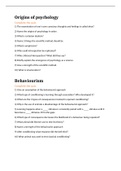
Origins of psychology
Complete the quiz.
1) The examination of one’s own conscious thoughts and feelings is called what?
2) Name the origins of psychology in order.
3) What is cartesian dualism?
4) Name 3 things the scientific method should be
5) What is empiricism?
6) Why could introspection be replicated?
7) Who criticised introspection? What did they say?
8) Briefly explain the emergence of psychology as a science.
9) Give a strength of the scientific method.
10) What is structuralism?
Behaviourism
Complete the quiz.
1) Give an assumption of the behaviourist approach
2) What type of conditioning is learning through association? Who developed it?
3) What are the 3 types of consequences involved in operant conditioning?
4) Why is the use of animals a disadvantage of the behaviourist approach?
5) Learning happens when a ____ stimulus is constantly paired with a ____ stimulus until it
becomes a ____ stimulus. Fill in the gaps
6) What type of consequence decreases the likelihood of a behaviour being repeated?
7) What animal did Skinner use to test his theory?
8) Name a strength of the behaviourist approach
9) After conditioning what response did the bell elicit?
10) What animal was used to test classical conditioning?
, Social learning theory
Complete the quiz.
1) According to SLT, learning occurs in 2 ways. What are they?
2) What is vicarious reinforcement?
3) Name the 4 cognitive internal mental processes that take place between stimulus and
response. What are they called?
4) Who are people more likely to imitate behaviour from?
5) How does SLT differ from behaviourism?
6) How does a person become a role model?
7) Who ran the Bobo doll study? What did it find?
8) Who were the children most likely to imitate and what does this show?
9) Give a criticism of the Bobo doll study
10) What does SLT explain that makes it a strength?
Cognitive approach
Complete the quiz.
1) How does the cognitive approach differ in its assumptions to the learning approaches?
2) What is a schema?
3) Briefly describe the computer model used by cognitive psychologists
4) How is machine reductionism a weakness?
5) What is materialism?
6) The cognitive approach has high external validity. True or false? Elaborate
7) Name 2 examples of the technology used in cognitive neuroscience
8) What is the aim of cognitive neuroscience?
9) Give a strength of the cognitive approach
10) Why are schemas helpful?
Complete the quiz.
1) The examination of one’s own conscious thoughts and feelings is called what?
2) Name the origins of psychology in order.
3) What is cartesian dualism?
4) Name 3 things the scientific method should be
5) What is empiricism?
6) Why could introspection be replicated?
7) Who criticised introspection? What did they say?
8) Briefly explain the emergence of psychology as a science.
9) Give a strength of the scientific method.
10) What is structuralism?
Behaviourism
Complete the quiz.
1) Give an assumption of the behaviourist approach
2) What type of conditioning is learning through association? Who developed it?
3) What are the 3 types of consequences involved in operant conditioning?
4) Why is the use of animals a disadvantage of the behaviourist approach?
5) Learning happens when a ____ stimulus is constantly paired with a ____ stimulus until it
becomes a ____ stimulus. Fill in the gaps
6) What type of consequence decreases the likelihood of a behaviour being repeated?
7) What animal did Skinner use to test his theory?
8) Name a strength of the behaviourist approach
9) After conditioning what response did the bell elicit?
10) What animal was used to test classical conditioning?
, Social learning theory
Complete the quiz.
1) According to SLT, learning occurs in 2 ways. What are they?
2) What is vicarious reinforcement?
3) Name the 4 cognitive internal mental processes that take place between stimulus and
response. What are they called?
4) Who are people more likely to imitate behaviour from?
5) How does SLT differ from behaviourism?
6) How does a person become a role model?
7) Who ran the Bobo doll study? What did it find?
8) Who were the children most likely to imitate and what does this show?
9) Give a criticism of the Bobo doll study
10) What does SLT explain that makes it a strength?
Cognitive approach
Complete the quiz.
1) How does the cognitive approach differ in its assumptions to the learning approaches?
2) What is a schema?
3) Briefly describe the computer model used by cognitive psychologists
4) How is machine reductionism a weakness?
5) What is materialism?
6) The cognitive approach has high external validity. True or false? Elaborate
7) Name 2 examples of the technology used in cognitive neuroscience
8) What is the aim of cognitive neuroscience?
9) Give a strength of the cognitive approach
10) Why are schemas helpful?