LIT ESSAY NB NOTES:
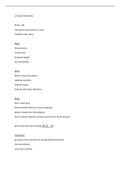
PLAN = NB
Use quotes and pictures as clues
Underline play name
Style:
Present tense
Formal tone
Standard English
No contractions
Intro:
Refer to play and authour
rephrase question
indicate stance
indicate path essay will follow
Body:
Don’t retell story
Each character/theme is a new paragraph
Doesn’t need to be chronological
Don’t include irrelevant info just to prove you ‘know the play’
prove your point by providing DETAIL – NB
conclusion:
go back to intro and see if it actually followed the path
no new evidence
sum up & conclude
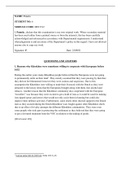
, Tempest Essay
Question:
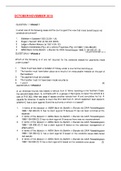
Discuss how the play The Tempest, by William Shakespeare links to the following quote.
“The best revenge is no revenge, move on, be happy.” Consider two central characters in
your response.
In Shakespeare’s play, The Tempest, it is acknowledged through the characters, mainly
Prospero and Caliban, that the “rarer act” is in “virtue” and not in revenge. The play also
displays how those that “move on” from revenge find happiness.
Caliban is a character who has faced many hardships and adopts an attitude solely focused
on revenge. When he meets Trinculo and Stephano, he sees it as an opportunity to plan his
revenge on Prospero and kill him. He plans to kill him violently, piercing a “nail” into his
head. Caliban is so consumed with this violent plan and so bent on revenge that he makes
himself a slave once again, this time to Stephano and Trinculo. They use this opportunity
and, in their drunken state, exploit and abuse Caliban. Trinculo sees him as a way to get
monetary gain and thinks of how people would “give a piece of silver” to see Caliban and
treat him as a spectacle. Stephano could “find it in [his] heart to beat him” and calls him a
“servant monster.” They treat him condescendingly, and yet, Caliban is too blinded by
revenge on Prospero and ignores their treatment. He still sees Stephano as a “king” or even
a “God”. Even as he tries to help them and warn them against stealing Prospero’s clothes,
Stephano threatens to banish him from “[his] kingdom”.
When Stephano, Trinculo and Caliban are brought to reckoning by Prospero, Caliban finally
realises that he needs to “move on” from his harbored grudge against Prospero. He has
been exploited and ridiculed and lost his sense of humanity trough the search for revenge.
In the end, he acknowledges that by “seeking for grace” he is “wise” and can then be free of
this burden. By doing so, he gains what he wanted the whole time, the island, and his
happiness is attained.
Prospero is another character who starts the play with a vengeful attitude. He creates a
“tempest” to wreck King Alonso’s ship so that he has power over all those abroad it. He
terrorizes Alonso, Sebastian and Antonio through Ariel and refers to them as the “three men
of sin”. He also causes fear in Stephano and Trinculo. When he uses Ariel to send spirits
after them, he chooses to “leave them” in “these fits”.
It is seen however, that not once does Prospero use his magic and his power to harm
someone. He ensures that everyone from the boat is safe and even that their clothes are
clean and dry and look better than before. When at last he is faced with all of the people
that he wanted to take revenge on, he realises that “at this hour lies at my mercy all mine
enemies”. Instead of destroying Alonso, Sebastian and Antonio; he chooses to forgive them.
He tells Alonso that there is a “heaviness that’s gone” and the two reconcile. While Antonio
PLAN = NB
Use quotes and pictures as clues
Underline play name
Style:
Present tense
Formal tone
Standard English
No contractions
Intro:
Refer to play and authour
rephrase question
indicate stance
indicate path essay will follow
Body:
Don’t retell story
Each character/theme is a new paragraph
Doesn’t need to be chronological
Don’t include irrelevant info just to prove you ‘know the play’
prove your point by providing DETAIL – NB
conclusion:
go back to intro and see if it actually followed the path
no new evidence
sum up & conclude
, Tempest Essay
Question:
Discuss how the play The Tempest, by William Shakespeare links to the following quote.
“The best revenge is no revenge, move on, be happy.” Consider two central characters in
your response.
In Shakespeare’s play, The Tempest, it is acknowledged through the characters, mainly
Prospero and Caliban, that the “rarer act” is in “virtue” and not in revenge. The play also
displays how those that “move on” from revenge find happiness.
Caliban is a character who has faced many hardships and adopts an attitude solely focused
on revenge. When he meets Trinculo and Stephano, he sees it as an opportunity to plan his
revenge on Prospero and kill him. He plans to kill him violently, piercing a “nail” into his
head. Caliban is so consumed with this violent plan and so bent on revenge that he makes
himself a slave once again, this time to Stephano and Trinculo. They use this opportunity
and, in their drunken state, exploit and abuse Caliban. Trinculo sees him as a way to get
monetary gain and thinks of how people would “give a piece of silver” to see Caliban and
treat him as a spectacle. Stephano could “find it in [his] heart to beat him” and calls him a
“servant monster.” They treat him condescendingly, and yet, Caliban is too blinded by
revenge on Prospero and ignores their treatment. He still sees Stephano as a “king” or even
a “God”. Even as he tries to help them and warn them against stealing Prospero’s clothes,
Stephano threatens to banish him from “[his] kingdom”.
When Stephano, Trinculo and Caliban are brought to reckoning by Prospero, Caliban finally
realises that he needs to “move on” from his harbored grudge against Prospero. He has
been exploited and ridiculed and lost his sense of humanity trough the search for revenge.
In the end, he acknowledges that by “seeking for grace” he is “wise” and can then be free of
this burden. By doing so, he gains what he wanted the whole time, the island, and his
happiness is attained.
Prospero is another character who starts the play with a vengeful attitude. He creates a
“tempest” to wreck King Alonso’s ship so that he has power over all those abroad it. He
terrorizes Alonso, Sebastian and Antonio through Ariel and refers to them as the “three men
of sin”. He also causes fear in Stephano and Trinculo. When he uses Ariel to send spirits
after them, he chooses to “leave them” in “these fits”.
It is seen however, that not once does Prospero use his magic and his power to harm
someone. He ensures that everyone from the boat is safe and even that their clothes are
clean and dry and look better than before. When at last he is faced with all of the people
that he wanted to take revenge on, he realises that “at this hour lies at my mercy all mine
enemies”. Instead of destroying Alonso, Sebastian and Antonio; he chooses to forgive them.
He tells Alonso that there is a “heaviness that’s gone” and the two reconcile. While Antonio