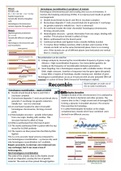
Mitosis Homologous recombination in prophase I of meiosis
Somatic cells Homologous chromosomes pair and crossing over occurs at chiasmata. It
2n -> 2n + 2n (1n -> 1n + 1n for involves the breaking and joining of DNA. It is reciprocal and results in genetic
haploid organisms)
rearrangement.
Genetically identical daughter
1) Double strand break by Spo11 and Mre11 (nuclease complex)
cells
Homologous chromosomes 2) Exonuclease degrades 5’ ends around break site to generate 3’ overhangs
remain separate throughout. (so genetic material is initially lost – but it is reformed)
3) An overhand invades the sister chromatid/ homologous chromosome,
Meiosis forming a branch point.
Haploid gamete production 4) Heteroduplex structure – genetic information from one origin, binding with
2n -> n x4
another. This structure formed is called a D-loop
Genetically different daughter
5) DNA is synthesised from the branch point
cells
Homologous chromosomes pair 6) Continued synthesis and ligation forms a double Holliday Junction
and recombine. 7) To resolve these Holliday Junctions, DNA is broken and re-joined. If the
strands are both cut on the same (horizontal) plane, there is no crossing
over. If the strands are cut of different planes (one horizontal one vertical,
there is crossing over)
Recombination can be used for:
1) Linkage analysis by measuring the recombination frequency of genes. Large
distance = high recombination frequency. Use transcription genetics by
looking at the frequency of recombination between generations
2) Gene targeting. Use a homologous sequence with a suitable marker. Circular
DNA: single crossover, insertion of sequence into the gene (gene disrupted).
Linear DNA: 2 regions of homology, double crossing over, deletion of gene.
Homologous recombination can occur in bacteria with circular (plasmid) DNA (all
inserted) or a piece of linear DNA (removal of homologous original).
Recombin Bacteriophages can make use of
this to make recombinants.
Homologous recombination – repair of dsDNA
8) Double strand break by Spo11 and Mre11
(nuclease complex)
ation Heteroduplex formation
Synapsis (fusion) of the chromosomes (3) is catalysed by
9) Exonuclease degrades 5’ ends around break site to Rad51 (or RecA in bacteria) and other proteins. The
generate 3’ overhangs (so genetic material is enzyme bins to the 3’ single strand end of damaged DNA
initially lost – but it is reformed) forming a dynamic 3-stranded structure. The enzyme
10) An overhand invades the sister chromatid/ then searches for homology.
homologous chromosome, forming a branch It is called heteroduplex formation as the single,
point. complementary strands which have combined were
11) Heteroduplex structure – genetic information derived from different sources.
from one origin, binding with another. This
structure formed is called a D-loop
12) DNA is synthesised from the branch point
13) The newly synthesised DNA is paired with the top
strand for its DNA synthesis
14) The repairs are then joined into the DNA by DNA
ligation
This is a very accurate repair process compared to
non-homologous recombination – a process only used
why homologous recombination isn’t available.
Repairs accurately, is universal, non-reciprocal (one
way exchange), but it can cause a loss of
heterozygosity.
Non-homologous recombination
The ends of the strands close to the double strand
break are degraded, causing the loss of genetic
material. The ends are then joined through ligation.
Somatic cells Homologous chromosomes pair and crossing over occurs at chiasmata. It
2n -> 2n + 2n (1n -> 1n + 1n for involves the breaking and joining of DNA. It is reciprocal and results in genetic
haploid organisms)
rearrangement.
Genetically identical daughter
1) Double strand break by Spo11 and Mre11 (nuclease complex)
cells
Homologous chromosomes 2) Exonuclease degrades 5’ ends around break site to generate 3’ overhangs
remain separate throughout. (so genetic material is initially lost – but it is reformed)
3) An overhand invades the sister chromatid/ homologous chromosome,
Meiosis forming a branch point.
Haploid gamete production 4) Heteroduplex structure – genetic information from one origin, binding with
2n -> n x4
another. This structure formed is called a D-loop
Genetically different daughter
5) DNA is synthesised from the branch point
cells
Homologous chromosomes pair 6) Continued synthesis and ligation forms a double Holliday Junction
and recombine. 7) To resolve these Holliday Junctions, DNA is broken and re-joined. If the
strands are both cut on the same (horizontal) plane, there is no crossing
over. If the strands are cut of different planes (one horizontal one vertical,
there is crossing over)
Recombination can be used for:
1) Linkage analysis by measuring the recombination frequency of genes. Large
distance = high recombination frequency. Use transcription genetics by
looking at the frequency of recombination between generations
2) Gene targeting. Use a homologous sequence with a suitable marker. Circular
DNA: single crossover, insertion of sequence into the gene (gene disrupted).
Linear DNA: 2 regions of homology, double crossing over, deletion of gene.
Homologous recombination can occur in bacteria with circular (plasmid) DNA (all
inserted) or a piece of linear DNA (removal of homologous original).
Recombin Bacteriophages can make use of
this to make recombinants.
Homologous recombination – repair of dsDNA
8) Double strand break by Spo11 and Mre11
(nuclease complex)
ation Heteroduplex formation
Synapsis (fusion) of the chromosomes (3) is catalysed by
9) Exonuclease degrades 5’ ends around break site to Rad51 (or RecA in bacteria) and other proteins. The
generate 3’ overhangs (so genetic material is enzyme bins to the 3’ single strand end of damaged DNA
initially lost – but it is reformed) forming a dynamic 3-stranded structure. The enzyme
10) An overhand invades the sister chromatid/ then searches for homology.
homologous chromosome, forming a branch It is called heteroduplex formation as the single,
point. complementary strands which have combined were
11) Heteroduplex structure – genetic information derived from different sources.
from one origin, binding with another. This
structure formed is called a D-loop
12) DNA is synthesised from the branch point
13) The newly synthesised DNA is paired with the top
strand for its DNA synthesis
14) The repairs are then joined into the DNA by DNA
ligation
This is a very accurate repair process compared to
non-homologous recombination – a process only used
why homologous recombination isn’t available.
Repairs accurately, is universal, non-reciprocal (one
way exchange), but it can cause a loss of
heterozygosity.
Non-homologous recombination
The ends of the strands close to the double strand
break are degraded, causing the loss of genetic
material. The ends are then joined through ligation.