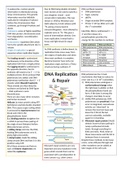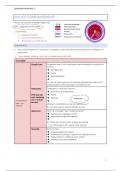
In eukaryotes, nuclear genetic Due to DNA being double stranded, DNA synthesis requires:
information is distributed among each strand can be used to specify a DNA polymerase
linear chromosomes. This genetic new daughter strand – semi- Mg2+ cofactor
information must be faithfully conservative replication. This was dNTPs
replicated in interphase (S-phase) shown in 1958 by Meselson and Single stranded DNA template
before the chromosomes then Stahl where by E.Coli cultures with Primer 3’ OH (as DNA can’t add
condense, go through M-phase and 15
the 1st nucleotide)
N, giving a heavy band in
divide.
ultracentrifugation , were allowed to
Telomeres- areas of highly repetitive Like RNA, DNA is synthesised 5’ ->
replicate once in 14N. This gave a
DNA that protect chromosome ends 3’ and the release of a
from degradation, recombination band of intermediate density. One
pyrophosphate provides the
and fusion. more replication, formed both a
energy for the reaction to continue
Centromeres- repetitive DNA which heavy and light strand in equal
forms the spindle attachment site in parts. DNA synthesis RNA synthesis
mitosis DNA polymerase RNA polymerase
Origin of replication- a special As DNA synthesis is bidirectional, its Mg2+ No cofactor
sequence where replication begins replication forks move away from dNTPs (T) NTPs (U)
the origins of replication and when S,s. DNA S.s. DNA
The leading strand is synthesised they meet synthesis is complete. template template
Bacteria however have only one Primer needed No primer
continuously in the direction of the
More accurate Less accurate
replication fork from a single primer. replication origin and form a Theta
Bidirectional One-way
The lagging strand is synthesised in structure during synthesis. θ
the opposite direction, but its
synthesis still needs to be 5’ -> 3’.So
multiple primers (from primase RNA DNA Replication DNA polymerase has 3 main
mechanisms that help to reduce its
polymerase) are added, and DNA
polymerase synthesises short 5’ -> 3’
strands called Okazaki fragments.
& Repair error rate to a 1 in 1010 nucleotides.
1) DNA polymerase undergoes a
These strands are then timed by conformational change when
nucleases and joined by DNA ligase the right base is added, so that
∴ DNA synthesis is semi- the phosphodiester bond can
discontinuous. form. If the base is wrong this
There are also many other enzymes change is less likely to occur
and factors involved: 2) Unlike RNA polymerase, DNA
Helicase (a motor protein using ATP polymerase can proofread. If an
hydrolysis) unwinds double stranded error is integrated, exonuclease
DNA. This causes super-coiling which activity can ‘chew back’ to
is unwound by topoisomerases that remove the incorrect base and
break and reform the leave the 3’OH of the last
phosphodiester bond. correct nucleotide, available
S.s. binding proteins straighten the again for re-bonding.
s.s.DNA to prevent base pairing of 3) Mismatch repair protein (MutS)
the single strand (hairpins) before detects incorrect base pairing in
DNA polymerase arrives. newly-synthesised strands
A sliding clamp encircles the DNA, (only), through searching for
holding DNA polymerase onto it, kinks and nicks. MutL binds to
giving high processivity. these inaccuracies and the bit in
A clamp loader, loads the sliding between them is removed.
clamp around DNA and fixes it in this Despite these methods to decrease
position using ATP. errors, some still pass through and
All of these enzymes and factors Mismatch repair proteins are very other mutations can be added at
such as histone chaperones are important and any mutations in the later stages in the cell cycle.
called the replisome. genes which encode them can be
associated with a predisposition to
some cancers e.g. colon cancer.
information is distributed among each strand can be used to specify a DNA polymerase
linear chromosomes. This genetic new daughter strand – semi- Mg2+ cofactor
information must be faithfully conservative replication. This was dNTPs
replicated in interphase (S-phase) shown in 1958 by Meselson and Single stranded DNA template
before the chromosomes then Stahl where by E.Coli cultures with Primer 3’ OH (as DNA can’t add
condense, go through M-phase and 15
the 1st nucleotide)
N, giving a heavy band in
divide.
ultracentrifugation , were allowed to
Telomeres- areas of highly repetitive Like RNA, DNA is synthesised 5’ ->
replicate once in 14N. This gave a
DNA that protect chromosome ends 3’ and the release of a
from degradation, recombination band of intermediate density. One
pyrophosphate provides the
and fusion. more replication, formed both a
energy for the reaction to continue
Centromeres- repetitive DNA which heavy and light strand in equal
forms the spindle attachment site in parts. DNA synthesis RNA synthesis
mitosis DNA polymerase RNA polymerase
Origin of replication- a special As DNA synthesis is bidirectional, its Mg2+ No cofactor
sequence where replication begins replication forks move away from dNTPs (T) NTPs (U)
the origins of replication and when S,s. DNA S.s. DNA
The leading strand is synthesised they meet synthesis is complete. template template
Bacteria however have only one Primer needed No primer
continuously in the direction of the
More accurate Less accurate
replication fork from a single primer. replication origin and form a Theta
Bidirectional One-way
The lagging strand is synthesised in structure during synthesis. θ
the opposite direction, but its
synthesis still needs to be 5’ -> 3’.So
multiple primers (from primase RNA DNA Replication DNA polymerase has 3 main
mechanisms that help to reduce its
polymerase) are added, and DNA
polymerase synthesises short 5’ -> 3’
strands called Okazaki fragments.
& Repair error rate to a 1 in 1010 nucleotides.
1) DNA polymerase undergoes a
These strands are then timed by conformational change when
nucleases and joined by DNA ligase the right base is added, so that
∴ DNA synthesis is semi- the phosphodiester bond can
discontinuous. form. If the base is wrong this
There are also many other enzymes change is less likely to occur
and factors involved: 2) Unlike RNA polymerase, DNA
Helicase (a motor protein using ATP polymerase can proofread. If an
hydrolysis) unwinds double stranded error is integrated, exonuclease
DNA. This causes super-coiling which activity can ‘chew back’ to
is unwound by topoisomerases that remove the incorrect base and
break and reform the leave the 3’OH of the last
phosphodiester bond. correct nucleotide, available
S.s. binding proteins straighten the again for re-bonding.
s.s.DNA to prevent base pairing of 3) Mismatch repair protein (MutS)
the single strand (hairpins) before detects incorrect base pairing in
DNA polymerase arrives. newly-synthesised strands
A sliding clamp encircles the DNA, (only), through searching for
holding DNA polymerase onto it, kinks and nicks. MutL binds to
giving high processivity. these inaccuracies and the bit in
A clamp loader, loads the sliding between them is removed.
clamp around DNA and fixes it in this Despite these methods to decrease
position using ATP. errors, some still pass through and
All of these enzymes and factors Mismatch repair proteins are very other mutations can be added at
such as histone chaperones are important and any mutations in the later stages in the cell cycle.
called the replisome. genes which encode them can be
associated with a predisposition to
some cancers e.g. colon cancer.