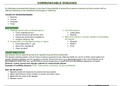
COMMUNICABLE DISEASES
An infectious/communicable disease is one that is transmissible or spread from person to person by direct contact with an
affected individual or the individual's discharges or indirectly.
CAUSED BY MICROORGANISMS:
Bacteria
Viruses
Parasites
Fungi
TRANSMISSION
1. Physical contact with an infected person 3. Travel through air
Touch (staphylococcus) Tuberculosis
Sexual intercourse (gonorrhea, HIV) Measles
Faecal/oral transmission (hepatitis A) 4. Bites from insects or animals capable of transmitting
Droplets (influenza, TB) the disease
2. Contact with a contaminated surface or object Mosquito
Food (salmonella, E. coli) Malaria
Blood (HIV, hepatitis B) Fever
Water (cholera)
NOTIFIABLE DISEASES
Any disease that is required by law to be reported to government authorities.
The disease reporting system in South Africa is based on government law (National Health Act, Act 61 of 2003): which states t hat
specific infectious diseases must be reported on specific Government forms on a daily/weekly basis to the Local Authority (Local
Municipality) for action who then reports to the Provincial Department of Health and on to the National Department of Healt h.
Reasons: control, prevent and manage outbreak of communicable disease
Examples of notifiable diseases: Polio, Tuberculosis, Listeriosis, Cholera and Malaria
WHY DO WE NOTIFY
1. Speedily implement measures (to prevent and stop spread)
2. Allow rapid tracing of close contacts to prevent secondary cases
3. Determine the cause of the disease
4. Disease control
, COMMUNICABLE DISEASES
CAUSATION
Epidemiologic triad or triangle of infectious disease
1. Agent
An infectious microorganism or pathogen: Virus, Bacterium, Parasite
Generally, the agent must be present for disease to occur.
However, presence of an agent alone is not always sufficient to cause disease.
2. Host
Human who can get the disease
Risk factors can influence an individual's exposure and response to a causative agent.
Exposure opportunities influenced by:
i. Sexual practices
ii. Age and sex (gender)
iii. Hygiene
iv. Other personal choices
Human response to disease is influenced by:
i. Presence of disease or medications (co-morbidities)
ii. Psychological makeup
iii. Immunologic status
iv. Nutritional status
v. Genetic composition
3. Environment/ Mode of transmission
Extrinsic factors that affect the agent
Environmental factors
o Physical factors such as geology and climate
o Biologic factors such as insects that transmit the agent
o Socioeconomic factors such as crowding, sanitation and the availability of health services
CONTROL AND MANAGEMENT OF COMMUNICABLE DISEASES
Case finding
Health education and promotion
Referral
Immunization
Supportive care
Treatment
An infectious/communicable disease is one that is transmissible or spread from person to person by direct contact with an
affected individual or the individual's discharges or indirectly.
CAUSED BY MICROORGANISMS:
Bacteria
Viruses
Parasites
Fungi
TRANSMISSION
1. Physical contact with an infected person 3. Travel through air
Touch (staphylococcus) Tuberculosis
Sexual intercourse (gonorrhea, HIV) Measles
Faecal/oral transmission (hepatitis A) 4. Bites from insects or animals capable of transmitting
Droplets (influenza, TB) the disease
2. Contact with a contaminated surface or object Mosquito
Food (salmonella, E. coli) Malaria
Blood (HIV, hepatitis B) Fever
Water (cholera)
NOTIFIABLE DISEASES
Any disease that is required by law to be reported to government authorities.
The disease reporting system in South Africa is based on government law (National Health Act, Act 61 of 2003): which states t hat
specific infectious diseases must be reported on specific Government forms on a daily/weekly basis to the Local Authority (Local
Municipality) for action who then reports to the Provincial Department of Health and on to the National Department of Healt h.
Reasons: control, prevent and manage outbreak of communicable disease
Examples of notifiable diseases: Polio, Tuberculosis, Listeriosis, Cholera and Malaria
WHY DO WE NOTIFY
1. Speedily implement measures (to prevent and stop spread)
2. Allow rapid tracing of close contacts to prevent secondary cases
3. Determine the cause of the disease
4. Disease control
, COMMUNICABLE DISEASES
CAUSATION
Epidemiologic triad or triangle of infectious disease
1. Agent
An infectious microorganism or pathogen: Virus, Bacterium, Parasite
Generally, the agent must be present for disease to occur.
However, presence of an agent alone is not always sufficient to cause disease.
2. Host
Human who can get the disease
Risk factors can influence an individual's exposure and response to a causative agent.
Exposure opportunities influenced by:
i. Sexual practices
ii. Age and sex (gender)
iii. Hygiene
iv. Other personal choices
Human response to disease is influenced by:
i. Presence of disease or medications (co-morbidities)
ii. Psychological makeup
iii. Immunologic status
iv. Nutritional status
v. Genetic composition
3. Environment/ Mode of transmission
Extrinsic factors that affect the agent
Environmental factors
o Physical factors such as geology and climate
o Biologic factors such as insects that transmit the agent
o Socioeconomic factors such as crowding, sanitation and the availability of health services
CONTROL AND MANAGEMENT OF COMMUNICABLE DISEASES
Case finding
Health education and promotion
Referral
Immunization
Supportive care
Treatment