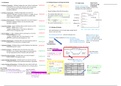
1.1 Definitions 1.2. Enthalpy Change on Forming Ionic Bonds
2.1. Haber Cycles Never have to
draw one, just fill
Enthalpy of Formation – Enthalpy change when one mole of a substance Exothermic • Metals will lose an e to form positive ions
Measure Lattice Enthalpy in the blanks
is formed from its constituent elements with all substances • Non-metals will gain an e to form negative
Includes all enthalpy changes involved in the
in their standard states, and the reaction done under ions
formation of an ionic compound
standard conditions
• Overall enthalpy will be ∆H of formation 1st EA (O)
Enthalpy of Combustion – Enthalpy change when one mole of a
substance undergoes complete combustion in oxygen with all Exothermic • The reaction takes place over several steps
2nd IE(Ca)
substances in their standard state, and the reaction done • The original reactants need to form a gas so
under standard conditions require ∆H of atomization of each element 2nd EA (O)
1st IE(Ca)
(x2)
Enthalpy of Neutralisation – Enthalpy change when one mole of water is • Then IE is needed to form the ions (x2) ∆Hatm (O) ∆Hlef(CaO)
Exothermic • Formation of the lattice (x1)
formed in a reaction between an acid and alkali under
standard conditions • This can be represented by a Born Haber cycle ∆Hatm (Ca)
Ionisation Enthalpy – 1st IE = enthalpy when an atom loses an e in the Endothermic ∆Hf
gaseous state to form a +1 ion 1.3. Enthalpy of Solution
– 2nd IE = enthalpy when a +1 ion loses an electron to Endothermic ∆H1 = ∆H2 +∆H3 + ∆H4 +∆H5 etc
form a +2 ion in the gaseous state Ionic solid dissolves in vol. of water large enough that the ions formed do not
interact with each other
Electron Affinity – 1st EA = enthalpy when an atom gains an e to form Exothermic
one mole of gaseous 1- ions Ionic Bonding is important – attraction between ions When a solid ionic lattice
– 2nd EA = enthalpy when one mole of gaseous 1- ions Endothermic dissolves in water, the ions
gains an e to form one mole of gaseous 2- ions Calculations: values needed are enthalpy of solutions, dissociate from each other
hydration enthalpy, Water is polar, so bonds can be
Enthalpy of Atomisation – Enthalpy when one mole of gaseous atoms is Physical lattice enthalpy of formation, easily made from the ions
produced from its elements in standard states Endothermic lattice enthalpy of dissociation
Chemistry formed
Thermodynamics
Hydration Enthalpy – Enthalpy when one mole of gaseous ions becomes Exothermic
hydrated/dissolved in water Can be calculated using an enthalpy cycle diagram
4.1. Gibbs Free Energy Enthalpy Change of sol.
Enthalpy of Solution – Enthalpy when one mole of an ionic solid Solid Ionic Lattice Aqueous Ions
Equation: ∆G = ∆H – (T x ∆S)
dissolves in vol. of water large enough so the dissolved ions Endothermic Ionic these factors give
are well separated and do not interact with each other Dissociation Enthalpy of
stronger attraction
∆G needs to be –ve or 0 for Enthalpy Gaseous Ions Hydration
reaction to spontaneously
Bond Dissociation Enthalpy – Enthalpy when one mole of covalent
Endothermic occur
bonds is broken in the gaseous state
Factors: Influenced by: smaller ions,
Lattice Enthalpy of Formation – Enthalpy when one mole of solid ionic
compound is formed from constituent elements in gas phase Exothermic higher charged ions
•Exo. and +∆S = feasible at
any temp.
Lattice Enthalpy of Dissociation – Enthalpy when one mole of solid ionic Compound NaCl Al2O3
Endothermic • Endo. and - ∆S = not
compound is broken up into constituent ions in the gas phase ∆Hf, -771 -15421 The smaller the % difference,
feasible
Experimental the closer to having a perfect
3.1. Entropy • Endo. and + ∆S = feasible Value
ionic structure – spherical
Defined: the disorder within a system ∆s is the symbol, above certain temp.
∆Hf, -760 -14910 structure
Measure of no. of ways particles can be arranged units = JK−1mol−1 • Exo. and - ∆S = feasible Theoretical Larger % difference = more
no. of ways energy can be shared Equation: ∆s = Σs products - Σs reactants below certain temp. Value
covalent characteristics
Affected by: state (gas disorder > disorder solid) % Difference 0.6% 3.3%
dissolved or not
no. of particles
2.1. Haber Cycles Never have to
draw one, just fill
Enthalpy of Formation – Enthalpy change when one mole of a substance Exothermic • Metals will lose an e to form positive ions
Measure Lattice Enthalpy in the blanks
is formed from its constituent elements with all substances • Non-metals will gain an e to form negative
Includes all enthalpy changes involved in the
in their standard states, and the reaction done under ions
formation of an ionic compound
standard conditions
• Overall enthalpy will be ∆H of formation 1st EA (O)
Enthalpy of Combustion – Enthalpy change when one mole of a
substance undergoes complete combustion in oxygen with all Exothermic • The reaction takes place over several steps
2nd IE(Ca)
substances in their standard state, and the reaction done • The original reactants need to form a gas so
under standard conditions require ∆H of atomization of each element 2nd EA (O)
1st IE(Ca)
(x2)
Enthalpy of Neutralisation – Enthalpy change when one mole of water is • Then IE is needed to form the ions (x2) ∆Hatm (O) ∆Hlef(CaO)
Exothermic • Formation of the lattice (x1)
formed in a reaction between an acid and alkali under
standard conditions • This can be represented by a Born Haber cycle ∆Hatm (Ca)
Ionisation Enthalpy – 1st IE = enthalpy when an atom loses an e in the Endothermic ∆Hf
gaseous state to form a +1 ion 1.3. Enthalpy of Solution
– 2nd IE = enthalpy when a +1 ion loses an electron to Endothermic ∆H1 = ∆H2 +∆H3 + ∆H4 +∆H5 etc
form a +2 ion in the gaseous state Ionic solid dissolves in vol. of water large enough that the ions formed do not
interact with each other
Electron Affinity – 1st EA = enthalpy when an atom gains an e to form Exothermic
one mole of gaseous 1- ions Ionic Bonding is important – attraction between ions When a solid ionic lattice
– 2nd EA = enthalpy when one mole of gaseous 1- ions Endothermic dissolves in water, the ions
gains an e to form one mole of gaseous 2- ions Calculations: values needed are enthalpy of solutions, dissociate from each other
hydration enthalpy, Water is polar, so bonds can be
Enthalpy of Atomisation – Enthalpy when one mole of gaseous atoms is Physical lattice enthalpy of formation, easily made from the ions
produced from its elements in standard states Endothermic lattice enthalpy of dissociation
Chemistry formed
Thermodynamics
Hydration Enthalpy – Enthalpy when one mole of gaseous ions becomes Exothermic
hydrated/dissolved in water Can be calculated using an enthalpy cycle diagram
4.1. Gibbs Free Energy Enthalpy Change of sol.
Enthalpy of Solution – Enthalpy when one mole of an ionic solid Solid Ionic Lattice Aqueous Ions
Equation: ∆G = ∆H – (T x ∆S)
dissolves in vol. of water large enough so the dissolved ions Endothermic Ionic these factors give
are well separated and do not interact with each other Dissociation Enthalpy of
stronger attraction
∆G needs to be –ve or 0 for Enthalpy Gaseous Ions Hydration
reaction to spontaneously
Bond Dissociation Enthalpy – Enthalpy when one mole of covalent
Endothermic occur
bonds is broken in the gaseous state
Factors: Influenced by: smaller ions,
Lattice Enthalpy of Formation – Enthalpy when one mole of solid ionic
compound is formed from constituent elements in gas phase Exothermic higher charged ions
•Exo. and +∆S = feasible at
any temp.
Lattice Enthalpy of Dissociation – Enthalpy when one mole of solid ionic Compound NaCl Al2O3
Endothermic • Endo. and - ∆S = not
compound is broken up into constituent ions in the gas phase ∆Hf, -771 -15421 The smaller the % difference,
feasible
Experimental the closer to having a perfect
3.1. Entropy • Endo. and + ∆S = feasible Value
ionic structure – spherical
Defined: the disorder within a system ∆s is the symbol, above certain temp.
∆Hf, -760 -14910 structure
Measure of no. of ways particles can be arranged units = JK−1mol−1 • Exo. and - ∆S = feasible Theoretical Larger % difference = more
no. of ways energy can be shared Equation: ∆s = Σs products - Σs reactants below certain temp. Value
covalent characteristics
Affected by: state (gas disorder > disorder solid) % Difference 0.6% 3.3%
dissolved or not
no. of particles