SUMMARY ENVIRONMENTAL PSYCHOLOGY
CHAPTER 1
4 key features of environmental psychology:
1. Interactive approach between humans and the environment 2. Interdisciplinary collaboration 3.
Problem-focused approach 4. Diversity of methods
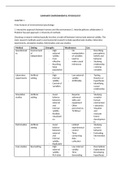
Choosing a research method typically involves a trade-off between interna land external validity. The
main research methods used in environmental research include questionnaire studies, laboratory
experiments, simulation studies, field studies and case studies.
Method Setting Strengths Weaknesses Use
Questionnair Environment - High - No - Describing
es al external manipulation perceptions,
independent validity of variables beliefs and
- Cost- - Hard to behavior
effective make causal - Studying
- Reaching inferences relationship
large s among
population variables
s
Laboratory Artificial - High - Low external - Testing
experiments setting internal validity theories or
validity - Artificiality hypotheses
- Control of - Identifying
variables causal
relationship
s
Simulation Artificial - Good - Requires - Studying
studies setting balance advanced complex
between skills and human-
external equipment environmen
and - Often t dynamics
internal perceived as - Visualize
validity ‘fictitious’ and
- Realistic evaluate
visualizati future
on developmen
ts
Field studies Artificial - Good - Limited - Studying
setting balance experimental current
between control behavior
external - Time- - Evaluating
and consuming intervention
internal data s
validity collection
- Replicable
Case studies Real setting - High - Low internal - Descriptions
external validity - Explorations
validity - Time - Developing
- Rich data demanding hypotheses
, - Limited
generalizabili
ty
CHAPTER 2
Environmental risks differ from other risks:
1. they are characterized by high complexity and uncertainty, entailing intricate causal relationships
and multiple consequences
2. they often emerge from the aggregated behaviors of many individuals rather than from a signle
activity
3. the consequences are often temporally delayed and georaphically distant
Heuristics and biases in risk judgements:
Availability heuristic = people are more likely to overestimate the occurence of an event the easier it
is fort hem tob ring to mind examples of similar events
Anchoring-and-adjustment heuristic = when making estimates, people often start out from a
reference point that is salient in the situation (the anchor) and then adjust this first estimate to arrive
at a final judgement
Unrealistic optimism = people’s tendency to believe that they are more likely to experience positive
events and less likely to experience negative events than others
Framing effects = different descriptions of otherwise identical problems can alter people’s decisions
Loss aversion = a loss is subjectively experienced as more devastating than the equivalent gain is
gratifying
Affective heuristic = affective states serve as important informational inputs for risk judgements: if
individuals feel positive about an activity, they tend to judge the risk as low and the benefits as high.
Conversely, if they feel negative about an activity, they tend to judge the risk as high and the benefit
as low.
Temporal discounting = the psychological phenomenon that outcomes in the far future are
subjectively less significant than immediate outcomes (not much evidence found for this effect on
environmental risks)
Psychometric paradigm: aims to identify the ‘cognitive map’ of diverse risk events, activities or
technologies and its underlying psychological dimensions that lead individuals to perceive someting
as more or less risky.
Dread risk = the extent to which a risk is experienced as dreadful or as having severe, catastrophic
consequences
Unknown risk = the extent to which a risk is experiences as new, unfamiliar, unobservable, or having
delayed effects
People low on traditional values and high on altruism tent to perceive greater global environmental
risks. People who value nature in its own right (biospheric value orientation) show greater awareness
while people with strong egoistic values show reduced awareness of environmental problems.
, Experts generally ascribe lower impacts to the presented risks than lay people.
Protected or sacred values = people can be highly reluctant to make trade-offs among different
values (for example: sacrificing nature for money)
Individuals holding protected values are more likely to reject market-based approaches to trading
emission rights, despite their possible benefit in mitigating climate change.
Moral philosophy contrast between consequentialist principles and deontological principles
Deontological principles = the focus is on the inherent rightness or wrongness of the act per se
Consequentialist principles = conclusions about what is morally right or wrong based on the
magnitude and likelihood of outcomes
Protected values are more strongly associated with deontological orientations and with a stronger
preference for acts than omissions. Participants more strongly endorsing protected values and
deontological orientations were immune to framing effects. They focus more on their duties then on
outcomes.
CHAPTER 3
Anthropogenic climate change = human-caused climate change
Much diversity in (public) understanding can be attributed not to what we learn about climate
change but to how, and from whom, we learn: the sources of our information and how we evaluate
those sources.
The extent to which people understand climate change is also reflected in perceptions of the risk it
entails.
Attributional ambiguity = when there are multiple plausible alternative explanations making it
difficult to know which explanation is most valid
False-balance (in news media) = presenting two opposing positions in a way that implies that they
represent two equally representative opinions
Psychological distance = the perceived distance between oneself and the impacts of climate change
Threat to positive evaluations of ingroups diminishes perceived climate change risk.
Solution aversion = the tendency to discount problems because of a dislike of the solution rather
than because of an assessment of the problem itself. If people don’t feel capable of reducing the
risks, they cope with the seriousness by attenuating the perceived threat. Thus, it is important to pair
communication of seriousness of climate change with solutions to reduce the risks of climate change.
Mitigation = to slow down and eventually stop climate change
Adaptation = to adjust and prepare for he inevitable impacts of climate change
Mitigation and adaptation involve both decreasing vulnerability and increasing resilience. We are at a
point where mitigation cannot prevent upcoming changes, making adaptation critical.
Environmental justice issue = Impacts and changes are more likely to affect animals, the poor, elderly
and women, making the need for adaptation and mitigation a social justice issue
CHAPTER 4
CHAPTER 1
4 key features of environmental psychology:
1. Interactive approach between humans and the environment 2. Interdisciplinary collaboration 3.
Problem-focused approach 4. Diversity of methods
Choosing a research method typically involves a trade-off between interna land external validity. The
main research methods used in environmental research include questionnaire studies, laboratory
experiments, simulation studies, field studies and case studies.
Method Setting Strengths Weaknesses Use
Questionnair Environment - High - No - Describing
es al external manipulation perceptions,
independent validity of variables beliefs and
- Cost- - Hard to behavior
effective make causal - Studying
- Reaching inferences relationship
large s among
population variables
s
Laboratory Artificial - High - Low external - Testing
experiments setting internal validity theories or
validity - Artificiality hypotheses
- Control of - Identifying
variables causal
relationship
s
Simulation Artificial - Good - Requires - Studying
studies setting balance advanced complex
between skills and human-
external equipment environmen
and - Often t dynamics
internal perceived as - Visualize
validity ‘fictitious’ and
- Realistic evaluate
visualizati future
on developmen
ts
Field studies Artificial - Good - Limited - Studying
setting balance experimental current
between control behavior
external - Time- - Evaluating
and consuming intervention
internal data s
validity collection
- Replicable
Case studies Real setting - High - Low internal - Descriptions
external validity - Explorations
validity - Time - Developing
- Rich data demanding hypotheses
, - Limited
generalizabili
ty
CHAPTER 2
Environmental risks differ from other risks:
1. they are characterized by high complexity and uncertainty, entailing intricate causal relationships
and multiple consequences
2. they often emerge from the aggregated behaviors of many individuals rather than from a signle
activity
3. the consequences are often temporally delayed and georaphically distant
Heuristics and biases in risk judgements:
Availability heuristic = people are more likely to overestimate the occurence of an event the easier it
is fort hem tob ring to mind examples of similar events
Anchoring-and-adjustment heuristic = when making estimates, people often start out from a
reference point that is salient in the situation (the anchor) and then adjust this first estimate to arrive
at a final judgement
Unrealistic optimism = people’s tendency to believe that they are more likely to experience positive
events and less likely to experience negative events than others
Framing effects = different descriptions of otherwise identical problems can alter people’s decisions
Loss aversion = a loss is subjectively experienced as more devastating than the equivalent gain is
gratifying
Affective heuristic = affective states serve as important informational inputs for risk judgements: if
individuals feel positive about an activity, they tend to judge the risk as low and the benefits as high.
Conversely, if they feel negative about an activity, they tend to judge the risk as high and the benefit
as low.
Temporal discounting = the psychological phenomenon that outcomes in the far future are
subjectively less significant than immediate outcomes (not much evidence found for this effect on
environmental risks)
Psychometric paradigm: aims to identify the ‘cognitive map’ of diverse risk events, activities or
technologies and its underlying psychological dimensions that lead individuals to perceive someting
as more or less risky.
Dread risk = the extent to which a risk is experienced as dreadful or as having severe, catastrophic
consequences
Unknown risk = the extent to which a risk is experiences as new, unfamiliar, unobservable, or having
delayed effects
People low on traditional values and high on altruism tent to perceive greater global environmental
risks. People who value nature in its own right (biospheric value orientation) show greater awareness
while people with strong egoistic values show reduced awareness of environmental problems.
, Experts generally ascribe lower impacts to the presented risks than lay people.
Protected or sacred values = people can be highly reluctant to make trade-offs among different
values (for example: sacrificing nature for money)
Individuals holding protected values are more likely to reject market-based approaches to trading
emission rights, despite their possible benefit in mitigating climate change.
Moral philosophy contrast between consequentialist principles and deontological principles
Deontological principles = the focus is on the inherent rightness or wrongness of the act per se
Consequentialist principles = conclusions about what is morally right or wrong based on the
magnitude and likelihood of outcomes
Protected values are more strongly associated with deontological orientations and with a stronger
preference for acts than omissions. Participants more strongly endorsing protected values and
deontological orientations were immune to framing effects. They focus more on their duties then on
outcomes.
CHAPTER 3
Anthropogenic climate change = human-caused climate change
Much diversity in (public) understanding can be attributed not to what we learn about climate
change but to how, and from whom, we learn: the sources of our information and how we evaluate
those sources.
The extent to which people understand climate change is also reflected in perceptions of the risk it
entails.
Attributional ambiguity = when there are multiple plausible alternative explanations making it
difficult to know which explanation is most valid
False-balance (in news media) = presenting two opposing positions in a way that implies that they
represent two equally representative opinions
Psychological distance = the perceived distance between oneself and the impacts of climate change
Threat to positive evaluations of ingroups diminishes perceived climate change risk.
Solution aversion = the tendency to discount problems because of a dislike of the solution rather
than because of an assessment of the problem itself. If people don’t feel capable of reducing the
risks, they cope with the seriousness by attenuating the perceived threat. Thus, it is important to pair
communication of seriousness of climate change with solutions to reduce the risks of climate change.
Mitigation = to slow down and eventually stop climate change
Adaptation = to adjust and prepare for he inevitable impacts of climate change
Mitigation and adaptation involve both decreasing vulnerability and increasing resilience. We are at a
point where mitigation cannot prevent upcoming changes, making adaptation critical.
Environmental justice issue = Impacts and changes are more likely to affect animals, the poor, elderly
and women, making the need for adaptation and mitigation a social justice issue
CHAPTER 4