Essentials of Dental Radiography 9th Edition By Evelyn Thomson,Orlen Johnson – Test Bank
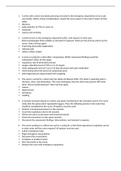
Test Bank Chapter 1 Multiple Choice 1. Who was awarded the first Nobel Prize for physics in 1901, for his experimental work with radiation? 2. W. J. Morton 3. O. Walkhof 4. W. D. Coolidge 5. W. C. Roentgen 6. Who is credited with introducing the bitewing radiograph? 7. F. W. McCormack 8. H. R. Raper 9. G. M. Fitzgerald 10. C. E. Kells 11. Who developed the hot cathode ray tube? 12. W. D. Coolidge 13. W. A. Price 14. H. R. Raper 15. W. H. Rollins 16. The development of radiation protection as a science is credited to: 17. A. Cieszyński. 18. W. D. Coolidge. 19. W. H. Rollins.20. F. Mouyen. 21. What New Orleans dentist first made practical use of x-rays in the treatment of dental patients? 22. H. R. Raper 23. G. M. Fitzgerald 24. F. Mouyen 25. C. E. Kells 26. Early researchers working in the field of radiography were not aware that continued exposure to x-rays produced accumulations of radiation efects in the body because x-rays are invisible. 27. Both the statement and reason are correct and related. 28. Both the statement and reason are correct but NOT related. 29. The statement is correct, but the reason is NOT. 30. The statement is NOT correct, but the reason is correct. 31. NEITHER the statement NOR the reason is correct. 32. 7. The most significant advancement in the early days of radiography came in 1913 when W. D. Coolidge: 33. became the first to alert the profession of the dangers of radiation exposure and advocated for the science of radiation protection. 34. exposed a prototype of a dental radiograph, setting the stage for preventive oral health care. 35. developed a variable, high kilovoltage x-ray machine compatible with the paralleling technique. 36. introduced an x-ray tube that allowed for an x-ray output that could be predetermined and accurately controlled. 37. The first dental radiograph was produced using an exposure time of: 38. 0.5 second. 39. 1 minute.40. 5 minutes. 41. 25 minutes. 42. 1 hour. 43. What component of the dental x-ray machine best limits the size of the x-ray beam to the approximate size of the image receptor? 44. A pointed cone 45. An open round cylinder 46. A rectangular PID 47. A slit collimator 48. Panoramic radiology became popular in the: 49. 1930s. 50. 1940s. 51. 1950s. 52. 1960s. 53. 1970s. 54. Which of the following is NOT true regarding cone beam volumetric imaging? 55. It images a single selected plane of tissues. 56. It is based on computed tomography. 57. It uses less radiation than a panoramic radiograph. 58. It is designed specifically for imaging dental applications. 59. It is purported to become the gold standard for imaging certain oral conditions. 60. Early dental film required long exposure times because: 61. it was hand-wrapped. 62. the emulsion was only on one side.63. glass plates were used as the base. 64. the packets were not moisture resistant. 65. Each of the following is an advantage of digital imaging EXCEPT one. Which one is the EXCEPTION? 66. It reduces radiation over film-based radiography. 67. It eliminates the need for the darkroom and processing chemistry. 68. It allows the use of pointed cones without radiation hazards. 69. It avoids the need for disposal of hazardous materials such as lead foils from film packets. 70. It produces enhanced two- and three-dimensional images. 71. The <KT>bisecting technique was the first and earliest radiographic technique for exposing intraoral radiographs because the bisecting technique is based on the rule of isometry. 72. Both the statement and reason are correct and related. 73. Both the statement and reason are correct but NOT related. 74. The statement is correct, but the reason is NOT. 75. The statement is NOT correct, but the reason is correct. 76. NEITHER the statement NOR the reason is correct. 77. The <KT>parpaparalleling technique is taught in all dental assisting, dental hygiene, and dental schools because it is the technique of choice for imaging intraoral radiographs. 78. Both the statement and reason are correct and related. 79. Both the statement and reason are correct but NOT related. 80. The statement is correct, but the reason is NOT. 81. The statement is NOT correct, but the reason is correct. 82. NEITHER the statement NOR the reason is correct. 83. The rule of isometry is the basis for what dental radiographic technique? 84. Bisecting85. Paralleling 86. Panoramic 87. Digital 88. Computed tomography 89. Each of the following is a potential use of dental radiographs EXCEPT one. Which one is the EXCEPTION? 90. Diagnosing dental caries 91. Evaluating development of dentition 92. Detecting missing teeth 93. Assessing patient self-care 94. Evaluating trauma to teeth and supporting bone 18. Producing radiographs of the teeth and/or the oral cavity is called: 19. Radiation producing. 20. Radiology. 21. Roentgenograph. 22. X-raying. 23. Radiography. 24. Dental assistants and dental hygienists meet an important need by providing each of the following EXCEPT one. Which one is the EXEPTION? 25. Exposing radiographs 26. Processing radiographs27. Mounting radiographs 28. Prescribing radiographs 29. Interpreting radiographs 30. The positioning indicating device (PID) is sometimes called a “cone” because the PID of early dental x-ray machines was of a pointed shape.
Connected book
Written for
Document information
- Uploaded on
- July 29, 2021
- File latest updated on
- September 21, 2022
- Number of pages
- 412
- Written in
- 2020/2021
- Type
- Exam (elaborations)
- Contains
- Questions & answers
Subjects
- for his e
-
essentials of dental radiography 9th edition by evelyn thomson
-
orlen johnson – test bank
-
test bank chapter 1 multiple choice 1 who was awarded the first nobel prize for physics in 1901