

Structure and function of DNA
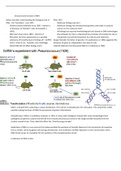
Before and after understanding the biological role of After 1953
DNA – the “boundary” year 1953 - Molecular biology was born.
- Genetics existed (officially since 1900 – thanks to - Molecular biology has revolutionised genetics and made it a precise
re-discovery of Mendel’s rules formulated in science on the molecular level.
1865). - All biology has acquired methodological tools based on DNA technologies
- DNA was known (since 1869 – thanks to F. that allowed not only to understand the principles of heredity but also to
Miescher) and even appreciated as a possible manipulate it practically (important for industry and medicine).
substance of heredity (due to findings of F. Griffith Gregor Mendel: the father of genetics. His publications in 1866 suggested the
and O. Avery & Co). However, this knowledge existence of genes as independent units kept in cells.
about DNA did not affect biology much. Friedrich Miescher has discovered DNA as a substance in 1869
DNA is a double helix containing a unique distribution of TA and GC nucleotide pairs for every gene. This uniqueness makes
possible coding functions of DNA (the possession of genetic information).
Ostwald Avery: DNA is a hereditary molecule. In 1943, O. Avery with colleagues showed that some morphological and
pathogenic properties could be transferred from smooth pneumococcal strain to the tough by DNA extracted from the
virulent smooth strain. They called this effect the “transforming principle”.
Replication of DNA is a core process that makes possible the existence of heredity (based on the transmission of properties
from a mother cell to daughter cells during cell divisions). The mechanism of DNA replication is semi-conservative: every
DNA strand serves as a template for the synthesis of the complementary strand.
Localisation of DNA in cells:
,Organisation of DNA in chromosomes DNA surrounds histones (proteins) and forms nucleosomes. They are
Types of DNA: arranged into solenoids, which make chromatin loops (units of
chromatin in the chromatids of chromosomes).
DNA coiling in the chromosome
, Details of gene structure:
Enhancer is bound by activator proteins (transcription factors) to start
transcription. The TATA box is non-coding DNA sequence (known as a cis-
regulatory element). It indicates a start of reading and decoding of a
genetic sequence. Transcription factors bind to the TATA box and recruit
RNA polymerase, which synthesises RNA from DNA. AATAAA is a
conserved sequence of polyadenylation signal sites.
Extrachromosomal DNA of eukaryotes:
- 2 eukaryotic organelle, mitochondria (in all eukaryotes) and chloroplasts (in plants and algae) contain their own
genomes with a small number of genes. These genes are called extrachromosomal (or cytoplasmic) because they’re
located outside of chromosomes. These genomes are in multiple copies per each organelle, and each cell has a few or
many organelle, so overall each cell contains many copies of extrachromosomal DNA.
- Mitochondria DNA (mtDNA) and chloroplast DNA (cpDNA) are important for cellular functions. The products of their
genes interact with products of nuclear (chromosomal) genes during growth and development, this results in long co-
evolution of nuclear and organelle genomes.
- Mutations in cytoplasmic genes could lead to drastic deviations of development, in particular to human diseases.
- Transmission of cytoplasmic genes is complex and associated with unique features of cytoplasmic genetics and
inheritance. They’re typically transmitted to progenies only from one parent (usually from a female).
Bi-parental and uniparental inheritance Maternal inheritance of variegation in reciprocal crosses
Before and after understanding the biological role of After 1953
DNA – the “boundary” year 1953 - Molecular biology was born.
- Genetics existed (officially since 1900 – thanks to - Molecular biology has revolutionised genetics and made it a precise
re-discovery of Mendel’s rules formulated in science on the molecular level.
1865). - All biology has acquired methodological tools based on DNA technologies
- DNA was known (since 1869 – thanks to F. that allowed not only to understand the principles of heredity but also to
Miescher) and even appreciated as a possible manipulate it practically (important for industry and medicine).
substance of heredity (due to findings of F. Griffith Gregor Mendel: the father of genetics. His publications in 1866 suggested the
and O. Avery & Co). However, this knowledge existence of genes as independent units kept in cells.
about DNA did not affect biology much. Friedrich Miescher has discovered DNA as a substance in 1869
DNA is a double helix containing a unique distribution of TA and GC nucleotide pairs for every gene. This uniqueness makes
possible coding functions of DNA (the possession of genetic information).
Ostwald Avery: DNA is a hereditary molecule. In 1943, O. Avery with colleagues showed that some morphological and
pathogenic properties could be transferred from smooth pneumococcal strain to the tough by DNA extracted from the
virulent smooth strain. They called this effect the “transforming principle”.
Replication of DNA is a core process that makes possible the existence of heredity (based on the transmission of properties
from a mother cell to daughter cells during cell divisions). The mechanism of DNA replication is semi-conservative: every
DNA strand serves as a template for the synthesis of the complementary strand.
Localisation of DNA in cells:
,Organisation of DNA in chromosomes DNA surrounds histones (proteins) and forms nucleosomes. They are
Types of DNA: arranged into solenoids, which make chromatin loops (units of
chromatin in the chromatids of chromosomes).
DNA coiling in the chromosome
, Details of gene structure:
Enhancer is bound by activator proteins (transcription factors) to start
transcription. The TATA box is non-coding DNA sequence (known as a cis-
regulatory element). It indicates a start of reading and decoding of a
genetic sequence. Transcription factors bind to the TATA box and recruit
RNA polymerase, which synthesises RNA from DNA. AATAAA is a
conserved sequence of polyadenylation signal sites.
Extrachromosomal DNA of eukaryotes:
- 2 eukaryotic organelle, mitochondria (in all eukaryotes) and chloroplasts (in plants and algae) contain their own
genomes with a small number of genes. These genes are called extrachromosomal (or cytoplasmic) because they’re
located outside of chromosomes. These genomes are in multiple copies per each organelle, and each cell has a few or
many organelle, so overall each cell contains many copies of extrachromosomal DNA.
- Mitochondria DNA (mtDNA) and chloroplast DNA (cpDNA) are important for cellular functions. The products of their
genes interact with products of nuclear (chromosomal) genes during growth and development, this results in long co-
evolution of nuclear and organelle genomes.
- Mutations in cytoplasmic genes could lead to drastic deviations of development, in particular to human diseases.
- Transmission of cytoplasmic genes is complex and associated with unique features of cytoplasmic genetics and
inheritance. They’re typically transmitted to progenies only from one parent (usually from a female).
Bi-parental and uniparental inheritance Maternal inheritance of variegation in reciprocal crosses


