Pure Mathematics Year 2 (A Level) Unit Test 4: Sequences and Series
1 The first 3 terms of a geometric sequence are , . Find the value
of k. (4 marks)
2 For an arithmetic sequence and
a Find the value of the 20th term. (4 marks)
b Given that the sum of the first n terms is 78, find the value of n. (4 marks)
3 a Prove that the sum of the first n terms of an arithmetic series is
(3 marks)
b Hence, or otherwise, find the sum of the first 200 odd numbers. (2 marks)
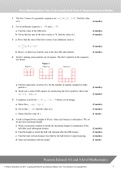
4 Jacob is making some patterns out of squares. The first 3 patterns in the sequence
are shown.
Figure 1
a Find an expression, in terms of n, for the number of squares required to make
pattern n. (2 marks)
b Jacob uses a total of 948 squares in constructing the first k patterns. Show that
(2 marks)
5 A sequence is given by , where p is an integer.
a Show that (2 marks)
b Given that , find the value of p. (3 marks)
c Hence find the value of . (1 mark)
6 A ball is dropped from a height of 80 cm. After each bounce it rebounds to 70% of
its previous maximum height.
a Write a recurrence relation to model the maximum height in centimetres of the
ball after each subsequent bounce. (2 marks)
b Find the height to which the ball will rebound after the fifth bounce. (2 marks)
c Find the total vertical distance travelled by the ball before it stops bouncing. (4 marks)
d State one limitation with the model. (1 mark)
© Pearson Education Ltd 2017. Copying permitted for purchasing institution only. This material is not copyright free. 1
1 The first 3 terms of a geometric sequence are , . Find the value
of k. (4 marks)
2 For an arithmetic sequence and
a Find the value of the 20th term. (4 marks)
b Given that the sum of the first n terms is 78, find the value of n. (4 marks)
3 a Prove that the sum of the first n terms of an arithmetic series is
(3 marks)
b Hence, or otherwise, find the sum of the first 200 odd numbers. (2 marks)
4 Jacob is making some patterns out of squares. The first 3 patterns in the sequence
are shown.
Figure 1
a Find an expression, in terms of n, for the number of squares required to make
pattern n. (2 marks)
b Jacob uses a total of 948 squares in constructing the first k patterns. Show that
(2 marks)
5 A sequence is given by , where p is an integer.
a Show that (2 marks)
b Given that , find the value of p. (3 marks)
c Hence find the value of . (1 mark)
6 A ball is dropped from a height of 80 cm. After each bounce it rebounds to 70% of
its previous maximum height.
a Write a recurrence relation to model the maximum height in centimetres of the
ball after each subsequent bounce. (2 marks)
b Find the height to which the ball will rebound after the fifth bounce. (2 marks)
c Find the total vertical distance travelled by the ball before it stops bouncing. (4 marks)
d State one limitation with the model. (1 mark)
© Pearson Education Ltd 2017. Copying permitted for purchasing institution only. This material is not copyright free. 1