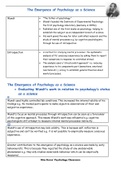
Wundt • “The father of psychology.”
• Wundt founded the Institute of Experimental Psychology;
the first psychology laboratory (Germany in 1870s).
• Published one of the first books on psychology, helping to
establish the subject as an independent branch of science.
• His work paved the way for later controlled research and the
study of mental processes e.g. by cognitive psychologists,
through his use of introspection.
Introspection • A method for studying mental processes: the systematic
analysis of Ps’ conscious experience by asking them to report
their sensations in response to controlled stimuli.
• The analysis used a “structuralist approach” i.e. reducing
experience to its components part (sensations, emotional
reactions etc.), aiming to establish general theories about
mental processes.
Wundt used highly controlled lab conditions. This increased the internal validity of his
findings e.g. He trained participants to make objective observations of their own
subjective experience...
Wundt’s focus on mental processes through introspection can be seen as a forerunner
of the cognitive approach. This means Wundt’s work was influential e.g. cognitive
psychologists still attempt to measure internal mental processes indirectly…
Wundt’s use of introspection may lack validity. This is because self-reflection is
subjective and can’t be verified e.g. it is not possible to empirically measure conscious
experience…
Greater contributions to the emergence of psychology as a science was made by early
behaviourists. This is because they rejected the study of any unobservable
phenomenon e.g. they only studies observable behaviour which can be empirically
measured…
Miss Burns’ Psychology Classroom
, Much of our behaviour stems from unconscious drives. Early childhood
experiences influence adult behaviour and personality, depending on how these drives are
gratified as we move through the stages of psychosexual development.
The unconscious The reservoir of feelings/ thoughts/ urges/ memories that are outside
of our conscious awareness, esp. ones causing anxiety or conflict.
Unpleasant memories repressed in the unconscious may still cause us to
develop anxiety disorders e.g. phobias.
Id The primitive and instinctive component of personality operating
according to the pleasure principle. Present from birth. An over-
demanding id leads to greedy/selfish/aggressive behaviour.
Ego The mediating part of the personality operating according to the reality
principle. Develops at age 2-4. Partly un/conscious.
Superego The part of the personality operating according to the morality principle.
Develops at age 4-5. Partly un/conscious. Incorporates the values and
morals of society which are learned from one's parents and others,
Causes feelings of guilt.
Defence mechanisms Unconscious psychological mechanisms employed by the ego
to reduce anxiety arising from unacceptable or potentially harmful
stimuli e.g...
Repression Mechanism employed by the ego to keep threatening or disturbing
thoughts from becoming conscious.
Denial Refusing to see the unpleasant aspects of reality.
Displacement Transferring emotional impulses to a neutral target.
Psychosexual stages The stages of development which describes the way in which children
receive sexual gratification from birth to puberty, during which their
personalities are shaped e.g. if fixation occurs at a particular stage due
to over/under-gratification.
Oral (0-2), anal (2-3), phallic (3-6), latency (6-puberty) & genital
(puberty+).
Freud: Little Hans was the 5 year old son of Freud’s friend had developed a phobia of
horses. The father wrote to him to tell him about his son’s development, revealing Hans was
particularly afraid of large white horses with black blinkers and black around the mouth. He
was terrified to leave the house and believed that the horses might either bite him or fall
down. This supports that the unconscious (Oedipus complex) can manifest itself to affect
observable behaviour.
Miss Burns’ Psychology Classroom
• Wundt founded the Institute of Experimental Psychology;
the first psychology laboratory (Germany in 1870s).
• Published one of the first books on psychology, helping to
establish the subject as an independent branch of science.
• His work paved the way for later controlled research and the
study of mental processes e.g. by cognitive psychologists,
through his use of introspection.
Introspection • A method for studying mental processes: the systematic
analysis of Ps’ conscious experience by asking them to report
their sensations in response to controlled stimuli.
• The analysis used a “structuralist approach” i.e. reducing
experience to its components part (sensations, emotional
reactions etc.), aiming to establish general theories about
mental processes.
Wundt used highly controlled lab conditions. This increased the internal validity of his
findings e.g. He trained participants to make objective observations of their own
subjective experience...
Wundt’s focus on mental processes through introspection can be seen as a forerunner
of the cognitive approach. This means Wundt’s work was influential e.g. cognitive
psychologists still attempt to measure internal mental processes indirectly…
Wundt’s use of introspection may lack validity. This is because self-reflection is
subjective and can’t be verified e.g. it is not possible to empirically measure conscious
experience…
Greater contributions to the emergence of psychology as a science was made by early
behaviourists. This is because they rejected the study of any unobservable
phenomenon e.g. they only studies observable behaviour which can be empirically
measured…
Miss Burns’ Psychology Classroom
, Much of our behaviour stems from unconscious drives. Early childhood
experiences influence adult behaviour and personality, depending on how these drives are
gratified as we move through the stages of psychosexual development.
The unconscious The reservoir of feelings/ thoughts/ urges/ memories that are outside
of our conscious awareness, esp. ones causing anxiety or conflict.
Unpleasant memories repressed in the unconscious may still cause us to
develop anxiety disorders e.g. phobias.
Id The primitive and instinctive component of personality operating
according to the pleasure principle. Present from birth. An over-
demanding id leads to greedy/selfish/aggressive behaviour.
Ego The mediating part of the personality operating according to the reality
principle. Develops at age 2-4. Partly un/conscious.
Superego The part of the personality operating according to the morality principle.
Develops at age 4-5. Partly un/conscious. Incorporates the values and
morals of society which are learned from one's parents and others,
Causes feelings of guilt.
Defence mechanisms Unconscious psychological mechanisms employed by the ego
to reduce anxiety arising from unacceptable or potentially harmful
stimuli e.g...
Repression Mechanism employed by the ego to keep threatening or disturbing
thoughts from becoming conscious.
Denial Refusing to see the unpleasant aspects of reality.
Displacement Transferring emotional impulses to a neutral target.
Psychosexual stages The stages of development which describes the way in which children
receive sexual gratification from birth to puberty, during which their
personalities are shaped e.g. if fixation occurs at a particular stage due
to over/under-gratification.
Oral (0-2), anal (2-3), phallic (3-6), latency (6-puberty) & genital
(puberty+).
Freud: Little Hans was the 5 year old son of Freud’s friend had developed a phobia of
horses. The father wrote to him to tell him about his son’s development, revealing Hans was
particularly afraid of large white horses with black blinkers and black around the mouth. He
was terrified to leave the house and believed that the horses might either bite him or fall
down. This supports that the unconscious (Oedipus complex) can manifest itself to affect
observable behaviour.
Miss Burns’ Psychology Classroom