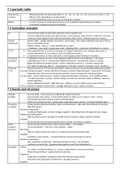
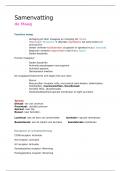
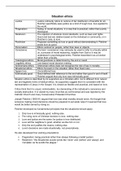
14.1 - NOTES = properties of alcohols +classifying alcohols
Alcohol homologous - Has OH (hydroxyl)
series - Responsible for both physical and chemical properties of alcohols
- CH3OH – used in high performance fuel for efficient combustion, and important chemical
feedstock.
- Can be converted into polymers, paints and solvents, insulation, adhesives etc.
- Ethanol - in alcoholic drinks and fuel, uses as solvent and feedstock.
Naming alcohols - Identify the carbon chain.
- Find how many alcohols (this is the end) and what branch they are on.
- If there are multiple alcohols (starts with consonant) so the alkyl group name stays as full
- Find alkyl and what branch it is.
- (no)-alkyl carbon chain length - (no)-alcohol
Physical properties - Less volatile (even with same carbon chain length)
- Higher melting points
- Greater water solubility
- Differences become smaller as carbon chain length increases due to polarity of bonds in
alkanes and alcohols – this affects strength on IM forces.
- Alkanes have nonpolar bonds due to electronegativity of H+ and C+ = nonpolar
- Intermolecular forces between nonpolar molecules are weak London forces (induced)
- Alcohol is polar due to O- and H+ = polar
- Still have weak London forces but strong H bonds between OH will be there.
Volatility and boiling - Boiling point is higher in alcohols than alkanes.
points - In liquid state there are H bonds holding the alcohol molecules together.
- H bonds must be broken to change liquid into gas and requires energy.
- Energy to overcome the weak London forces in alkanes.
- Alcohols have lower volatility than the alkanes with the same number of carbon atoms.
Solubility in water - Compound forming H bonds with water is more water soluble than one that doesn’t.
- Alkanes are nonpolar and cannot form H bonds with water = less soluble
- Alcohols can form H bonds with water = more water soluble
- As hydrocarbon chain increases, OH group becomes smaller = solubility decreases
- OH, makes it easy to form H bonds with water = more soluble.
Primary alcohols - OH, group is attached to a carbon.
- 2 H on each branch
- And alkyl on another branch
- e.g., ethanol and methanol (excused but accepted)
- Focus on C with the OH attached
Secondary alcohols - OH, group is attached to C.
- 1 H on branch
- 2 alkyl groups
- Focus on C with the OH attached
Tertiary alcohols - OH, is attached to carbon.
- No H
- 3 alkyl groups.
- Focus on C with the OH attached
14.2 - NOTES = reactions of alcohols
Combustion of alcohols - Alcohol burns in plentiful supply of O2 -> CO2 + H20 (balance accordingly)
- Exothermic and releases large quantity of energy as heat
- Number of carbons in alcohol chain increases, quantity of heat released per mole
increases too.
Oxidation of alcohols - Primary and secondary alcohols are oxidised by oxidising agent.
- Usually, K2Cr2O7 with dilute H2SO4
- When alcohol is oxidised, orange solution with (Cr2O7 2-) dichromate (VI) ions is reduced
to green containing Cr 3+ ions.
Alcohol homologous - Has OH (hydroxyl)
series - Responsible for both physical and chemical properties of alcohols
- CH3OH – used in high performance fuel for efficient combustion, and important chemical
feedstock.
- Can be converted into polymers, paints and solvents, insulation, adhesives etc.
- Ethanol - in alcoholic drinks and fuel, uses as solvent and feedstock.
Naming alcohols - Identify the carbon chain.
- Find how many alcohols (this is the end) and what branch they are on.
- If there are multiple alcohols (starts with consonant) so the alkyl group name stays as full
- Find alkyl and what branch it is.
- (no)-alkyl carbon chain length - (no)-alcohol
Physical properties - Less volatile (even with same carbon chain length)
- Higher melting points
- Greater water solubility
- Differences become smaller as carbon chain length increases due to polarity of bonds in
alkanes and alcohols – this affects strength on IM forces.
- Alkanes have nonpolar bonds due to electronegativity of H+ and C+ = nonpolar
- Intermolecular forces between nonpolar molecules are weak London forces (induced)
- Alcohol is polar due to O- and H+ = polar
- Still have weak London forces but strong H bonds between OH will be there.
Volatility and boiling - Boiling point is higher in alcohols than alkanes.
points - In liquid state there are H bonds holding the alcohol molecules together.
- H bonds must be broken to change liquid into gas and requires energy.
- Energy to overcome the weak London forces in alkanes.
- Alcohols have lower volatility than the alkanes with the same number of carbon atoms.
Solubility in water - Compound forming H bonds with water is more water soluble than one that doesn’t.
- Alkanes are nonpolar and cannot form H bonds with water = less soluble
- Alcohols can form H bonds with water = more water soluble
- As hydrocarbon chain increases, OH group becomes smaller = solubility decreases
- OH, makes it easy to form H bonds with water = more soluble.
Primary alcohols - OH, group is attached to a carbon.
- 2 H on each branch
- And alkyl on another branch
- e.g., ethanol and methanol (excused but accepted)
- Focus on C with the OH attached
Secondary alcohols - OH, group is attached to C.
- 1 H on branch
- 2 alkyl groups
- Focus on C with the OH attached
Tertiary alcohols - OH, is attached to carbon.
- No H
- 3 alkyl groups.
- Focus on C with the OH attached
14.2 - NOTES = reactions of alcohols
Combustion of alcohols - Alcohol burns in plentiful supply of O2 -> CO2 + H20 (balance accordingly)
- Exothermic and releases large quantity of energy as heat
- Number of carbons in alcohol chain increases, quantity of heat released per mole
increases too.
Oxidation of alcohols - Primary and secondary alcohols are oxidised by oxidising agent.
- Usually, K2Cr2O7 with dilute H2SO4
- When alcohol is oxidised, orange solution with (Cr2O7 2-) dichromate (VI) ions is reduced
to green containing Cr 3+ ions.