

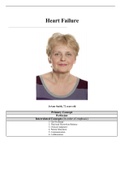
Heart Failure
JoAnn Smith, 72 years old
Primary Concept
Perfusion
Interrelated Concepts (In order of emphasis)
1. Gas Exchange
2. Fluid and Electrolyte Balance
3. Clinical Judgment
4. Patient Education
5. Communication
6. Collaboration
, UNFOLDING Reasoning Case Study: STUDENT
Heart Failure
History of Present Problem:
JoAnn Smith is a 72-year-old woman who has a history of myocardial infarction (MI) four years ago and systolic heart
failure secondary to ischemic cardiomyopathy with a current ejection fraction (EF) of only 15%. She presents to the
emergency department (ED) for shortness of breath (SOB) the past three days. Her shortness of breath has progressed
from SOB with activity to becoming SOB at rest. The last two nights she had to sleep in her recliner chair to rest
comfortably upright. She is able to speak only in partial sentences and then has to take a breath when talking to the nurse.
She has noted increased swelling in her lower legs and has gained six pounds in the last three days. She is being
transferred from the ED to the cardiac step-down where you are the nurse assigned to care for her.
Personal/Social History:
JoAnn is a retired math teacher who is unable to maintain the level of activity she has been accustomed to because of the
progression of her heart failure the past two years. She has struggled with depression the past two years and has been
more withdrawn since her husband of 52 years died unexpectedly three months ago from a myocardial infarction.
What data from the histories is RELEVANT and has clinical significance to the nurse?
RELEVANT Data from Present Problem: Clinical Significance:
MI four years ago, MI is significant because it decreases heart function due to death of
increase shortness of breath at rest; can only myocardial muscle
speak in partial sentences, EF of 15% shows that the heart is having a hard time pumping blood out to
ischemic cardiomyopathy with EF of 15% rest of the body therefore starving it of oxygenated blood.
last two nights slept in recliner Weight gain and increased swelling signifies she is fluid overloaded and it
increased swelling in lower legs can be reason why she is having a hard time talking, breathing, being
gained 6 pounds in last 3 days active and why she has to sleep in a recliner the past 2 nights
RELEVANT Data from Social History: Clinical Significance:
Retired math teacher, recent widow, history of Depression might affect her enthusiasm to recover, to stick to a therapy
depression, decreasing activity level regimen
What is the RELATIONSHIP of your patient’s past medical history (PMH) and current meds?
(Which medication treats which condition? Draw lines to connect)
PMH: Home Meds: Pharm. Classification: Expected Outcome:
Diabetes mellitus type II 1. ASA 81 mg PO daily Antiplatelets Decrease chance of
Hypertension 2. Carvedilol 3.25 mg PO Beta blocker clot formation
Atrial fibrillation daily ACE inhibitor Decrease blood
3. Lisinopril 5 mg PO Cholesterol pressure
Hyperlipidemia
daily medication Decrease blood
Chronic renal insufficiency 4. Ezetimide 10 mg PO Vasodilator pressure, helps with
(baseline creatinine 2.0) daily Diuretic heart failure,
Cerebral vascular accident 5. Hydralazine 25 mg PO Electrolyte decrease chance of
(CVA) with no residual 4x daily replacement death from heart
deficits 6. Torsemide 20 mg PO Anticoagulant attack
Heart failure (systolic) bid Antidiabetic Decrease
7. KCL 20 meq PO daily cholesterol
secondary to ischemic
8. Warfarin 5 mg PO daily Decrease blood
cardiomyopathy 9. Glyburide 5 mg PO pressure
MI with stent x2 to LAD 4 daily Decrease swelling,
years ago decrease fluid
overload
Increase serum
, potassium
Thins the blood,
decrease chance of
clot forming
Treat type 2
diabetes, helps
control blood sugar
levels
JoAnn Smith, 72 years old
Primary Concept
Perfusion
Interrelated Concepts (In order of emphasis)
1. Gas Exchange
2. Fluid and Electrolyte Balance
3. Clinical Judgment
4. Patient Education
5. Communication
6. Collaboration
, UNFOLDING Reasoning Case Study: STUDENT
Heart Failure
History of Present Problem:
JoAnn Smith is a 72-year-old woman who has a history of myocardial infarction (MI) four years ago and systolic heart
failure secondary to ischemic cardiomyopathy with a current ejection fraction (EF) of only 15%. She presents to the
emergency department (ED) for shortness of breath (SOB) the past three days. Her shortness of breath has progressed
from SOB with activity to becoming SOB at rest. The last two nights she had to sleep in her recliner chair to rest
comfortably upright. She is able to speak only in partial sentences and then has to take a breath when talking to the nurse.
She has noted increased swelling in her lower legs and has gained six pounds in the last three days. She is being
transferred from the ED to the cardiac step-down where you are the nurse assigned to care for her.
Personal/Social History:
JoAnn is a retired math teacher who is unable to maintain the level of activity she has been accustomed to because of the
progression of her heart failure the past two years. She has struggled with depression the past two years and has been
more withdrawn since her husband of 52 years died unexpectedly three months ago from a myocardial infarction.
What data from the histories is RELEVANT and has clinical significance to the nurse?
RELEVANT Data from Present Problem: Clinical Significance:
MI four years ago, MI is significant because it decreases heart function due to death of
increase shortness of breath at rest; can only myocardial muscle
speak in partial sentences, EF of 15% shows that the heart is having a hard time pumping blood out to
ischemic cardiomyopathy with EF of 15% rest of the body therefore starving it of oxygenated blood.
last two nights slept in recliner Weight gain and increased swelling signifies she is fluid overloaded and it
increased swelling in lower legs can be reason why she is having a hard time talking, breathing, being
gained 6 pounds in last 3 days active and why she has to sleep in a recliner the past 2 nights
RELEVANT Data from Social History: Clinical Significance:
Retired math teacher, recent widow, history of Depression might affect her enthusiasm to recover, to stick to a therapy
depression, decreasing activity level regimen
What is the RELATIONSHIP of your patient’s past medical history (PMH) and current meds?
(Which medication treats which condition? Draw lines to connect)
PMH: Home Meds: Pharm. Classification: Expected Outcome:
Diabetes mellitus type II 1. ASA 81 mg PO daily Antiplatelets Decrease chance of
Hypertension 2. Carvedilol 3.25 mg PO Beta blocker clot formation
Atrial fibrillation daily ACE inhibitor Decrease blood
3. Lisinopril 5 mg PO Cholesterol pressure
Hyperlipidemia
daily medication Decrease blood
Chronic renal insufficiency 4. Ezetimide 10 mg PO Vasodilator pressure, helps with
(baseline creatinine 2.0) daily Diuretic heart failure,
Cerebral vascular accident 5. Hydralazine 25 mg PO Electrolyte decrease chance of
(CVA) with no residual 4x daily replacement death from heart
deficits 6. Torsemide 20 mg PO Anticoagulant attack
Heart failure (systolic) bid Antidiabetic Decrease
7. KCL 20 meq PO daily cholesterol
secondary to ischemic
8. Warfarin 5 mg PO daily Decrease blood
cardiomyopathy 9. Glyburide 5 mg PO pressure
MI with stent x2 to LAD 4 daily Decrease swelling,
years ago decrease fluid
overload
Increase serum
, potassium
Thins the blood,
decrease chance of
clot forming
Treat type 2
diabetes, helps
control blood sugar
levels


