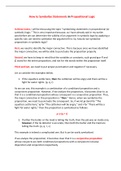
How to Symbolize Statements in Propositional Logic
In these notes, I will be discussing the topic “symbolizing statements in propositional (or
symbolic) logic.” This is very important because, as I have already said in my earlier
post before we can determine the validity of an argument in symbolic logic by applying a
specific rule, we need to symbolize the argument first. So, how do we symbolize
propositions in symbolic logic?
First, we need to identify the major connective. This is because once we have identified
the major connective, we will be able to punctuate the proposition properly.
Second, we have to keep in mind that the variables or constants, such p and q or Y and
Z, stand for the entire proposition, and not for the words within the proposition itself.
Third and last, we need to put proper punctuation and negation if necessary.
Let us consider the examples below.
1. If the squatters settle here, then the cattlemen will be angry and there will be a
fight for water rights. (p, q, r)
As we can see, this example is a combination of a conditional proposition and a
conjunctive proposition. However, if we analyze the proposition, it becomes clear to us
that it is a conditional proposition whose consequent is a conjunctive proposition. Thus,
the major connective in this proposition is “then.” Hence, when we symbolize the
proposition, we need to punctuate the consequent. So, if we let p stand for “The
squatters settle here,” q for “The cattlemen will be angry,” and r for “There will be a
fight for water rights,” then the proposition is symbolized as follows:
p ⊃ (q • r)
2. If either the butler or the maid is telling the truth, then the job was an inside one;
however, if the lie detector is accurate, then both the butler and the maid are
telling the truth. (p, q, r, s)
This example is indeed a complicated one. But it can be easily symbolized.
If we analyze the proposition, it becomes clear that it is a conjunctive proposition
whose conjuncts are both conditional propositions with a component inclusive
disjunction and conjunction respectively.
, Now, if we let
p stands for “The butler is telling the truth”
q for “The maid is telling the truth”
r for “The job was an inside one” and
s for “The lie detector is accurate”
then we initially come up with the following symbol: p v q ⊃ r • s ⊃ p • q
The symbol above, however, is not yet complete. In fact, it remains very complicated.
So, we have to punctuate it.
Since the major connective of the proposition is “however,” then we have to punctuate
the component conjuncts. Thus, we initially come up with the following symbol:
[p v q ⊃ r] • [s ⊃ p • q]
However, the symbolized form of the proposition remains complicated because the
component conjuncts have not been properly punctuated. As already said, there should
only be one major connective in a proposition. So, let us punctuate the first conjunct.
Since it is stated in the first conjunct that the proposition is a conditional proposition
whose antecedent is an inclusive disjunction, then we have to punctuate p v q. Thus, we
initially come up with the following symbol:
[(p v q) ⊃ r] • [s ⊃ p • q]
And then let us punctuate the second conjunct. Since it is stated in the second conjunct
that the proposition is a conditional proposition whose consequent is a conjunctive
proposition, then we have to punctuate p • q. Thus, we come up with the following
symbol:
[(p v q) ⊃ r] • [s ⊃ (p • q)]
Now, the symbol appears to be complete. Thus, the final symbol of the proposition “If
either the butler or the maid is telling the truth, then the job was an inside one;
however, if the lie detector is accurate, then both the butler and the maid are telling the
truth” is as follows:
[(p v q) ⊃ r] • [s ⊃ (p • q)]
In these notes, I will be discussing the topic “symbolizing statements in propositional (or
symbolic) logic.” This is very important because, as I have already said in my earlier
post before we can determine the validity of an argument in symbolic logic by applying a
specific rule, we need to symbolize the argument first. So, how do we symbolize
propositions in symbolic logic?
First, we need to identify the major connective. This is because once we have identified
the major connective, we will be able to punctuate the proposition properly.
Second, we have to keep in mind that the variables or constants, such p and q or Y and
Z, stand for the entire proposition, and not for the words within the proposition itself.
Third and last, we need to put proper punctuation and negation if necessary.
Let us consider the examples below.
1. If the squatters settle here, then the cattlemen will be angry and there will be a
fight for water rights. (p, q, r)
As we can see, this example is a combination of a conditional proposition and a
conjunctive proposition. However, if we analyze the proposition, it becomes clear to us
that it is a conditional proposition whose consequent is a conjunctive proposition. Thus,
the major connective in this proposition is “then.” Hence, when we symbolize the
proposition, we need to punctuate the consequent. So, if we let p stand for “The
squatters settle here,” q for “The cattlemen will be angry,” and r for “There will be a
fight for water rights,” then the proposition is symbolized as follows:
p ⊃ (q • r)
2. If either the butler or the maid is telling the truth, then the job was an inside one;
however, if the lie detector is accurate, then both the butler and the maid are
telling the truth. (p, q, r, s)
This example is indeed a complicated one. But it can be easily symbolized.
If we analyze the proposition, it becomes clear that it is a conjunctive proposition
whose conjuncts are both conditional propositions with a component inclusive
disjunction and conjunction respectively.
, Now, if we let
p stands for “The butler is telling the truth”
q for “The maid is telling the truth”
r for “The job was an inside one” and
s for “The lie detector is accurate”
then we initially come up with the following symbol: p v q ⊃ r • s ⊃ p • q
The symbol above, however, is not yet complete. In fact, it remains very complicated.
So, we have to punctuate it.
Since the major connective of the proposition is “however,” then we have to punctuate
the component conjuncts. Thus, we initially come up with the following symbol:
[p v q ⊃ r] • [s ⊃ p • q]
However, the symbolized form of the proposition remains complicated because the
component conjuncts have not been properly punctuated. As already said, there should
only be one major connective in a proposition. So, let us punctuate the first conjunct.
Since it is stated in the first conjunct that the proposition is a conditional proposition
whose antecedent is an inclusive disjunction, then we have to punctuate p v q. Thus, we
initially come up with the following symbol:
[(p v q) ⊃ r] • [s ⊃ p • q]
And then let us punctuate the second conjunct. Since it is stated in the second conjunct
that the proposition is a conditional proposition whose consequent is a conjunctive
proposition, then we have to punctuate p • q. Thus, we come up with the following
symbol:
[(p v q) ⊃ r] • [s ⊃ (p • q)]
Now, the symbol appears to be complete. Thus, the final symbol of the proposition “If
either the butler or the maid is telling the truth, then the job was an inside one;
however, if the lie detector is accurate, then both the butler and the maid are telling the
truth” is as follows:
[(p v q) ⊃ r] • [s ⊃ (p • q)]