Venn Diagram and Validity of Arguments
Another method of symbolizing categorical propositions is the use of the Venn diagram.
John Venn, who introduced the method (thus the name Venn Diagram) used two
overlapping circles to represent the relationship between two classes. Consider the
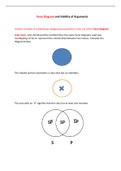
diagram below.
The shaded portion represents a class that has no members.
The area with an "X" signifies that the class has at least one member.
, is read as "S but not P" and this represents the class of things that are part of S but are
not part of P.
is read as "not S but P" and this represents the class of things that are part of P but are
not part of S.
is read as "S but P" and this represents the class of things that are both parts of S and P.
The diagrams below are used to represent the four standard types of categorical
propositions.
The shaded area of the Venn diagram above represents a class that has no members. In
the Venn diagram for a universal affirmative (A) proposition, the area "S but not P" is
shaded to indicate that all members of S are members of P. Thus, we say, "All S are P".
Another method of symbolizing categorical propositions is the use of the Venn diagram.
John Venn, who introduced the method (thus the name Venn Diagram) used two
overlapping circles to represent the relationship between two classes. Consider the
diagram below.
The shaded portion represents a class that has no members.
The area with an "X" signifies that the class has at least one member.
, is read as "S but not P" and this represents the class of things that are part of S but are
not part of P.
is read as "not S but P" and this represents the class of things that are part of P but are
not part of S.
is read as "S but P" and this represents the class of things that are both parts of S and P.
The diagrams below are used to represent the four standard types of categorical
propositions.
The shaded area of the Venn diagram above represents a class that has no members. In
the Venn diagram for a universal affirmative (A) proposition, the area "S but not P" is
shaded to indicate that all members of S are members of P. Thus, we say, "All S are P".