Research Plan: Definition and How to Prepare It
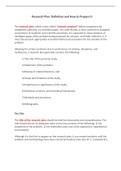
The research plan, which is also called “research proposal” before acceptance by
competent authority, is a scholarly paper. As is well-known, it must conform to accepted
conventions of academic and scientific procedure. It is expected to show evidence of
intelligent grasp of the problem being proposed for solution, and fields related to it. It
must also present appropriate and valid method and procedure for the solution of the
problem.
Allowing for certain variations due to preferences of scholars, disciplines, and
institutions, a research plan generally contains the following:
1) The title of the personal study,
2) Statement of the problem,
3) Review of related literature, and
4) Scope and limitation of the study,
5) Importance or significance of the study,
6) Definition of terms, and theoretical framework,
7) Methods and procedure,
8) Bibliography.
The Title
The title of the research plan should be brief but descriptive and comprehensive. The
title should also be an adequate index to the key contents of the following: 1) the
statement of the problem, 2) the method(s) used, and 3) the expected or hypothetical
conclusion(s).
Although it is the first to appear on the research plan, it can remain tentative until the
problem and methodology have been clearly formulated. (See also W. C. Campbell & S.
, V. Ballou, Form and Style: Theses, Reports, Term Papers, 4th ed., Boston, USA: Houghton
Miffin, 1974, p. 15).
The Statement of the Problem
The statement of the problem is the part of the research plan, which contains two
parts, namely: 1) a careful exposition of an area involving significant problems, and how
such problems affect knowledge in the given discipline, and 2) a clear and concise
statement of the problem. The first is an essay that demonstrates the researcher’s
intelligent and broad grasp of the key problem currently confronting her discipline. The
second is a clear statement of the question(s) to be answered or hypothesis to be
tested.
The statement of the problem in experimental research is usually in the form of a
hypothesis or a series of related hypotheses which call for proof or disproof. Other types
of research require that the problem be stated categorically in the form of a question or
series of related questions. In case a question needs further specification by means of
sub-questions, care is to be taken that the sub-questions are all comprehended by the
primary question. Multiple questions and questions which add new problems not
expressed or implied in the primary question must be avoided. (See Campbell & Ballou,
p. 18).
It must be remembered that the statement of the problem is not the same with the
statement of the purpose of the study. The first is the question to be answered, while
the second is the reason for answering the question.
A good statement of the problem must be consistent with the title and the methods and
procedure to be used in the research.
Review of Related Literature
It is assumed that before the researcher starts making the research plan, she has read
many important works related to the proposed study. The aims of the review of related
literature are:
1) to show that the researcher is familiar with key ideas in his field of study;
2) to show that the knowledge in the field is incomplete, unreliable, or both; and
3) to show that the findings of the proposed study will: a) add to, b) supplement,
and/or c) correct present knowledge.
The research plan, which is also called “research proposal” before acceptance by
competent authority, is a scholarly paper. As is well-known, it must conform to accepted
conventions of academic and scientific procedure. It is expected to show evidence of
intelligent grasp of the problem being proposed for solution, and fields related to it. It
must also present appropriate and valid method and procedure for the solution of the
problem.
Allowing for certain variations due to preferences of scholars, disciplines, and
institutions, a research plan generally contains the following:
1) The title of the personal study,
2) Statement of the problem,
3) Review of related literature, and
4) Scope and limitation of the study,
5) Importance or significance of the study,
6) Definition of terms, and theoretical framework,
7) Methods and procedure,
8) Bibliography.
The Title
The title of the research plan should be brief but descriptive and comprehensive. The
title should also be an adequate index to the key contents of the following: 1) the
statement of the problem, 2) the method(s) used, and 3) the expected or hypothetical
conclusion(s).
Although it is the first to appear on the research plan, it can remain tentative until the
problem and methodology have been clearly formulated. (See also W. C. Campbell & S.
, V. Ballou, Form and Style: Theses, Reports, Term Papers, 4th ed., Boston, USA: Houghton
Miffin, 1974, p. 15).
The Statement of the Problem
The statement of the problem is the part of the research plan, which contains two
parts, namely: 1) a careful exposition of an area involving significant problems, and how
such problems affect knowledge in the given discipline, and 2) a clear and concise
statement of the problem. The first is an essay that demonstrates the researcher’s
intelligent and broad grasp of the key problem currently confronting her discipline. The
second is a clear statement of the question(s) to be answered or hypothesis to be
tested.
The statement of the problem in experimental research is usually in the form of a
hypothesis or a series of related hypotheses which call for proof or disproof. Other types
of research require that the problem be stated categorically in the form of a question or
series of related questions. In case a question needs further specification by means of
sub-questions, care is to be taken that the sub-questions are all comprehended by the
primary question. Multiple questions and questions which add new problems not
expressed or implied in the primary question must be avoided. (See Campbell & Ballou,
p. 18).
It must be remembered that the statement of the problem is not the same with the
statement of the purpose of the study. The first is the question to be answered, while
the second is the reason for answering the question.
A good statement of the problem must be consistent with the title and the methods and
procedure to be used in the research.
Review of Related Literature
It is assumed that before the researcher starts making the research plan, she has read
many important works related to the proposed study. The aims of the review of related
literature are:
1) to show that the researcher is familiar with key ideas in his field of study;
2) to show that the knowledge in the field is incomplete, unreliable, or both; and
3) to show that the findings of the proposed study will: a) add to, b) supplement,
and/or c) correct present knowledge.