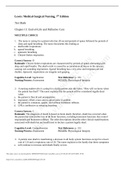
TEST BANK FOR LEWIS MEDICAL SURGICAL NURSING 11TH EDITION
Test Bank Chapter 11: End-of-Life and Palliative Care MULTIPLE CHOICE 1. The nurse is caring for a patient who has 20-second periods of apnea followed by periods of deep and rapid breathing. The nurse documents this finding as a. death-rattle respirations. b. agonal breathing. c. apneustic breathing. d. Cheyne-Stokes respiration. Correct Answer: D Rationale: Cheyne-Stokes respirations are characterized by periods of apnea alternating with deep and rapid breaths. The death rattle is caused by accumulation of mucus in the airways, causing wet-sounding respirations. Agonal breathing has a very slow and irregular rate and rhythm. Apneustic respirations are irregular and gasping. Cognitive Level: Application Text Reference: p. 152 Nursing Process: Assessment NCLEX: Physiological Integrity 2. A nursing student who is caring for a dying patient asks the nurse, “How will we know when the patient has died?” The nurse explains that the patient will be considered legally dead when a. the patient is flaccid and unresponsive. b. respiratory efforts cease and no apical pulse is audible. c. the patient is comatose, apneic, and without brainstem reflexes. d. CPR is ineffective in restoring heartbeat. Correct Answer: C Rationale: The diagnosis of death is based on brain death; therefore, death has occurred when the patient has irreversible loss of all brain functions, including brainstem functions that control respirations and brainstem reflexes. The other descriptions describe other clinical manifestations associated with death but are insufficient to declare a patient legally dead. Cognitive Level: Comprehension Text Reference: p. 153 Nursing Process: Assessment NCLEX: Physiological Integrity 3. A patient near death is manifesting a decrease in all body system functions except for a heart rate of 124 and a respiratory rate of 28. The nurse explains to the family that these symptoms a. will continue to increase until death finally occurs. This study source
Written for
Document information
- Uploaded on
- July 8, 2021
- Number of pages
- 7
- Written in
- 2020/2021
- Type
- Exam (elaborations)
- Contains
- Questions & answers
Subjects
- surgical nursing 11th
-
test bank for lewis medical

Also available in package deal