

Written by students who passed Immediately available after payment Read online or as PDF Wrong document? Swap it for free 4.6 TrustPilot
logo-home
Document preview thumbnail
Preview 3 out of 20 pages
Exam (elaborations)

DAANCE Module 5 Exam 2026/2027 | 100+ Questions & Correct Answers | Airway Emergencies, Cardiac Emergencies, Hypoxia, Dysrhythmias, Anaphylaxis & Medical Emergencies

Document preview thumbnail
Preview 3 out of 20 pages

This comprehensive DAANCE Module 5 Exam 2026/2027 study resource contains 100+ exam questions with correct answers across 20 pages, concentrating on the recognition and management of anesthesia-related and medical emergencies encountered in dental and oral surgery settings. The material begins with hypoxia, preoxygenation, airway assessment, airway obstruction, and respiratory emergencies. Students review anatomical airway evaluation involving the neck, mandible, tongue, obesity, and Mallampati classification, along with signs of obstruction and airway adjuncts such as nasopharyngeal and oropharyngeal airways, LMA, I-gel, endotracheal intubation, and emergency cricothyrotomy. A major portion covers laryngospasm, bronchospasm, aspiration, respiratory depression, apnea, and hyperventilation. The questions address clinical signs such as wheezing, labored breathing, suprasternal retraction, cyanosis, and altered capnography patterns. Management concepts presented in the document include oxygen administration, bag-mask ventilation, suction, positioning, albuterol, ipratropium, succinylcholine, naloxone, and advanced airway support. Monitoring with pulse oximetry, capnography, and a pretracheal stethoscope is also emphasized. The cardiovascular section provides extensive exam preparation on acute coronary syndrome, angina pectoris, myocardial infarction, bradycardia, supraventricular tachycardia, premature ventricular contractions, ventricular tachycardia, ventricular fibrillation, asystole, and pulseless electrical activity (PEA). Students review emergency interventions and medications identified in the source, including nitroglycerin, aspirin, morphine, atropine, adenosine, amiodarone, and epinephrine, together with CPR, synchronized cardioversion, cardiac monitoring, and emergency medical service activation. The document further examines hypertension, hypotension, syncope, and IV/venipuncture complications. Questions address elevated and reduced blood pressure, relevant symptoms, patient positioning, IV fluid support, and medications such as labetalol, esmolol, atenolol, ephedrine, and phenylephrine as presented in the source. Venipuncture complications include infiltration, hematoma, phlebitis, and accidental intra-arterial injection, with emphasis on recognizing pain, edema, swelling, redness, and other warning signs. Additional sections focus on hypoglycemia, acute adrenal insufficiency, seizures, stroke, and transient ischemic attacks (TIA). Learners review mild versus severe hypoglycemia, oral glucose, IV glucose and glucagon, cortisol-related adrenal emergencies, syncope and presyncope, seizure recognition and management, diazepam and midazolam, CVA symptoms, and the importance of documenting symptom-onset time in suspected stroke. These topics broaden the resource beyond anesthesia-specific complications to medical emergencies that may arise in a dental surgical environment. The final pages concentrate on allergic reactions, anaphylaxis, malignant hyperthermia, and hemorrhage. Students review hives, itching, angioedema, erythema, airway compromise, epinephrine, diphenhydramine (Benadryl), corticosteroids, and emergency monitoring. Malignant hyperthermia is addressed through signs such as tachycardia, muscle rigidity, increased temperature, and potentially lethal arrhythmias, with dantrolene and emergency support included in the source's treatment discussion. Hemorrhage questions address hypovolemia, shock, pressure and cauterization, and the potential consequences of uncontrolled bleeding. Overall, this DAANCE Module 5 question-and-answer bank is particularly suited to active recall and examination revision because it integrates emergency recognition, signs and symptoms, monitoring, medications, airway interventions, and emergency-response steps. The uploaded document identifies itself as DAANCE Module 5 2026/2027 – Exam Questions and Correct Answers | New Update. It does not identify a university or academic institution, so no university name has been invented for the listing. Relevant Students: DAANCE certification candidates, dental anesthesia assistant students, oral and maxillofacial surgery assistants, OMS anesthesia assistants, dental assisting students studying sedation and anesthesia, and learners reviewing airway emergencies, respiratory complications, cardiovascular emergencies, emergency medications, dysrhythmias, allergic reactions, and anesthesia-related medical emergencies. Keywords: DAANCE Module 5, DAANCE Module 5 exam 2026, DAANCE Module 5 exam 2027, DAANCE questions and answers, DAANCE practice questions, DAANCE exam preparation, DAANCE study guide, DAANCE certification, dental anesthesia assistant exam, dental anesthesia emergencies, anesthesia emergencies, airway obstruction, hypoxia, laryngospasm, bronchospasm, aspiration, respiratory depression, apnea, airway management, cricothyrotomy, acute coronary syndrome, angina pectoris, myocardial infarction, cardiac dysrhythmias, bradycardia, supraventricular tachycardia, SVT, ventricular tachycardia, ventricular fibrillation, asystole, pulseless electrical activity, PEA, hypertension, hypotension, syncope, hypoglycemia, adrenal insufficiency, seizures, stroke, TIA, anaphylaxis, allergic reactions, malignant hyperthermia, dantrolene, hemorrhage, emergency pharmacology, DAANCE Module 5 review

Content preview

Daance Module 5 2026/2027
Exam Questions and Correct
Answers | New Update


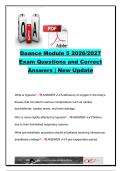
What is hypoxia? - ANSWER ✔✔A deficiency of oxygen in the body's

tissues that can lead to serious complications such as cardiac

dysrhythmias, cardiac arrest, and brain damage.


Who is more rapidly affected by hypoxia? - ANSWER ✔✔Children,

due to their diminished respiratory reserve.

What pre-anesthetic procedure should all patients receiving intravenous

anesthesia undergo? - ANSWER ✔✔A pre-oxygenation period.

,What anatomical evaluations are important for airway management? -

ANSWER ✔✔Evaluation of the neck, mandible, tongue, and body

obesity.

What is a common cause of airway obstruction during anesthesia? -

ANSWER ✔✔Posterior positioning of the tongue in the oropharynx.


What are signs of airway obstruction? - ANSWER ✔✔Choking,

gagging, suprasternal notch retraction, labored breathing, and changes

in pulse.


What is the initial treatment for airway obstruction? - ANSWER

✔✔Administer 100% oxygen via nasal mask and position the patient in a

Trendelenburg position.

What airway adjuncts can be used if the tongue obstructs the airway? -

ANSWER ✔✔Nasopharyngeal airway, oropharyngeal airway, LMA,

igel, or endotracheal intubation.


What is a cricothyrotomy? - ANSWER ✔✔A surgical procedure to

establish an airway by creating an opening through the cricothyroid

membrane.

, What should be done if a foreign body is suspected to cause airway

obstruction? - ANSWER ✔✔Digital removal if visible, chest

compressions if no airflow, or direct laryngoscopy for retrieval.


What is laryngospasm? - ANSWER ✔✔A protective reflex of the

vocal cords that can cause airway obstruction by closing partially or

completely.


What are the signs of laryngospasm? - ANSWER ✔✔Crowing

sounds, labored breathing, suprasternal retraction, and paradoxical

chest movements.


What is the first step in managing laryngospasm? - ANSWER

✔✔Administer 100% oxygen via nasal hood and establish proper head

position.

What medication can be administered to manage laryngospasm? -

ANSWER ✔✔Succinylcholine (Anectine®) to facilitate ventilation.


What is bronchospasm? - ANSWER ✔✔A contraction of the smooth

muscles of the bronchi and bronchioles, restricting airflow.


What symptoms indicate bronchospasm? - ANSWER ✔✔Wheezing,

labored breathing, and difficulty with expiration.


COPYRIGHT©NINJANERD 2025/2026. YEAR PUBLISHED 2026. COMPANY REGISTRATION NUMBER: 619652435. TERMS OF USE. PRIVACY
STATEMENT. ALL RIGHTS RESERVED
3


Document information

Uploaded on
August 19, 2026
Number of pages
20
Written in
2026/2027
Type
Exam (elaborations)
Contains
Questions & answers
$18.99

Wrong document? Swap it for free Within 14 days of purchase and before downloading, you can choose a different document. You can simply spend the amount again.
Written by students who passed
Immediately available after payment
Read online or as PDF

Seller avatar
Reputation scores are based on the amount of documents a seller has sold for a fee and the reviews they have received for those documents. There are three levels: Bronze, Silver and Gold. The better the reputation, the more your can rely on the quality of the sellers work.
NinjaNerd
3.4
(76)
Sold
401
Followers
6
Items
15442
Last sold
3 days ago


Why students choose Stuvia

Created by fellow students, verified by reviews

Quality you can trust: written by students who passed their tests and reviewed by others who've used these notes.

Didn't get what you expected? Choose another document

No worries! You can instantly pick a different document that better fits what you're looking for.

Pay as you like, start learning right away

No subscription, no commitments. Pay the way you're used to via credit card and download your PDF document instantly.

Student with book image

“Bought, downloaded, and aced it. It really can be that simple.”

Alisha Student

Working on your references?

Create accurate citations in APA, MLA and Harvard with our free citation generator.

Working on your references?

Frequently asked questions
