

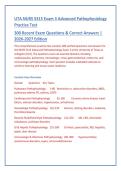
UTA NURS 5315 Exam 3 Advanced Pathophysiology
Practice Test
300 Recent Exam Questions & Correct Answers |
2026-2027 Edition
This comprehensive practice test contains 300 verified questions and answers for
the NURS 5315 Advanced Pathophysiology Exam 3 at the University of Texas at
Arlington (UTA). The questions cover all essential domains including
cardiovascular, pulmonary, hematologic, renal, gastrointestinal, endocrine, and
immunologic pathophysiology. Each question includes a detailed rationale to
reinforce learning and ensure exam readiness.
Content Area Overview
Domain Questions Key Topics
Pulmonary Pathophysiology 1-80 Restrictive vs. obstructive disorders, ARDS,
pulmonary edema, PE, asthma, COPD
Cardiovascular Pathophysiology 81-160 Coronary artery disease, heart
failure, valvular disorders, hypertension, arrhythmias
Hematologic Pathophysiology 161-210 Anemia, clotting disorders, leukemia,
thrombocytopenia
Renal & Fluid/Electrolyte Pathophysiology 211-250 AKI, CKD, electrolyte
imbalances, acid-base disorders
GI & Hepatic Pathophysiology 251-280 Cirrhosis, pancreatitis, IBD, hepatitis,
peptic ulcer disease
Immunologic & Infectious Pathophysiology 281-300 Hypersensitivity,
autoimmune disorders, sepsis, immunodeficiencies
,SECTION 1: PULMONARY PATHOPHYSIOLOGY (Questions 1-80)
Question 1: What are the two broad categories of pulmonary disease?
A) Acute and chronic
B) Restrictive and obstructive
C) Infectious and non-infectious
D) Both B and C
Correct Answer: D) Both B and C
Rationale: Pulmonary diseases are classified into two broad categories: restrictive
vs. obstructive, and infectious vs. non-infectious .
Question 2: Which of the following is characteristic of a restrictive pulmonary
disorder?
A) High lung volumes on pulmonary function tests (PFTs)
B) Inability to exhale air that has been inhaled
C) Inability to breathe air in (low lung volumes on PFTs)
D) Normal lung volumes on PFTs
Correct Answer: C) Inability to breathe air in (low lung volumes on PFTs)
Rationale: Restrictive disorders are characterized by an inability to breathe air in,
resulting in low lung volumes on pulmonary function tests. Examples include
pulmonary fibrosis, atelectasis, and pulmonary edema .
,Question 3: Which of the following is characteristic of an obstructive pulmonary
disorder?
A) Low lung volumes on PFTs
B) Inability to exhale the air that has been inhaled (high lung volumes on PFTs)
C) Inability to breathe air in
D) Normal lung volumes on PFTs
Correct Answer: B) Inability to exhale the air that has been inhaled (high lung
volumes on PFTs)
Rationale: Obstructive disorders are characterized by an inability to exhale the air
that has been inhaled, resulting in high lung volumes on pulmonary function tests.
Examples include asthma and COPD .
Question 4: What is the primary pathophysiologic mechanism of pulmonary
edema?
A) Accumulation of air in the pleural space
B) Accumulation of water in the pulmonary alveolar sacs
C) Inflammation of the bronchial airways
D) Destruction of alveolar walls
Correct Answer: B) Accumulation of water in the pulmonary alveolar sacs
, Rationale: Pulmonary edema is the accumulation of water in the pulmonary
alveolar sacs, which prevents proper gas exchange and leads to dyspnea, chest
pain, and hypoxia .
Question 5: Which condition is the most common cause of pulmonary edema?
A) Acute respiratory distress syndrome (ARDS)
B) Left-sided heart failure
C) Inhalation of toxic gases
D) Pulmonary embolism
Correct Answer: B) Left-sided heart failure
Rationale: Pulmonary edema is most commonly caused by left-sided heart failure.
When the left side of the heart fails, blood backs up into the lungs, increasing
capillary hydrostatic pressure and pushing fluid into the alveolar sacs .
Question 6: What are the clinical manifestations of pulmonary edema?
A) Dyspnea, hypoxemia, pulmonary rales, S3 heart sound, and frothy sputum
B) Wheezing, barrel chest, and prolonged expiration
C) Fever, productive cough, and crackles
D) Sudden pleuritic pain, tachypnea, and decreased breath sounds
Correct Answer: A) Dyspnea, hypoxemia, pulmonary rales, S3 heart sound, and
frothy sputum
Practice Test
300 Recent Exam Questions & Correct Answers |
2026-2027 Edition
This comprehensive practice test contains 300 verified questions and answers for
the NURS 5315 Advanced Pathophysiology Exam 3 at the University of Texas at
Arlington (UTA). The questions cover all essential domains including
cardiovascular, pulmonary, hematologic, renal, gastrointestinal, endocrine, and
immunologic pathophysiology. Each question includes a detailed rationale to
reinforce learning and ensure exam readiness.
Content Area Overview
Domain Questions Key Topics
Pulmonary Pathophysiology 1-80 Restrictive vs. obstructive disorders, ARDS,
pulmonary edema, PE, asthma, COPD
Cardiovascular Pathophysiology 81-160 Coronary artery disease, heart
failure, valvular disorders, hypertension, arrhythmias
Hematologic Pathophysiology 161-210 Anemia, clotting disorders, leukemia,
thrombocytopenia
Renal & Fluid/Electrolyte Pathophysiology 211-250 AKI, CKD, electrolyte
imbalances, acid-base disorders
GI & Hepatic Pathophysiology 251-280 Cirrhosis, pancreatitis, IBD, hepatitis,
peptic ulcer disease
Immunologic & Infectious Pathophysiology 281-300 Hypersensitivity,
autoimmune disorders, sepsis, immunodeficiencies
,SECTION 1: PULMONARY PATHOPHYSIOLOGY (Questions 1-80)
Question 1: What are the two broad categories of pulmonary disease?
A) Acute and chronic
B) Restrictive and obstructive
C) Infectious and non-infectious
D) Both B and C
Correct Answer: D) Both B and C
Rationale: Pulmonary diseases are classified into two broad categories: restrictive
vs. obstructive, and infectious vs. non-infectious .
Question 2: Which of the following is characteristic of a restrictive pulmonary
disorder?
A) High lung volumes on pulmonary function tests (PFTs)
B) Inability to exhale air that has been inhaled
C) Inability to breathe air in (low lung volumes on PFTs)
D) Normal lung volumes on PFTs
Correct Answer: C) Inability to breathe air in (low lung volumes on PFTs)
Rationale: Restrictive disorders are characterized by an inability to breathe air in,
resulting in low lung volumes on pulmonary function tests. Examples include
pulmonary fibrosis, atelectasis, and pulmonary edema .
,Question 3: Which of the following is characteristic of an obstructive pulmonary
disorder?
A) Low lung volumes on PFTs
B) Inability to exhale the air that has been inhaled (high lung volumes on PFTs)
C) Inability to breathe air in
D) Normal lung volumes on PFTs
Correct Answer: B) Inability to exhale the air that has been inhaled (high lung
volumes on PFTs)
Rationale: Obstructive disorders are characterized by an inability to exhale the air
that has been inhaled, resulting in high lung volumes on pulmonary function tests.
Examples include asthma and COPD .
Question 4: What is the primary pathophysiologic mechanism of pulmonary
edema?
A) Accumulation of air in the pleural space
B) Accumulation of water in the pulmonary alveolar sacs
C) Inflammation of the bronchial airways
D) Destruction of alveolar walls
Correct Answer: B) Accumulation of water in the pulmonary alveolar sacs
, Rationale: Pulmonary edema is the accumulation of water in the pulmonary
alveolar sacs, which prevents proper gas exchange and leads to dyspnea, chest
pain, and hypoxia .
Question 5: Which condition is the most common cause of pulmonary edema?
A) Acute respiratory distress syndrome (ARDS)
B) Left-sided heart failure
C) Inhalation of toxic gases
D) Pulmonary embolism
Correct Answer: B) Left-sided heart failure
Rationale: Pulmonary edema is most commonly caused by left-sided heart failure.
When the left side of the heart fails, blood backs up into the lungs, increasing
capillary hydrostatic pressure and pushing fluid into the alveolar sacs .
Question 6: What are the clinical manifestations of pulmonary edema?
A) Dyspnea, hypoxemia, pulmonary rales, S3 heart sound, and frothy sputum
B) Wheezing, barrel chest, and prolonged expiration
C) Fever, productive cough, and crackles
D) Sudden pleuritic pain, tachypnea, and decreased breath sounds
Correct Answer: A) Dyspnea, hypoxemia, pulmonary rales, S3 heart sound, and
frothy sputum


