

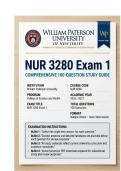
,NUR 3280 Exam 1 – Nursing Practice I –
Q&A (2026) | William Paterson
1. Which statement best reflects the Institute of Medicine definition of patient
safety?
A) Freedom from accidental injuries
B) Absence of all medication errors
C) Minimal legal liability for providers
D) Continuous staff education only
Correct Answer: A) Freedom from accidental injuries
Rationale: The Institute of Medicine defines patient safety as freedom from
accidental injuries. This definition focuses on preventing unintended harm
during healthcare delivery. It is broader than medication errors, legal concerns,
or education alone and guides safety initiatives across all care settings.
2. A nurse administers the wrong medication to a client. This action is best
classified as which type of error?
A) Diagnostic error
B) Commission error
C) Omission error
D) Execution error
Correct Answer: B) Commission error
,Rationale: A commission error occurs when the wrong action is taken, such as
administering the wrong medication. This differs from omission, which is failing
to act, and execution, which is doing the right action incorrectly. Recognizing
error categories helps target prevention strategies.
3. Which category of error occurs when a nurse fails to bathe an assigned client?
A) Commission error
B) Execution error
C) Omission error
D) Diagnostic error
Correct Answer: C) Omission error
Rationale: An omission error is the failure to do the right thing, such as
neglecting required care like bathing a client. Commission involves taking the
wrong action, and execution involves doing the right action incorrectly.
Correctly classifying errors supports root-cause analysis and safer practice.
4. An error that reaches the client and causes unintended harm is called what?
A) Near miss
B) Sentinel event
C) No-harm event
D) Adverse event
Correct Answer: D) Adverse event
, Rationale: An adverse event occurs when an error reaches the patient and
causes unintended harm. A near miss does not reach the patient, a sentinel
event causes death or catastrophic harm, and a no-harm event may reach the
patient without causing injury.
5. An error that does not result in patient harm is best documented as which
level?
A) Near miss
B) Adverse event
C) Sentinel event
D) Execution error
Correct Answer: A) Near miss
Rationale: A near miss is an error that occurred but did not result in harm, often
because it was caught before reaching the patient. Reporting near misses is
essential for identifying system weaknesses and preventing future adverse
events. It is not an adverse or sentinel event.
6. Which of the following is a treatment error?
A) Delaying a diagnostic test
B) Failure to screen for cancer
C) Administering the wrong dose of medication
D) Miscommunication during handoff
Correct Answer: C) Administering the wrong dose of medication
Q&A (2026) | William Paterson
1. Which statement best reflects the Institute of Medicine definition of patient
safety?
A) Freedom from accidental injuries
B) Absence of all medication errors
C) Minimal legal liability for providers
D) Continuous staff education only
Correct Answer: A) Freedom from accidental injuries
Rationale: The Institute of Medicine defines patient safety as freedom from
accidental injuries. This definition focuses on preventing unintended harm
during healthcare delivery. It is broader than medication errors, legal concerns,
or education alone and guides safety initiatives across all care settings.
2. A nurse administers the wrong medication to a client. This action is best
classified as which type of error?
A) Diagnostic error
B) Commission error
C) Omission error
D) Execution error
Correct Answer: B) Commission error
,Rationale: A commission error occurs when the wrong action is taken, such as
administering the wrong medication. This differs from omission, which is failing
to act, and execution, which is doing the right action incorrectly. Recognizing
error categories helps target prevention strategies.
3. Which category of error occurs when a nurse fails to bathe an assigned client?
A) Commission error
B) Execution error
C) Omission error
D) Diagnostic error
Correct Answer: C) Omission error
Rationale: An omission error is the failure to do the right thing, such as
neglecting required care like bathing a client. Commission involves taking the
wrong action, and execution involves doing the right action incorrectly.
Correctly classifying errors supports root-cause analysis and safer practice.
4. An error that reaches the client and causes unintended harm is called what?
A) Near miss
B) Sentinel event
C) No-harm event
D) Adverse event
Correct Answer: D) Adverse event
, Rationale: An adverse event occurs when an error reaches the patient and
causes unintended harm. A near miss does not reach the patient, a sentinel
event causes death or catastrophic harm, and a no-harm event may reach the
patient without causing injury.
5. An error that does not result in patient harm is best documented as which
level?
A) Near miss
B) Adverse event
C) Sentinel event
D) Execution error
Correct Answer: A) Near miss
Rationale: A near miss is an error that occurred but did not result in harm, often
because it was caught before reaching the patient. Reporting near misses is
essential for identifying system weaknesses and preventing future adverse
events. It is not an adverse or sentinel event.
6. Which of the following is a treatment error?
A) Delaying a diagnostic test
B) Failure to screen for cancer
C) Administering the wrong dose of medication
D) Miscommunication during handoff
Correct Answer: C) Administering the wrong dose of medication


