

NSG222 Exam 3 - Family Nursing | Herzing University Latest Update
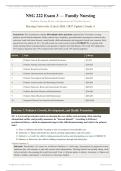
NSG 222 Exam 3 — Family Nursing
Pediatric Nursing Review with Questions and Verified Answers
Herzing University | Latest Update | Grade A
Instructions: This examination contains 100 multiple-choice questions organized into 10 sections covering
pediatric growth and development, family-centered care, respiratory, gastrointestinal, neurological, cardiovascular,
endocrine, renal, infectious diseases, mental health, child maltreatment, and integrated clinical case scenarios. Each
question has four options (A, B, C, D) with exactly one correct answer marked [CORRECT]. A rationale with
family nursing clinical reasoning follows each question. Cognitive level distribution: 25% recall, 50% application,
25% analysis. Question style: 70% scenario-based, 20% direct recall, 10% clinical judgment.
Section Topic Q Range
1 Pediatric Growth, Development, and Health Promotion Q1-Q15
2 Pediatric Nursing Assessment and Family-Centered Care Q16-Q25
3 Pediatric Respiratory Disorders Q26-Q35
4 Pediatric Gastrointestinal and Nutritional Disorders Q36-Q45
5 Pediatric Neurological and Musculoskeletal Disorders Q46-Q55
6 Pediatric Cardiovascular and Hematologic Disorders Q56-Q65
7 Pediatric Endocrine, Renal, and Genitourinary Disorders Q66-Q75
8 Pediatric Infectious Diseases and Immunizations Q76-Q85
9 Pediatric Mental Health and Child Maltreatment Q86-Q92
10 Integrated Clinical Case Scenarios and Prioritization Q93-Q100
Section 1: Pediatric Growth, Development, and Health Promotion
Q1. A 4-year-old preschooler insists on choosing his own clothes each morning, often selecting
mismatched outfits, and proudly announces he "dressed himself." According to Erikson's
psychosocial theory, which developmental stage is this child demonstrating, and what is the primary
task?
A. Trust vs. Mistrust; the child is learning to rely on caregivers for predictable care
B. Autonomy vs. Shame and Doubt; the child is asserting independence and self-control
C. Initiative vs. Guilt; the child is taking purposeful action and attempting new tasks [CORRECT]
D. Industry vs. Inferiority; the child is building competence through rule-based play
Correct Answer: C
Rationale: Preschoolers (3-6 years) are in Erikson's Initiative vs. Guilt stage, characterized by purposeful action,
ambitious play, and attempts to plan and execute tasks independently. Dressing himself and proudly taking credit
reflects initiative; discouraging this would foster guilt. Trust vs. Mistrust applies to infancy, Autonomy vs. Shame and
Doubt to toddlers, and Industry vs. Inferiority to school-age children.
100 Questions | Grade A Review Page 1 Verified Answers
,NSG222 Exam 3 - Family Nursing | Herzing University Latest Update
Q2. The mother of an 18-month-old toddler reports that her son points to a ball and says "ball" but
does not yet combine words. She is concerned he may be delayed. Which response by the nurse best
reflects normal developmental expectations?
A. "By 18 months, your child should be using 2-3 word phrases consistently; we should refer him for a speech
evaluation."
B. "Single words at 18 months are normal; most toddlers begin combining 2-3 word phrases around
age 2." [CORRECT]
C. "Your child should already be speaking in full sentences; this delay requires urgent neurology referral."
D. "Boys often don't speak until age 3; there is no need for concern at this time."
Correct Answer: B
Rationale: An 18-month-old typically uses single words and points to objects, while 2-3 word phrases emerge
around age 2. Reassuring the mother that this is normal development is appropriate and aligned with anticipatory
guidance. Referring prematurely causes unnecessary anxiety, while waiting until age 3 ignores the importance of
early identification of true speech-language delays.
Q3. A 9-month-old infant is brought to the well-child clinic. The mother asks the nurse what new
motor milestones she should expect in the coming weeks. Which milestone, when achieved at the
expected age, indicates the infant is developing typically?
A. Walks independently without support
B. Uses a pincer grasp to pick up small objects [CORRECT]
C. Climbs stairs using alternating feet
D. Rides a tricycle using pedals
Correct Answer: B
Rationale: The pincer grasp typically emerges around 9 months of age and represents a fine motor milestone critical
for self-feeding and exploration. Independent walking develops around 12 months, while climbing stairs and pedaling
a tricycle are toddler and preschool skills respectively. Achieving the pincer grasp at 9 months signals typical
neurological and motor maturation.
Q4. A nurse is teaching the parents of a 5-month-old infant about introducing solid foods. The mother
states, "I want to start with rice cereal mixed with formula in a bottle at bedtime so he sleeps longer."
Which response by the nurse is most appropriate based on current infant nutrition guidelines?
A. "Adding cereal to the bottle is fine as long as you use a fast-flow nipple to prevent clogging."
B. "Cereal should be offered by spoon starting around 6 months, and adding it to the bottle increases
choking risk and does not improve sleep." [CORRECT]
C. "Begin cereal at 4 months in the bottle, then transition to spoon feeding at 6 months."
D. "Bedtime cereal bottles are recommended to prevent night waking during growth spurts."
Correct Answer: B
Rationale: Solid foods should be introduced by spoon around 4-6 months when the infant shows developmental
readiness (head control, loss of tongue-thrust reflex). Adding cereal to a bottle is a choking hazard, does not improve
sleep, and bypasses the developmental skill of spoon feeding. Exclusive breastfeeding for the first 6 months remains
the AAP recommendation, with solids introduced around 6 months.
Q5. A nurse is providing anticipatory guidance to the parents of a 2-year-old toddler. Which nutrition
recommendation is most appropriate to prevent iron deficiency anemia while supporting healthy
growth?
A. Encourage up to 32-40 ounces of cow's milk per day to ensure adequate calcium intake
100 Questions | Grade A Review Page 2 Verified Answers
,NSG222 Exam 3 - Family Nursing | Herzing University Latest Update
B. Limit cow's milk to 24-28 ounces per day and offer iron-rich foods such as meat, beans, and
fortified cereals [CORRECT]
C. Restrict all dairy products until age 3 to prevent iron malabsorption
D. Provide only plant-based milks to avoid the constipating effects of cow's milk
Correct Answer: B
Rationale: Excessive cow's milk intake (>24-28 oz/day) can cause occult gastrointestinal blood loss and decreased
iron absorption, leading to iron deficiency anemia in toddlers. Limiting milk and offering iron-rich foods (red meat,
beans, fortified cereals) alongside vitamin C sources optimizes iron status. Total dairy restriction is unnecessary and
deprives the child of calcium and vitamin D needed for bone growth.
Q6. The parents of a 14-year-old adolescent ask the nurse about expected nutritional needs during this
developmental period. Which statement by the nurse best reflects evidence-based guidance for
adolescent nutrition?
A. "Adolescents need fewer calories than school-age children due to slower growth rates."
B. "Adequate calcium (1300 mg/day) and iron are essential, and fad diets should be discouraged due to
risks of disordered eating." [CORRECT]
C. "Protein powders and supplements are recommended to support muscle development in both sexes."
D. "Skipping breakfast is acceptable if the adolescent eats a larger lunch and dinner."
Correct Answer: B
Rationale: Adolescents experience rapid growth and require 1300 mg/day of calcium for peak bone mass accrual,
plus iron (especially for menstruating females). Fad diets are discouraged due to the risk of triggering disordered
eating patterns. Skipping breakfast impairs academic performance and metabolic regulation. Protein supplements are
generally unnecessary when intake is adequate through food.
Q7. According to Piaget's cognitive development theory, a 5-year-old child who believes the moon
follows him home because it is his "friend" is demonstrating thinking characteristic of which stage?
A. Sensorimotor stage, characterized by object permanence and sensory learning
B. Preoperational stage, characterized by egocentrism and magical thinking [CORRECT]
C. Concrete operational stage, characterized by logical thought about tangible objects
D. Formal operational stage, characterized by abstract reasoning
Correct Answer: B
Rationale: Piaget's Preoperational stage (2-7 years) is marked by egocentrism (inability to see others' perspectives)
and magical thinking (belief that thoughts or actions cause events). Attributing intent to the moon reflects this
animistic, magical worldview. The Sensorimotor stage involves infants exploring through senses, Concrete
Operational children use logic, and Formal Operational adolescents use abstract reasoning.
Q8. A nurse is preparing to administer a 12-month well-child visit for an infant who received Hep B at
birth, 1 month, and 6 months, and the full DTaP, IPV, Hib, PCV13, and RV series at 2, 4, and 6
months. According to the 2026 CDC immunization schedule, which vaccines should the infant receive
at this visit?
A. MMR, Varicella, Hib, PCV13, and Hep A (first dose) [CORRECT]
B. DTaP, IPV, MMR, Varicella, and HPV
C. Hep B booster, MMR, Tdap, and MenACWY
D. Influenza only, with all other vaccines delayed until 18 months
Correct Answer: A
100 Questions | Grade A Review Page 3 Verified Answers
, NSG222 Exam 3 - Family Nursing | Herzing University Latest Update
Rationale: At the 12-15 month visit, the CDC schedule includes MMR, Varicella, Hib (4th dose), PCV13 (4th dose),
and Hep A (first of two doses, given 6 months apart). DTaP and IPV boosters are given at 4-6 years, HPV and
MenACWY at 11-12 years, and Tdap at 11-12 years. Influenza is recommended annually starting at 6 months.
Q9. A nurse is teaching a parenting class about toilet training. Which statement by a parent indicates
the need for further teaching regarding readiness signs for toilet training?
A. "My son stays dry for at least 2 hours at a time and seems uncomfortable in soiled diapers."
B. "I will start toilet training at 18 months whether or not he shows interest, so he learns early."
[CORRECT]
C. "She can pull down her own pants and follows simple one-step directions."
D. "He shows curiosity about the bathroom and wants to watch me use the toilet."
Correct Answer: B
Rationale: Toilet training readiness typically occurs around 18-24 months and includes physiologic readiness (dry
for 2+ hours), motor skills (pulling down pants), cognitive ability (follow simple directions), and psychological
interest. Forcing training before readiness causes power struggles, constipation, and delay. Most children achieve
daytime continence by 3 years and nighttime continence variably thereafter.
Q10. A 6-month-old infant is brought in for a well-child visit. The parents ask about stranger anxiety.
Which response by the nurse best describes this developmental phenomenon?
A. "Stranger anxiety typically does not appear until 18 months of age; your infant is too young."
B. "Stranger anxiety commonly emerges around 8 months as the infant develops object permanence
and a clear attachment to primary caregivers." [CORRECT]
C. "Stranger anxiety is abnormal and suggests insecure attachment that requires evaluation."
D. "Stranger anxiety resolves by 6 months and should not be a concern going forward."
Correct Answer: B
Rationale: Stranger anxiety typically emerges around 8 months of age and is a normal developmental milestone
linked to the infant's growing ability to discriminate familiar from unfamiliar people, coinciding with object
permanence. Reassuring parents prevents mislabeling normal behavior as pathology. It typically peaks around 9-12
months and gradually resolves during the second year.
Q11. A nurse is counseling the parents of a 4-year-old preschooler about sleep requirements. The
parents report the child resists bedtime and frequently wakes during the night. Which intervention
best reflects developmentally appropriate sleep hygiene for a preschooler?
A. Allow the child to watch television until he falls asleep to reduce bedtime resistance
B. Establish a consistent bedtime routine, limit screen time before bed, and use a nightlight if fearful
[CORRECT]
C. Give the child a cup of juice before bed to satisfy nighttime hunger
D. Co-sleep with the child every night to reduce separation anxiety
Correct Answer: B
Rationale: Preschoolers need 10-13 hours of sleep per 24 hours and benefit from consistent bedtime routines that
signal the transition to sleep. Screen time before bed suppresses melatonin and impairs sleep onset, while sugary
drinks contribute to dental caries and disrupted sleep. Co-sleeping as a routine strategy does not foster independent
sleep habits and may pose safety risks for young children.
Q12. A nurse is performing a well-child examination on a 10-year-old. According to Kohlberg's theory
of moral development, which statement by the child indicates the conventional level of moral
reasoning?
100 Questions | Grade A Review Page 4 Verified Answers
NSG 222 Exam 3 — Family Nursing
Pediatric Nursing Review with Questions and Verified Answers
Herzing University | Latest Update | Grade A
Instructions: This examination contains 100 multiple-choice questions organized into 10 sections covering
pediatric growth and development, family-centered care, respiratory, gastrointestinal, neurological, cardiovascular,
endocrine, renal, infectious diseases, mental health, child maltreatment, and integrated clinical case scenarios. Each
question has four options (A, B, C, D) with exactly one correct answer marked [CORRECT]. A rationale with
family nursing clinical reasoning follows each question. Cognitive level distribution: 25% recall, 50% application,
25% analysis. Question style: 70% scenario-based, 20% direct recall, 10% clinical judgment.
Section Topic Q Range
1 Pediatric Growth, Development, and Health Promotion Q1-Q15
2 Pediatric Nursing Assessment and Family-Centered Care Q16-Q25
3 Pediatric Respiratory Disorders Q26-Q35
4 Pediatric Gastrointestinal and Nutritional Disorders Q36-Q45
5 Pediatric Neurological and Musculoskeletal Disorders Q46-Q55
6 Pediatric Cardiovascular and Hematologic Disorders Q56-Q65
7 Pediatric Endocrine, Renal, and Genitourinary Disorders Q66-Q75
8 Pediatric Infectious Diseases and Immunizations Q76-Q85
9 Pediatric Mental Health and Child Maltreatment Q86-Q92
10 Integrated Clinical Case Scenarios and Prioritization Q93-Q100
Section 1: Pediatric Growth, Development, and Health Promotion
Q1. A 4-year-old preschooler insists on choosing his own clothes each morning, often selecting
mismatched outfits, and proudly announces he "dressed himself." According to Erikson's
psychosocial theory, which developmental stage is this child demonstrating, and what is the primary
task?
A. Trust vs. Mistrust; the child is learning to rely on caregivers for predictable care
B. Autonomy vs. Shame and Doubt; the child is asserting independence and self-control
C. Initiative vs. Guilt; the child is taking purposeful action and attempting new tasks [CORRECT]
D. Industry vs. Inferiority; the child is building competence through rule-based play
Correct Answer: C
Rationale: Preschoolers (3-6 years) are in Erikson's Initiative vs. Guilt stage, characterized by purposeful action,
ambitious play, and attempts to plan and execute tasks independently. Dressing himself and proudly taking credit
reflects initiative; discouraging this would foster guilt. Trust vs. Mistrust applies to infancy, Autonomy vs. Shame and
Doubt to toddlers, and Industry vs. Inferiority to school-age children.
100 Questions | Grade A Review Page 1 Verified Answers
,NSG222 Exam 3 - Family Nursing | Herzing University Latest Update
Q2. The mother of an 18-month-old toddler reports that her son points to a ball and says "ball" but
does not yet combine words. She is concerned he may be delayed. Which response by the nurse best
reflects normal developmental expectations?
A. "By 18 months, your child should be using 2-3 word phrases consistently; we should refer him for a speech
evaluation."
B. "Single words at 18 months are normal; most toddlers begin combining 2-3 word phrases around
age 2." [CORRECT]
C. "Your child should already be speaking in full sentences; this delay requires urgent neurology referral."
D. "Boys often don't speak until age 3; there is no need for concern at this time."
Correct Answer: B
Rationale: An 18-month-old typically uses single words and points to objects, while 2-3 word phrases emerge
around age 2. Reassuring the mother that this is normal development is appropriate and aligned with anticipatory
guidance. Referring prematurely causes unnecessary anxiety, while waiting until age 3 ignores the importance of
early identification of true speech-language delays.
Q3. A 9-month-old infant is brought to the well-child clinic. The mother asks the nurse what new
motor milestones she should expect in the coming weeks. Which milestone, when achieved at the
expected age, indicates the infant is developing typically?
A. Walks independently without support
B. Uses a pincer grasp to pick up small objects [CORRECT]
C. Climbs stairs using alternating feet
D. Rides a tricycle using pedals
Correct Answer: B
Rationale: The pincer grasp typically emerges around 9 months of age and represents a fine motor milestone critical
for self-feeding and exploration. Independent walking develops around 12 months, while climbing stairs and pedaling
a tricycle are toddler and preschool skills respectively. Achieving the pincer grasp at 9 months signals typical
neurological and motor maturation.
Q4. A nurse is teaching the parents of a 5-month-old infant about introducing solid foods. The mother
states, "I want to start with rice cereal mixed with formula in a bottle at bedtime so he sleeps longer."
Which response by the nurse is most appropriate based on current infant nutrition guidelines?
A. "Adding cereal to the bottle is fine as long as you use a fast-flow nipple to prevent clogging."
B. "Cereal should be offered by spoon starting around 6 months, and adding it to the bottle increases
choking risk and does not improve sleep." [CORRECT]
C. "Begin cereal at 4 months in the bottle, then transition to spoon feeding at 6 months."
D. "Bedtime cereal bottles are recommended to prevent night waking during growth spurts."
Correct Answer: B
Rationale: Solid foods should be introduced by spoon around 4-6 months when the infant shows developmental
readiness (head control, loss of tongue-thrust reflex). Adding cereal to a bottle is a choking hazard, does not improve
sleep, and bypasses the developmental skill of spoon feeding. Exclusive breastfeeding for the first 6 months remains
the AAP recommendation, with solids introduced around 6 months.
Q5. A nurse is providing anticipatory guidance to the parents of a 2-year-old toddler. Which nutrition
recommendation is most appropriate to prevent iron deficiency anemia while supporting healthy
growth?
A. Encourage up to 32-40 ounces of cow's milk per day to ensure adequate calcium intake
100 Questions | Grade A Review Page 2 Verified Answers
,NSG222 Exam 3 - Family Nursing | Herzing University Latest Update
B. Limit cow's milk to 24-28 ounces per day and offer iron-rich foods such as meat, beans, and
fortified cereals [CORRECT]
C. Restrict all dairy products until age 3 to prevent iron malabsorption
D. Provide only plant-based milks to avoid the constipating effects of cow's milk
Correct Answer: B
Rationale: Excessive cow's milk intake (>24-28 oz/day) can cause occult gastrointestinal blood loss and decreased
iron absorption, leading to iron deficiency anemia in toddlers. Limiting milk and offering iron-rich foods (red meat,
beans, fortified cereals) alongside vitamin C sources optimizes iron status. Total dairy restriction is unnecessary and
deprives the child of calcium and vitamin D needed for bone growth.
Q6. The parents of a 14-year-old adolescent ask the nurse about expected nutritional needs during this
developmental period. Which statement by the nurse best reflects evidence-based guidance for
adolescent nutrition?
A. "Adolescents need fewer calories than school-age children due to slower growth rates."
B. "Adequate calcium (1300 mg/day) and iron are essential, and fad diets should be discouraged due to
risks of disordered eating." [CORRECT]
C. "Protein powders and supplements are recommended to support muscle development in both sexes."
D. "Skipping breakfast is acceptable if the adolescent eats a larger lunch and dinner."
Correct Answer: B
Rationale: Adolescents experience rapid growth and require 1300 mg/day of calcium for peak bone mass accrual,
plus iron (especially for menstruating females). Fad diets are discouraged due to the risk of triggering disordered
eating patterns. Skipping breakfast impairs academic performance and metabolic regulation. Protein supplements are
generally unnecessary when intake is adequate through food.
Q7. According to Piaget's cognitive development theory, a 5-year-old child who believes the moon
follows him home because it is his "friend" is demonstrating thinking characteristic of which stage?
A. Sensorimotor stage, characterized by object permanence and sensory learning
B. Preoperational stage, characterized by egocentrism and magical thinking [CORRECT]
C. Concrete operational stage, characterized by logical thought about tangible objects
D. Formal operational stage, characterized by abstract reasoning
Correct Answer: B
Rationale: Piaget's Preoperational stage (2-7 years) is marked by egocentrism (inability to see others' perspectives)
and magical thinking (belief that thoughts or actions cause events). Attributing intent to the moon reflects this
animistic, magical worldview. The Sensorimotor stage involves infants exploring through senses, Concrete
Operational children use logic, and Formal Operational adolescents use abstract reasoning.
Q8. A nurse is preparing to administer a 12-month well-child visit for an infant who received Hep B at
birth, 1 month, and 6 months, and the full DTaP, IPV, Hib, PCV13, and RV series at 2, 4, and 6
months. According to the 2026 CDC immunization schedule, which vaccines should the infant receive
at this visit?
A. MMR, Varicella, Hib, PCV13, and Hep A (first dose) [CORRECT]
B. DTaP, IPV, MMR, Varicella, and HPV
C. Hep B booster, MMR, Tdap, and MenACWY
D. Influenza only, with all other vaccines delayed until 18 months
Correct Answer: A
100 Questions | Grade A Review Page 3 Verified Answers
, NSG222 Exam 3 - Family Nursing | Herzing University Latest Update
Rationale: At the 12-15 month visit, the CDC schedule includes MMR, Varicella, Hib (4th dose), PCV13 (4th dose),
and Hep A (first of two doses, given 6 months apart). DTaP and IPV boosters are given at 4-6 years, HPV and
MenACWY at 11-12 years, and Tdap at 11-12 years. Influenza is recommended annually starting at 6 months.
Q9. A nurse is teaching a parenting class about toilet training. Which statement by a parent indicates
the need for further teaching regarding readiness signs for toilet training?
A. "My son stays dry for at least 2 hours at a time and seems uncomfortable in soiled diapers."
B. "I will start toilet training at 18 months whether or not he shows interest, so he learns early."
[CORRECT]
C. "She can pull down her own pants and follows simple one-step directions."
D. "He shows curiosity about the bathroom and wants to watch me use the toilet."
Correct Answer: B
Rationale: Toilet training readiness typically occurs around 18-24 months and includes physiologic readiness (dry
for 2+ hours), motor skills (pulling down pants), cognitive ability (follow simple directions), and psychological
interest. Forcing training before readiness causes power struggles, constipation, and delay. Most children achieve
daytime continence by 3 years and nighttime continence variably thereafter.
Q10. A 6-month-old infant is brought in for a well-child visit. The parents ask about stranger anxiety.
Which response by the nurse best describes this developmental phenomenon?
A. "Stranger anxiety typically does not appear until 18 months of age; your infant is too young."
B. "Stranger anxiety commonly emerges around 8 months as the infant develops object permanence
and a clear attachment to primary caregivers." [CORRECT]
C. "Stranger anxiety is abnormal and suggests insecure attachment that requires evaluation."
D. "Stranger anxiety resolves by 6 months and should not be a concern going forward."
Correct Answer: B
Rationale: Stranger anxiety typically emerges around 8 months of age and is a normal developmental milestone
linked to the infant's growing ability to discriminate familiar from unfamiliar people, coinciding with object
permanence. Reassuring parents prevents mislabeling normal behavior as pathology. It typically peaks around 9-12
months and gradually resolves during the second year.
Q11. A nurse is counseling the parents of a 4-year-old preschooler about sleep requirements. The
parents report the child resists bedtime and frequently wakes during the night. Which intervention
best reflects developmentally appropriate sleep hygiene for a preschooler?
A. Allow the child to watch television until he falls asleep to reduce bedtime resistance
B. Establish a consistent bedtime routine, limit screen time before bed, and use a nightlight if fearful
[CORRECT]
C. Give the child a cup of juice before bed to satisfy nighttime hunger
D. Co-sleep with the child every night to reduce separation anxiety
Correct Answer: B
Rationale: Preschoolers need 10-13 hours of sleep per 24 hours and benefit from consistent bedtime routines that
signal the transition to sleep. Screen time before bed suppresses melatonin and impairs sleep onset, while sugary
drinks contribute to dental caries and disrupted sleep. Co-sleeping as a routine strategy does not foster independent
sleep habits and may pose safety risks for young children.
Q12. A nurse is performing a well-child examination on a 10-year-old. According to Kohlberg's theory
of moral development, which statement by the child indicates the conventional level of moral
reasoning?
100 Questions | Grade A Review Page 4 Verified Answers


