

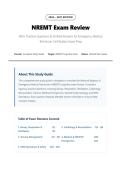
2026 – 2027 EDITION
NREMT Exam Review
600+ Practice Questions & Verified Answers for Emergency Medical
Technician Certification Exam Prep
Format: Complete Study Guide Target: NREMT Cognitive Exam Status: Verified Pass Guide
About This Study Guide
This comprehensive study guide is designed to simulate the National Registry of
Emergency Medical Technicians (NREMT) cognitive exam format. It contains
rigorous practice questions covering Airway, Respiration, Ventilation, Cardiology,
Resuscitation, Trauma, Medical Emergencies, Obstetrics/Gynecology, and EMS
Operations. Each question features detailed answer rationales to ensure deep
concept mastery.
Table of Exam Domains Covered
1. Airway, Respiration & Q1 - 2. Cardiology & Resuscitation Q4 - Q6
Ventilation Q3
3. Trauma Management Q7 - Q9 4. Medical & OB/GYN Q10 -
Emergencies Q12
5. EMS Operations & Safety Q13 - Q15
,Domain 1: Airway, Respiration & Ventilation Questions 1–3
Question 1 An unresponsive 45-year-old male is found lying supine on
the floor. You observe snoring respirations at a rate of 8
breaths/min. What is your immediate priority intervention?
A. Begin chest compressions at a rate of 100-120 per minute.
B. Perform a head-tilt, chin-lift maneuver to open the airway.
C. Apply high-flow oxygen via a non-rebreather mask at 15 L/min.
D. Insert a nasopharyngeal airway without positioning the head.
Correct Answer: Perform a head-tilt, chin-lift maneuver to open the
B airway.
Rationale: Snoring respirations typically indicate a partial upper airway
obstruction caused by the tongue falling back against the posterior pharynx in
an unresponsive patient. The immediate first step is to open the airway manually
using the head-tilt, chin-lift maneuver (or jaw-thrust if trauma is suspected).
Oxygenation and adjunct placement follow once the basic airway position is
established.
, Question 2 Which of the following signs most reliably indicates that a
patient receiving bag-valve-mask (BVM) ventilations is
receiving adequate artificial ventilation?
A. The pop-off valve on the BVM engages with each squeeze.
B. Visible and equal chest rise and fall with each ventilation.
C. Stomach expansion noted during ventilation.
D. The reservoir bag remains fully inflated at all times.
Correct Answer: Visible and equal chest rise and fall with each
B ventilation.
Rationale: The primary objective indicator of adequate ventilation is observing
clear, gentle, visible chest rise and fall with each breath delivered over 1 second.
Gastric distension (stomach expansion) indicates excessive volume or improper
mask seal/airway positioning.
NREMT Exam Review
600+ Practice Questions & Verified Answers for Emergency Medical
Technician Certification Exam Prep
Format: Complete Study Guide Target: NREMT Cognitive Exam Status: Verified Pass Guide
About This Study Guide
This comprehensive study guide is designed to simulate the National Registry of
Emergency Medical Technicians (NREMT) cognitive exam format. It contains
rigorous practice questions covering Airway, Respiration, Ventilation, Cardiology,
Resuscitation, Trauma, Medical Emergencies, Obstetrics/Gynecology, and EMS
Operations. Each question features detailed answer rationales to ensure deep
concept mastery.
Table of Exam Domains Covered
1. Airway, Respiration & Q1 - 2. Cardiology & Resuscitation Q4 - Q6
Ventilation Q3
3. Trauma Management Q7 - Q9 4. Medical & OB/GYN Q10 -
Emergencies Q12
5. EMS Operations & Safety Q13 - Q15
,Domain 1: Airway, Respiration & Ventilation Questions 1–3
Question 1 An unresponsive 45-year-old male is found lying supine on
the floor. You observe snoring respirations at a rate of 8
breaths/min. What is your immediate priority intervention?
A. Begin chest compressions at a rate of 100-120 per minute.
B. Perform a head-tilt, chin-lift maneuver to open the airway.
C. Apply high-flow oxygen via a non-rebreather mask at 15 L/min.
D. Insert a nasopharyngeal airway without positioning the head.
Correct Answer: Perform a head-tilt, chin-lift maneuver to open the
B airway.
Rationale: Snoring respirations typically indicate a partial upper airway
obstruction caused by the tongue falling back against the posterior pharynx in
an unresponsive patient. The immediate first step is to open the airway manually
using the head-tilt, chin-lift maneuver (or jaw-thrust if trauma is suspected).
Oxygenation and adjunct placement follow once the basic airway position is
established.
, Question 2 Which of the following signs most reliably indicates that a
patient receiving bag-valve-mask (BVM) ventilations is
receiving adequate artificial ventilation?
A. The pop-off valve on the BVM engages with each squeeze.
B. Visible and equal chest rise and fall with each ventilation.
C. Stomach expansion noted during ventilation.
D. The reservoir bag remains fully inflated at all times.
Correct Answer: Visible and equal chest rise and fall with each
B ventilation.
Rationale: The primary objective indicator of adequate ventilation is observing
clear, gentle, visible chest rise and fall with each breath delivered over 1 second.
Gastric distension (stomach expansion) indicates excessive volume or improper
mask seal/airway positioning.


