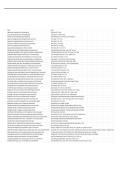
Question Answer
Weight Conversion: A patient weighs 176 lbs. Convert this weight to kg. 80 kg (Formula: .2 = 80 kg)
Ounces to Grams: A newborn weighs 112 oz. What is this weight in grams? 3,175.2 g (Formula: 112 * 28.35 g = 3,175.2 g)
Metric Shift: Convert 0.05 grams to milligrams (mg) and micrograms (mcg). 50 mg and 50,000 mcg (0.05 g * 1,000 = 50 mg; 50 mg * 1,000 = 50,000 mcg)
Teaspoons to mL: Discharge orders say to take 1.5 teaspoons of syrup. How many mL is this? 7.5 mL (Formula: 1.5 * 5 mL = 7.5 mL)
Tablespoons to mL: A patient takes 2 tablespoons of an antacid. How many mL is this? 30 mL (Formula: 2 * 15 mL = 30 mL)
Fluid Ounces to mL: A patient drinks a 12 oz can of soda. How many mL did they consume? 360 mL (Formula: 12 * 30 mL = 360 mL)
Liters to mL: An IV bag contains 0.45 Liters of fluid. How many mL is this? 450 mL (Formula: 0.45 * 1,000 = 450 mL)
Celsius to Fahrenheit: A patient's temperature is 38°C. What is this in Fahrenheit? 100.4°F (Formula: (38°C * 1.8) + 32 = 100.4°F)
Whole Tablets: Ordered: Lasix 40 mg PO. Available: 20 mg tablets. How many tablets do you give? 2 tablets (Formula: [Desired / Have] * Quantity -> [40 mg / 20 mg] * 1 tab = 2 tabs)
Fractional Tablets: Ordered: Metoprolol 12.5 mg PO. Available: 25 mg scored tablets. How many tablets do you give? 0.5 (half) tablet (Formula: [Desired / Have] * Quantity -> [12.5 mg / 25 mg] * 1 tab = 0.5 tabs)
Oral Liquid Volume: Ordered: Tylenol 650 mg PO. Available: 160 mg / 5 mL. How many mL do you give? 20.3 mL (Formula: [650 mg / 160 mg] * 5 mL = 20.31 mL -> rounded to 20.3 mL)
Liquid Small Volumes: Ordered: Digoxin elixir 0.125 mg PO. Available: 0.05 mg / mL. How many mL do you give? 2.5 mL (Formula: [0.125 mg / 0.05 mg] * 1 mL = 2.5 mL)
Unit Matching (g): Ordered: Potassium Chloride 1 g PO. Available: 500 mg tablets. How many tablets do you give? 2 tablets (Conversion: 1 g = 1,000 mg. Formula: 1,000 mg / 500 mg = 2 tablets)
Unit Matching (mcg): Ordered: Levothyroxine 0.088 mg PO. Available: 44 mcg tablets. How many tablets do you give? 2 tablets (Conversion: 0.088 mg = 88 mcg. Formula: 88 mcg / 44 mcg = 2 tablets)
Daily Tablet Caps: Max dose is 4 g/day. Ordered: 1,000 mg tablets every 6 hours. Does this exceed the cap? No. 1,000 mg every 6 hours = 4 doses per day. 4 * 1,000 mg = 4,000 mg (exactly 4 g/day).
Suspension Mix: Label: 'Add 90 mL water to yield 250 mg / 5 mL.' If ordered 500 mg, how many mL do you give? 10 mL (Formula: [500 mg / 250 mg] * 5 mL = 10 mL)
IM Liquid Volume: Ordered: Demerol 35 mg IM. Available: 50 mg / mL. How many mL do you draw up? 0.7 mL (Formula: [35 mg / 50 mg] * 1 mL = 0.7 mL)
SubQ Heparin: Ordered: Heparin 7,500 units SubQ. Available: 10,000 units / mL. How many mL do you draw up? 0.75 mL (Formula: 7,500 units / 10,000 units/mL = 0.75 mL)
High-Concentration IM: Ordered: Penicillin G Benzathine 1.2 million units IM. Available: 600,000 units/mL. Give how many mL? 2 mL (Formula: 1,200,000 units / 600,000 units/mL = 2 mL)
Pre-filled Syringes: Ordered: Lovenox 30 mg SubQ. Available: 40 mg / 0.4 mL pre-filled syringe. Administer how many mL? 0.3 mL (Formula: [30 mg / 40 mg] * 0.4 mL = 0.3 mL)
Powder Reconstitution: Add 2.5 mL diluent to yield 500 mg / mL. Ordered: 250 mg IM. How many mL do you draw up? 0.5 mL (Formula: 250 mg / 500 mg/mL = 0.5 mL)
Multi-Dose Vials: Ordered: Phenobarbital 60 mg IM. Multi-dose vial contains 130 mg / mL. How many mL do you give? 0.46 mL (Formula: 60 mg / 130 mg/mL = 0.461 mL -> rounded to 0.46 mL)
Insulin U-100 Rule: Ordered: 14 units of NPH insulin. How many mL do you draw up in a U-100 insulin syringe? Zero calculation required. Draw directly to the 14-unit marker on a standard U-100 syringe.
Insulin U-500 Volume: Ordered: 50 units of U-500 insulin. Available: U-500 vial (500 units / mL). How many mL is this? 0.1 mL (Formula: 50 units / 500 units/mL = 0.1 mL)
Hourly Pump Rates: Infuse 1 Liter of Normal Saline over 10 hours. Set the pump to how many mL/hr? 100 mL/h (Formula: 1,000 mL / 10 hr = 100 mL/h)
Short IV PB Rates: Infuse 50 mL IVPB antibiotic over 15 minutes. Set the pump to how many mL/h? 200 mL/h (Formula: 15 min = 0.25 hr. 50 mL / 0.25 hr = 200 mL/h)
Fluid Bag Run Time: An IV of 1,000 mL is running at 150 mL/h. How long will the bag last in hours/minutes? 6 hours and 40 minutes (1,000 mL / 150 mL/h = 6.66 hours. 0.66 hours * 60 min = 40 minutes)
Macrodrip Rate (10): Infuse 1,000 mL over 8 hours. Drop factor is 10 gtt/mL. Find the gtt/min rate. 21 gtt/min (Formula: [1,000 mL * 10 gtt/mL] / 480 min = 20.83 -> rounded to 21 gtt/min)
Macrodrip Rate (15): Infuse 250 mL over 2 hours. Drop factor is 15 gtt/mL. Find the gtt/min rate. 31 gtt/min (Formula: [250 mL * 15 gtt/mL] / 120 min = 31.25 -> rounded to 31 gtt/min)
Microdrip Short-cut: Infuse 100 mL over 1 hour. Drop factor is 60 gtt/mL. Find the gtt/min rate. 100 gtt/min (Shortcut: In a standard microdrip setup of 60 gtt/mL, the gtt/min rate is identical to the mL/h rate)
Remaining Volume: 1,000 mL bag started at 0800 running at 125 mL/h. How much remains at 1200? 500 mL (Elapsed time: 4 hours. 4 hr * 125 mL/h = 500 mL infused. 1,000 mL - 500 mL = 500 mL remaining)
Discontinuing Fluids: IV running at 80 mL/hr is stopped after 3.5 hours. How much fluid entered the patient? 280 mL (Formula: 80 mL/h * 3.5 hr = 280 mL)
Weight-Based Daily: Child weighs 12 kg. Order: 15 mg/kg/day. What is the total daily dose? 180 mg/day (Formula: 12 kg * 15 mg/kg/day = 180 mg/day)
Divided Doses: Infant weighs 8 kg. Order: 30 mg/kg/day divided every 8 hours. How much is one dose? 80 mg per dose (Total: 8 kg * 30 mg/kg/day = 240 mg/day. Divided into 3 doses: 240 mg / 3 = 80 mg)
Safe Range Min: Safe range: 20 - 40 mg/kg/day. A 25 kg child gets 400 mg/day. Is this safe? No. Minimum safe dose is 500 mg/day (25 kg * 20 mg). The ordered 400 mg/day is below the safe threshold.
Safe Range Max: Safe range: 10-15 mg/kg/day. A 10 kg child gets 200 mg/day. Is this safe? No. Maximum safe dose is 150 mg/day (10 kg * 15 mg). The ordered 200 mg/day exceeds the safe threshold.
Pediatric Fluid Bolus: Order: 20 mL/kg fluid bolus over 1 hour. Child weighs 14 kg. How many mL do you program? 280 mL (Formula: 20 mL/kg * 14 kg = 280 mL)
Maintenance (0-10 kg): Infant weighs 7 kg. What is their hourly maintenance fluid rate using the 100 mL/kg/day rule? 29.2 mL/h (Total daily: 7 kg * 100 mL = 700 mL/day. Hourly rate: 700 mL / 24 hr = 29.16 -> rounded to 29.2 mL/h)
Maintenance (11-20kg): Child weighs 15 kg. Calculate daily maintenance volume (1,000 mL for first 10 kg + 50 mL/kg for next 5 kg). 1,250 mL/day (Formula: 1,000 mL for the first 10 kg + [5 kg * 50 mL/kg] = 1,250 mL/day)
Injection Safety Caps: Max safe IM volume for an infant is 1 mL. Calculated dose is 1.4 mL. What action is required? Split the volume equally and administer it across two separate injection sites to maintain safety limits.
Heparin Bolus: Order: 60 units/kg bolus. Patient weighs 90 kg. What is the bolus dose? 5,400 units (Formula: 60 units/kg * 90 kg = 5,400 units)
Heparin Infusion Rate: Order: 12 units/kg/h. Patient: 75 kg. Concentration: 25k units / 500 mL. Find pump rate. 18 mL/h (Step 1: 75 kg * 12 units/kg/h = 900 units/h. Step 2: [900 units/h / 25,000 units] * 500 mL = 18 mL/h)
Critical Care mg/hr: Order: Aminophylline 25 mg/h. Concentration: 500 mg / 500 mL D5W. Find the mL/hr pump rate? 25 mL/hr (Formula: [25 mg/h / 500 mg] * 500 mL = 25 mL/h)
Titration mcg/min: Order: Nitroglycerin 20 mcg/min. Concentration: 50 mg / 250 mL. Find the mL/h rate. 6 mL/h (Step 1: 20 mcg/min * 60 min = 1,200 mcg/h. Step 2: 1,200 mcg / 1,000 = 1.2 mg/h. Step 3: [1.2 mg / 50 mg] * 250 mL = 6 mL/h)
Weight Titration: Order: Dopamine 10 mcg/kg/min. Patient: 70 kg. Concentration: 400 mg / 250 mL. Find mL/hr. Round to the nearest tenth. 26.3 mL/h (Step 1: 70 kg * 10 mcg = 700 mcg/min. Step 2: 700 mcg * 60 min = 42,000 mcg/h. Step 3: 42,000 mcg / 1,000 = 42 mg/h. Step 4: [42 mg / 400 mg] * 250 mL = 26.25 mL/h -> rounded to 26.3 mL/h)
Reverse Pump mcg/min: Pump is set to 15 mL/h. Concentration: Lidocaine 2 g / 500 mL. How many mcg/min is running? 1,000 mcg/min (Step 1: [2 g / 500 mL] * 15 mL/h = 0.06 g/h. Step 2: 0.06 g * 1,000,000 = 60,000 mcg/h. Step 3: 60,000 mcg / 60 min = 1,000 mcg/min)
Reverse mcg/kg/min: Pump running at 12 mL/h. Bag: Dobutamine 500 mg / 250 mL. Patient: 80 kg. Find mcg/kg/min. 5 mcg/kg/min (Step 1: [12 mL/h / 250 mL] * 500 mg = 24 mg/h. Step 2: [24 mg * 1,000] / 60 min = 400 mcg/min. Step 3: 400 mcg/min / 80 kg = 5 mcg/kg/min)
Percent Solutions: How many grams of sodium chloride are in a 1,000 mL bag of 0.9% Normal Saline? 9 grams (0.9% concentration means 0.9 g per 100 mL. Therefore: [0.9 g / 100 mL] * 1,000 mL = 9 g)
IV Potassium Caps: Max peripheral IV rate is 10 mEq/h. Bag contains 40 mEq / 500 mL. Do not exceed what mL/h? 125 mL/h (Formula using dimensional analysis: 10 mEq/h * [500 mL / 40 mEq] = 125 mL/h)
Shift I/O Balance: Intake: 4 oz juice, 500 mL IV, 50 mL IVPB. Output: 400 mL urine. Net shift balance? +270 mL (Total Intake: [4 oz * 30 mL = 120 mL] + 500 mL + 50 mL = 670 mL. Net balance: 670 mL intake - 400 mL output = +270 mL)
Weight Conversion: A patient weighs 176 lbs. Convert this weight to kg. 80 kg (Formula: .2 = 80 kg)
Ounces to Grams: A newborn weighs 112 oz. What is this weight in grams? 3,175.2 g (Formula: 112 * 28.35 g = 3,175.2 g)
Metric Shift: Convert 0.05 grams to milligrams (mg) and micrograms (mcg). 50 mg and 50,000 mcg (0.05 g * 1,000 = 50 mg; 50 mg * 1,000 = 50,000 mcg)
Teaspoons to mL: Discharge orders say to take 1.5 teaspoons of syrup. How many mL is this? 7.5 mL (Formula: 1.5 * 5 mL = 7.5 mL)
Tablespoons to mL: A patient takes 2 tablespoons of an antacid. How many mL is this? 30 mL (Formula: 2 * 15 mL = 30 mL)
Fluid Ounces to mL: A patient drinks a 12 oz can of soda. How many mL did they consume? 360 mL (Formula: 12 * 30 mL = 360 mL)
Liters to mL: An IV bag contains 0.45 Liters of fluid. How many mL is this? 450 mL (Formula: 0.45 * 1,000 = 450 mL)
Celsius to Fahrenheit: A patient's temperature is 38°C. What is this in Fahrenheit? 100.4°F (Formula: (38°C * 1.8) + 32 = 100.4°F)
Whole Tablets: Ordered: Lasix 40 mg PO. Available: 20 mg tablets. How many tablets do you give? 2 tablets (Formula: [Desired / Have] * Quantity -> [40 mg / 20 mg] * 1 tab = 2 tabs)
Fractional Tablets: Ordered: Metoprolol 12.5 mg PO. Available: 25 mg scored tablets. How many tablets do you give? 0.5 (half) tablet (Formula: [Desired / Have] * Quantity -> [12.5 mg / 25 mg] * 1 tab = 0.5 tabs)
Oral Liquid Volume: Ordered: Tylenol 650 mg PO. Available: 160 mg / 5 mL. How many mL do you give? 20.3 mL (Formula: [650 mg / 160 mg] * 5 mL = 20.31 mL -> rounded to 20.3 mL)
Liquid Small Volumes: Ordered: Digoxin elixir 0.125 mg PO. Available: 0.05 mg / mL. How many mL do you give? 2.5 mL (Formula: [0.125 mg / 0.05 mg] * 1 mL = 2.5 mL)
Unit Matching (g): Ordered: Potassium Chloride 1 g PO. Available: 500 mg tablets. How many tablets do you give? 2 tablets (Conversion: 1 g = 1,000 mg. Formula: 1,000 mg / 500 mg = 2 tablets)
Unit Matching (mcg): Ordered: Levothyroxine 0.088 mg PO. Available: 44 mcg tablets. How many tablets do you give? 2 tablets (Conversion: 0.088 mg = 88 mcg. Formula: 88 mcg / 44 mcg = 2 tablets)
Daily Tablet Caps: Max dose is 4 g/day. Ordered: 1,000 mg tablets every 6 hours. Does this exceed the cap? No. 1,000 mg every 6 hours = 4 doses per day. 4 * 1,000 mg = 4,000 mg (exactly 4 g/day).
Suspension Mix: Label: 'Add 90 mL water to yield 250 mg / 5 mL.' If ordered 500 mg, how many mL do you give? 10 mL (Formula: [500 mg / 250 mg] * 5 mL = 10 mL)
IM Liquid Volume: Ordered: Demerol 35 mg IM. Available: 50 mg / mL. How many mL do you draw up? 0.7 mL (Formula: [35 mg / 50 mg] * 1 mL = 0.7 mL)
SubQ Heparin: Ordered: Heparin 7,500 units SubQ. Available: 10,000 units / mL. How many mL do you draw up? 0.75 mL (Formula: 7,500 units / 10,000 units/mL = 0.75 mL)
High-Concentration IM: Ordered: Penicillin G Benzathine 1.2 million units IM. Available: 600,000 units/mL. Give how many mL? 2 mL (Formula: 1,200,000 units / 600,000 units/mL = 2 mL)
Pre-filled Syringes: Ordered: Lovenox 30 mg SubQ. Available: 40 mg / 0.4 mL pre-filled syringe. Administer how many mL? 0.3 mL (Formula: [30 mg / 40 mg] * 0.4 mL = 0.3 mL)
Powder Reconstitution: Add 2.5 mL diluent to yield 500 mg / mL. Ordered: 250 mg IM. How many mL do you draw up? 0.5 mL (Formula: 250 mg / 500 mg/mL = 0.5 mL)
Multi-Dose Vials: Ordered: Phenobarbital 60 mg IM. Multi-dose vial contains 130 mg / mL. How many mL do you give? 0.46 mL (Formula: 60 mg / 130 mg/mL = 0.461 mL -> rounded to 0.46 mL)
Insulin U-100 Rule: Ordered: 14 units of NPH insulin. How many mL do you draw up in a U-100 insulin syringe? Zero calculation required. Draw directly to the 14-unit marker on a standard U-100 syringe.
Insulin U-500 Volume: Ordered: 50 units of U-500 insulin. Available: U-500 vial (500 units / mL). How many mL is this? 0.1 mL (Formula: 50 units / 500 units/mL = 0.1 mL)
Hourly Pump Rates: Infuse 1 Liter of Normal Saline over 10 hours. Set the pump to how many mL/hr? 100 mL/h (Formula: 1,000 mL / 10 hr = 100 mL/h)
Short IV PB Rates: Infuse 50 mL IVPB antibiotic over 15 minutes. Set the pump to how many mL/h? 200 mL/h (Formula: 15 min = 0.25 hr. 50 mL / 0.25 hr = 200 mL/h)
Fluid Bag Run Time: An IV of 1,000 mL is running at 150 mL/h. How long will the bag last in hours/minutes? 6 hours and 40 minutes (1,000 mL / 150 mL/h = 6.66 hours. 0.66 hours * 60 min = 40 minutes)
Macrodrip Rate (10): Infuse 1,000 mL over 8 hours. Drop factor is 10 gtt/mL. Find the gtt/min rate. 21 gtt/min (Formula: [1,000 mL * 10 gtt/mL] / 480 min = 20.83 -> rounded to 21 gtt/min)
Macrodrip Rate (15): Infuse 250 mL over 2 hours. Drop factor is 15 gtt/mL. Find the gtt/min rate. 31 gtt/min (Formula: [250 mL * 15 gtt/mL] / 120 min = 31.25 -> rounded to 31 gtt/min)
Microdrip Short-cut: Infuse 100 mL over 1 hour. Drop factor is 60 gtt/mL. Find the gtt/min rate. 100 gtt/min (Shortcut: In a standard microdrip setup of 60 gtt/mL, the gtt/min rate is identical to the mL/h rate)
Remaining Volume: 1,000 mL bag started at 0800 running at 125 mL/h. How much remains at 1200? 500 mL (Elapsed time: 4 hours. 4 hr * 125 mL/h = 500 mL infused. 1,000 mL - 500 mL = 500 mL remaining)
Discontinuing Fluids: IV running at 80 mL/hr is stopped after 3.5 hours. How much fluid entered the patient? 280 mL (Formula: 80 mL/h * 3.5 hr = 280 mL)
Weight-Based Daily: Child weighs 12 kg. Order: 15 mg/kg/day. What is the total daily dose? 180 mg/day (Formula: 12 kg * 15 mg/kg/day = 180 mg/day)
Divided Doses: Infant weighs 8 kg. Order: 30 mg/kg/day divided every 8 hours. How much is one dose? 80 mg per dose (Total: 8 kg * 30 mg/kg/day = 240 mg/day. Divided into 3 doses: 240 mg / 3 = 80 mg)
Safe Range Min: Safe range: 20 - 40 mg/kg/day. A 25 kg child gets 400 mg/day. Is this safe? No. Minimum safe dose is 500 mg/day (25 kg * 20 mg). The ordered 400 mg/day is below the safe threshold.
Safe Range Max: Safe range: 10-15 mg/kg/day. A 10 kg child gets 200 mg/day. Is this safe? No. Maximum safe dose is 150 mg/day (10 kg * 15 mg). The ordered 200 mg/day exceeds the safe threshold.
Pediatric Fluid Bolus: Order: 20 mL/kg fluid bolus over 1 hour. Child weighs 14 kg. How many mL do you program? 280 mL (Formula: 20 mL/kg * 14 kg = 280 mL)
Maintenance (0-10 kg): Infant weighs 7 kg. What is their hourly maintenance fluid rate using the 100 mL/kg/day rule? 29.2 mL/h (Total daily: 7 kg * 100 mL = 700 mL/day. Hourly rate: 700 mL / 24 hr = 29.16 -> rounded to 29.2 mL/h)
Maintenance (11-20kg): Child weighs 15 kg. Calculate daily maintenance volume (1,000 mL for first 10 kg + 50 mL/kg for next 5 kg). 1,250 mL/day (Formula: 1,000 mL for the first 10 kg + [5 kg * 50 mL/kg] = 1,250 mL/day)
Injection Safety Caps: Max safe IM volume for an infant is 1 mL. Calculated dose is 1.4 mL. What action is required? Split the volume equally and administer it across two separate injection sites to maintain safety limits.
Heparin Bolus: Order: 60 units/kg bolus. Patient weighs 90 kg. What is the bolus dose? 5,400 units (Formula: 60 units/kg * 90 kg = 5,400 units)
Heparin Infusion Rate: Order: 12 units/kg/h. Patient: 75 kg. Concentration: 25k units / 500 mL. Find pump rate. 18 mL/h (Step 1: 75 kg * 12 units/kg/h = 900 units/h. Step 2: [900 units/h / 25,000 units] * 500 mL = 18 mL/h)
Critical Care mg/hr: Order: Aminophylline 25 mg/h. Concentration: 500 mg / 500 mL D5W. Find the mL/hr pump rate? 25 mL/hr (Formula: [25 mg/h / 500 mg] * 500 mL = 25 mL/h)
Titration mcg/min: Order: Nitroglycerin 20 mcg/min. Concentration: 50 mg / 250 mL. Find the mL/h rate. 6 mL/h (Step 1: 20 mcg/min * 60 min = 1,200 mcg/h. Step 2: 1,200 mcg / 1,000 = 1.2 mg/h. Step 3: [1.2 mg / 50 mg] * 250 mL = 6 mL/h)
Weight Titration: Order: Dopamine 10 mcg/kg/min. Patient: 70 kg. Concentration: 400 mg / 250 mL. Find mL/hr. Round to the nearest tenth. 26.3 mL/h (Step 1: 70 kg * 10 mcg = 700 mcg/min. Step 2: 700 mcg * 60 min = 42,000 mcg/h. Step 3: 42,000 mcg / 1,000 = 42 mg/h. Step 4: [42 mg / 400 mg] * 250 mL = 26.25 mL/h -> rounded to 26.3 mL/h)
Reverse Pump mcg/min: Pump is set to 15 mL/h. Concentration: Lidocaine 2 g / 500 mL. How many mcg/min is running? 1,000 mcg/min (Step 1: [2 g / 500 mL] * 15 mL/h = 0.06 g/h. Step 2: 0.06 g * 1,000,000 = 60,000 mcg/h. Step 3: 60,000 mcg / 60 min = 1,000 mcg/min)
Reverse mcg/kg/min: Pump running at 12 mL/h. Bag: Dobutamine 500 mg / 250 mL. Patient: 80 kg. Find mcg/kg/min. 5 mcg/kg/min (Step 1: [12 mL/h / 250 mL] * 500 mg = 24 mg/h. Step 2: [24 mg * 1,000] / 60 min = 400 mcg/min. Step 3: 400 mcg/min / 80 kg = 5 mcg/kg/min)
Percent Solutions: How many grams of sodium chloride are in a 1,000 mL bag of 0.9% Normal Saline? 9 grams (0.9% concentration means 0.9 g per 100 mL. Therefore: [0.9 g / 100 mL] * 1,000 mL = 9 g)
IV Potassium Caps: Max peripheral IV rate is 10 mEq/h. Bag contains 40 mEq / 500 mL. Do not exceed what mL/h? 125 mL/h (Formula using dimensional analysis: 10 mEq/h * [500 mL / 40 mEq] = 125 mL/h)
Shift I/O Balance: Intake: 4 oz juice, 500 mL IV, 50 mL IVPB. Output: 400 mL urine. Net shift balance? +270 mL (Total Intake: [4 oz * 30 mL = 120 mL] + 500 mL + 50 mL = 670 mL. Net balance: 670 mL intake - 400 mL output = +270 mL)