

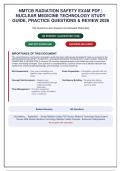
NMTCB RADIATION SAFETY EXAM PDF |
NUCLEAR MEDICINE TECHNOLOGY STUDY
GUIDE, PRACTICE QUESTIONS & REVIEW 2026
160 Questions with Answers and Detailed Rationales
100 PERCENT GUARANTEED PASS
INSTANT DOWNLOAD ANSWERS INCLUDED
IMPORTANCE OF THIS DOCUMENT
This comprehensive examination preparation guide has been meticulously developed to help you succeed in the
NMTCB RADIATION SAFETY EXAM PDF | NUCLEAR MEDICINE TECHNOLOGY STUDY GUIDE, PRACTICE
QUESTIONS & REVIEW 2026. It contains 160 carefully selected questions that reflect the most current exam
content and testing strategies. Each question is accompanied by a correct answer and a detailed rationale that
explains the underlying pathophysiology, pharmacology, or clinical reasoning.
Self-Assessment – Test your knowledge and Exam Preparation – Familiarize yourself with the
identify areas requiring further question format and content
study areas
Concept Reinforcement – Deepen your Confidence Building – Develop test-taking
understanding through strategies and reduce
evidence-based exam anxiety
rationales
Time Management – Practice answering
questions under simulated
exam conditions
Review Summary 160 Questions
Foundations - Application - Nmtcb Radiation Safety PDF Nuclear Medicine Technology Study Guide &
Review 2026 Nuclear Medicine Technology Radiation Safety Graduate / Advanced Undergraduate
All answers with rationales
,Table of Contents
Content Area Questions Key Topics
Nmtcb Radiation Safety PDF 1-27 Technologist, Tc-99m, Half-life, Nuclear Medicine, Effective
Nuclear Medicine
Technology Study Guide &
Review 2026 Nuclear
Medicine Technology
Radiation Safety Graduate /
Advanced Undergraduate
Source 28-54 Technologist, Effective, Nuclear, Exposure, Medicine
Nuclear 55-81 Technologist, Tc-99m, Source, DOSE RATE, Nuclear Medicine
Exposure 82-108 Source, DOSE RATE, Technologist, Nuclear Medicine, Meter
Medicine 109-135 Exposure, Technologist, Thyroid, Receives, Tc-99m
Tc-99m 136-160 Appropriate, Source, Procedure, Nuclear Medicine, Activity
TOTAL 160 All questions include answers and detailed rationales
,Section A - Nmtcb Radiation Safety PDF Nuclear Medicine
Technology Study Guide & Review 2026 Nuclear Medicine
Technology Radiation Safety Graduate / Advanced
Undergraduate
Q1.
A technologist is preparing a 740 MBq (20 mCi) dose of Tc-99m pertechnetate for a thyroid
uptake study. The vial has an activity concentration of 3.7 GBq/mL (100 mCi/mL). What
volume should be withdrawn to deliver the prescribed dose, assuming a 10% residual in
the syringe?
A. 0.18 mL B. 0.20 mL
C. 0.22 mL D. 0.24 mL
Correct: C - 0.22 mL
Rationale:The required volume is 740 MBq / 3700 MBq/mL = 0.20 mL. To account for 10%
residual, divide by 0.90: 0..90 = 0.222 mL, so 0.22 mL. Option C is correct; the others
either ignore the residual or apply it incorrectly.
Q2.
According to the ALARA principle, which of the following practices is most effective in
reducing radiation exposure to nuclear medicine personnel?
A. Increasing the distance from the source B. Using lead aprons during all procedures
by a factor of two
C. Reducing the activity administered to the D. Increasing the shielding thickness by one
patient half-value layer
Correct: A - Increasing the distance from the source by a factor of two
Rationale:The inverse square law dictates that doubling distance reduces exposure to
one-quarter, which is the most significant practical reduction. Lead aprons provide minimal
protection for high-energy gamma photons, reducing administered activity is not always
clinically appropriate, and adding one HVL reduces exposure by half, less than the distance
effect.
Q3.
A sealed source of I-125 is found to be leaking. What is the most appropriate initial action?
A. Wipe test the source and surrounding B. Isolate the area and notify the Radiation
area Safety Officer immediately
Page 3
, Section A - Nmtcb Radiation Safety PDF Nuclear Medicine Technology Study Guide & Review 2026 Nuclear Medicine Technology Radiation
Safety Graduate / Advanced Undergraduate
C. Place the source in a fume hood D. Dispose of the source in a radioactive
waste container
Correct: B - Isolate the area and notify the Radiation Safety Officer immediately
Rationale:Immediate isolation and notification of the RSO is critical to prevent spread and
initiate proper decontamination. While a wipe test may be needed, it is not the first action;
placing in a fume hood is inappropriate for a leaking sealed source, and disposal would
worsen contamination.
Q4.
A dose calibrator reading for a Tc-99m syringe is 15% higher than the expected activity.
Which of the following is the most likely cause?
A. The syringe contains Mo-99 breakthrough B. The calibrator is set to the wrong isotope
setting
C. The syringe is positioned too low in the D. The calibrator has not been zeroed
well recently
Correct: C - The syringe is positioned too low in the well
Rationale:If the syringe is placed too low, it may be in a region of higher detector response
due to geometry, causing an overestimation. Mo-99 breakthrough would also increase
readings but is less common; wrong isotope setting would likely give a different magnitude of
error; zeroing affects background, not high readings.
Q5.
Which of the following radionuclides poses the greatest external exposure hazard to
personnel when handling an unshielded source of the same activity?
A. Tc-99m B. I-131
C. F-18 D. P-32
Correct: C - F-18
Rationale:F-18 emits high-energy positrons (511 keV annihilation photons) with a high
exposure rate constant. I-131 also emits gamma but lower energy; Tc-99m is 140 keV; P-32
is a pure beta emitter with minimal external hazard. Thus F-18 presents the greatest external
dose.
Q6.
A spill of 370 MBq (10 mCi) of Tc-99m occurs on a linoleum floor. What is the first step in
the spill response procedure?
Page 4
NUCLEAR MEDICINE TECHNOLOGY STUDY
GUIDE, PRACTICE QUESTIONS & REVIEW 2026
160 Questions with Answers and Detailed Rationales
100 PERCENT GUARANTEED PASS
INSTANT DOWNLOAD ANSWERS INCLUDED
IMPORTANCE OF THIS DOCUMENT
This comprehensive examination preparation guide has been meticulously developed to help you succeed in the
NMTCB RADIATION SAFETY EXAM PDF | NUCLEAR MEDICINE TECHNOLOGY STUDY GUIDE, PRACTICE
QUESTIONS & REVIEW 2026. It contains 160 carefully selected questions that reflect the most current exam
content and testing strategies. Each question is accompanied by a correct answer and a detailed rationale that
explains the underlying pathophysiology, pharmacology, or clinical reasoning.
Self-Assessment – Test your knowledge and Exam Preparation – Familiarize yourself with the
identify areas requiring further question format and content
study areas
Concept Reinforcement – Deepen your Confidence Building – Develop test-taking
understanding through strategies and reduce
evidence-based exam anxiety
rationales
Time Management – Practice answering
questions under simulated
exam conditions
Review Summary 160 Questions
Foundations - Application - Nmtcb Radiation Safety PDF Nuclear Medicine Technology Study Guide &
Review 2026 Nuclear Medicine Technology Radiation Safety Graduate / Advanced Undergraduate
All answers with rationales
,Table of Contents
Content Area Questions Key Topics
Nmtcb Radiation Safety PDF 1-27 Technologist, Tc-99m, Half-life, Nuclear Medicine, Effective
Nuclear Medicine
Technology Study Guide &
Review 2026 Nuclear
Medicine Technology
Radiation Safety Graduate /
Advanced Undergraduate
Source 28-54 Technologist, Effective, Nuclear, Exposure, Medicine
Nuclear 55-81 Technologist, Tc-99m, Source, DOSE RATE, Nuclear Medicine
Exposure 82-108 Source, DOSE RATE, Technologist, Nuclear Medicine, Meter
Medicine 109-135 Exposure, Technologist, Thyroid, Receives, Tc-99m
Tc-99m 136-160 Appropriate, Source, Procedure, Nuclear Medicine, Activity
TOTAL 160 All questions include answers and detailed rationales
,Section A - Nmtcb Radiation Safety PDF Nuclear Medicine
Technology Study Guide & Review 2026 Nuclear Medicine
Technology Radiation Safety Graduate / Advanced
Undergraduate
Q1.
A technologist is preparing a 740 MBq (20 mCi) dose of Tc-99m pertechnetate for a thyroid
uptake study. The vial has an activity concentration of 3.7 GBq/mL (100 mCi/mL). What
volume should be withdrawn to deliver the prescribed dose, assuming a 10% residual in
the syringe?
A. 0.18 mL B. 0.20 mL
C. 0.22 mL D. 0.24 mL
Correct: C - 0.22 mL
Rationale:The required volume is 740 MBq / 3700 MBq/mL = 0.20 mL. To account for 10%
residual, divide by 0.90: 0..90 = 0.222 mL, so 0.22 mL. Option C is correct; the others
either ignore the residual or apply it incorrectly.
Q2.
According to the ALARA principle, which of the following practices is most effective in
reducing radiation exposure to nuclear medicine personnel?
A. Increasing the distance from the source B. Using lead aprons during all procedures
by a factor of two
C. Reducing the activity administered to the D. Increasing the shielding thickness by one
patient half-value layer
Correct: A - Increasing the distance from the source by a factor of two
Rationale:The inverse square law dictates that doubling distance reduces exposure to
one-quarter, which is the most significant practical reduction. Lead aprons provide minimal
protection for high-energy gamma photons, reducing administered activity is not always
clinically appropriate, and adding one HVL reduces exposure by half, less than the distance
effect.
Q3.
A sealed source of I-125 is found to be leaking. What is the most appropriate initial action?
A. Wipe test the source and surrounding B. Isolate the area and notify the Radiation
area Safety Officer immediately
Page 3
, Section A - Nmtcb Radiation Safety PDF Nuclear Medicine Technology Study Guide & Review 2026 Nuclear Medicine Technology Radiation
Safety Graduate / Advanced Undergraduate
C. Place the source in a fume hood D. Dispose of the source in a radioactive
waste container
Correct: B - Isolate the area and notify the Radiation Safety Officer immediately
Rationale:Immediate isolation and notification of the RSO is critical to prevent spread and
initiate proper decontamination. While a wipe test may be needed, it is not the first action;
placing in a fume hood is inappropriate for a leaking sealed source, and disposal would
worsen contamination.
Q4.
A dose calibrator reading for a Tc-99m syringe is 15% higher than the expected activity.
Which of the following is the most likely cause?
A. The syringe contains Mo-99 breakthrough B. The calibrator is set to the wrong isotope
setting
C. The syringe is positioned too low in the D. The calibrator has not been zeroed
well recently
Correct: C - The syringe is positioned too low in the well
Rationale:If the syringe is placed too low, it may be in a region of higher detector response
due to geometry, causing an overestimation. Mo-99 breakthrough would also increase
readings but is less common; wrong isotope setting would likely give a different magnitude of
error; zeroing affects background, not high readings.
Q5.
Which of the following radionuclides poses the greatest external exposure hazard to
personnel when handling an unshielded source of the same activity?
A. Tc-99m B. I-131
C. F-18 D. P-32
Correct: C - F-18
Rationale:F-18 emits high-energy positrons (511 keV annihilation photons) with a high
exposure rate constant. I-131 also emits gamma but lower energy; Tc-99m is 140 keV; P-32
is a pure beta emitter with minimal external hazard. Thus F-18 presents the greatest external
dose.
Q6.
A spill of 370 MBq (10 mCi) of Tc-99m occurs on a linoleum floor. What is the first step in
the spill response procedure?
Page 4


