

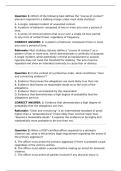
Question 1: Which of the following best defines the "course of conduct"
element required for a stalking charge under most state statutes?
A. A single, isolated incident of unwanted contact.
B. A pattern of behavior composed of two or more acts over a period of
time.
C. A series of communications that occur over a single 24-hour period.
D. Any form of verbal threat, regardless of frequency.
CORRECT ANSWER: B. A pattern of behavior composed of two or more
acts over a period of time.
Rationale: Most stalking statutes define a "course of conduct" as a
pattern of two or more acts, which demonstrates a continuity of purpose.
A single incident, while potentially criminal as harassment or assault,
typically does not meet the threshold for stalking. The acts must be
repeated and show an intended continuity to cause fear or distress.
Question 2: In the context of a protective order, what constitutes "clear
and convincing evidence"?
A. Evidence that proves the allegations are more likely true than not.
B. Evidence that leaves no reasonable doubt as to the truth of the
allegations.
C. Evidence that is uncontested by the respondent.
D. Evidence that demonstrates a high degree of probability that the
allegations are true.
CORRECT ANSWER: D. Evidence that demonstrates a high degree of
probability that the allegations are true.
Rationale: "Clear and convincing" is an intermediate standard of proof,
higher than a "preponderance" (more likely than not) but lower than
"beyond a reasonable doubt." It requires the evidence to be highly and
substantially more probable to be true than not.
Question 3: When a POST-certified officer responds to a domestic
violence call, what is the primary legal requirement regarding the arrest of
the primary aggressor?
A. The officer must arrest the primary aggressor if there is probable cause,
regardless of the victim's wishes.
B. The officer must obtain a warrant before making an arrest for domestic
violence.
C. The officer must arrest all parties involved if any physical injury is
,present.
D. The officer is required to mediate the dispute before any arrest is
made.
CORRECT ANSWER: A. The officer must arrest the primary aggressor if
there is probable cause, regardless of the victim's wishes.
Rationale: In most states, including Texas, Florida, California, and
Colorado, officers are mandated to make an arrest when they have
probable cause to believe that domestic violence has occurred and that
the suspect was the primary aggressor. The victim's desire to not press
charges does not negate this mandatory arrest provision.
Question 4: Which of the following actions constitutes a violation of the
Fourth Amendment regarding search and seizure?
A. Conducting a search incident to a lawful arrest for weapons.
B. Searching a vehicle's trunk based on probable cause that it contains
contraband.
C. Entering a home without a warrant to prevent the imminent destruction
of evidence.
D. Conducting a warrantless search of a cell phone's data incident to an
arrest.
CORRECT ANSWER: D. Conducting a warrantless search of a cell phone's
data incident to an arrest.
Rationale: The Supreme Court case Riley v. California established that
warrantless searches of digital information on a cell phone are generally
unconstitutional incident to an arrest, as they are considered a violation of
privacy. A warrant is generally required to access the data, unless exigent
circumstances apply.
Question 5: Under the doctrine of "qualified immunity," when is a law
enforcement officer protected from civil liability?
A. When the officer acted with malicious intent to harm the plaintiff.
B. When the officer's conduct did not violate a clearly established
statutory or constitutional right.
C. When the officer was acting outside the scope of their official duties.
D. When the officer failed to follow departmental policy regarding use of
force.
CORRECT ANSWER: B. When the officer's conduct did not violate a
clearly established statutory or constitutional right.
,Rationale: Qualified immunity protects government officials from liability
for civil damages insofar as their conduct does not violate "clearly
established" statutory or constitutional rights of which a reasonable
person would have known. It is a defense to liability, not immunity from
suit entirely.
Question 6: In Texas, what is the statutory requirement for an officer to
make a warrantless arrest for a misdemeanor offense?
A. The offense must be committed in the officer's presence.
B. The offense must be a crime of moral turpitude.
C. The offense must be punishable by a fine of over $500.
D. The officer must have a signed complaint from the victim.
CORRECT ANSWER: A. The offense must be committed in the officer's
presence.
Rationale: In Texas, a peace officer may arrest an individual without a
warrant for any offense committed within their view or presence. For
felonies, probable cause is sufficient to arrest without a warrant. This
principle is governed by the Texas Code of Criminal Procedure.
Question 7: The "community caretaking" exception to the warrant
requirement allows police to:
A. Enter a home to conduct a wellness check without probable cause or a
warrant.
B. Search a vehicle for contraband after a lawful traffic stop.
C. Establish a police substation within a high-crime neighborhood.
D. Conduct a warrantless arrest for a non-violent misdemeanor.
CORRECT ANSWER: A. Enter a home to conduct a wellness check
without probable cause or a warrant.
Rationale: The community caretaking exception allows officers to
perform functions that are unrelated to criminal investigation, such as
checking on the welfare of an individual (e.g., elderly person who hasn't
been seen). This is permissible under the Fourth Amendment when there
is a reasonable basis to believe that a person is in danger and needs
assistance.
Question 8: Which of the following is a recognized exception to the
Miranda requirement?
, A. Statements made during a traffic stop for a routine infraction.
B. Statements made to undercover officers.
C. Statements made during a custodial interrogation without a lawyer
present.
D. Statements made after the suspect has been read their rights and
waived them.
CORRECT ANSWER: B. Statements made to undercover officers.
Rationale: The Miranda warning is required only when a suspect is in
custody and subject to interrogation. If the suspect is unaware they are
speaking to a police officer (e.g., an undercover agent), the coercive
environment is absent, so Miranda is not required for statements to be
admissible.
Question 9: In Florida, which statute governs the release of a defendant
on bail before trial?
A. Chapter 903, Florida Statutes.
B. Section 921, Florida Statutes.
C. Chapter 847, Florida Statutes.
D. Section 775, Florida Statutes.
CORRECT ANSWER: A. Chapter 903, Florida Statutes.
Rationale: Chapter 903 of the Florida Statutes addresses bail and pretrial
release. It outlines the criteria for determining the amount of bail,
conditions of release, and the authority of magistrates and courts
regarding the release of defendants.
Question 10: What is the legal standard for an officer to use deadly force
against a fleeing felon under Tennessee v. Garner?
A. The officer must have probable cause to believe the suspect poses a
significant threat of death or serious physical injury.
B. The officer must have reasonable suspicion that the suspect committed
a violent felony.
C. The officer may use deadly force solely to prevent the escape of a felon
who committed a property crime.
D. The officer must give a verbal warning before any use of deadly force.
CORRECT ANSWER: A. The officer must have probable cause to believe
the suspect poses a significant threat of death or serious physical injury.
element required for a stalking charge under most state statutes?
A. A single, isolated incident of unwanted contact.
B. A pattern of behavior composed of two or more acts over a period of
time.
C. A series of communications that occur over a single 24-hour period.
D. Any form of verbal threat, regardless of frequency.
CORRECT ANSWER: B. A pattern of behavior composed of two or more
acts over a period of time.
Rationale: Most stalking statutes define a "course of conduct" as a
pattern of two or more acts, which demonstrates a continuity of purpose.
A single incident, while potentially criminal as harassment or assault,
typically does not meet the threshold for stalking. The acts must be
repeated and show an intended continuity to cause fear or distress.
Question 2: In the context of a protective order, what constitutes "clear
and convincing evidence"?
A. Evidence that proves the allegations are more likely true than not.
B. Evidence that leaves no reasonable doubt as to the truth of the
allegations.
C. Evidence that is uncontested by the respondent.
D. Evidence that demonstrates a high degree of probability that the
allegations are true.
CORRECT ANSWER: D. Evidence that demonstrates a high degree of
probability that the allegations are true.
Rationale: "Clear and convincing" is an intermediate standard of proof,
higher than a "preponderance" (more likely than not) but lower than
"beyond a reasonable doubt." It requires the evidence to be highly and
substantially more probable to be true than not.
Question 3: When a POST-certified officer responds to a domestic
violence call, what is the primary legal requirement regarding the arrest of
the primary aggressor?
A. The officer must arrest the primary aggressor if there is probable cause,
regardless of the victim's wishes.
B. The officer must obtain a warrant before making an arrest for domestic
violence.
C. The officer must arrest all parties involved if any physical injury is
,present.
D. The officer is required to mediate the dispute before any arrest is
made.
CORRECT ANSWER: A. The officer must arrest the primary aggressor if
there is probable cause, regardless of the victim's wishes.
Rationale: In most states, including Texas, Florida, California, and
Colorado, officers are mandated to make an arrest when they have
probable cause to believe that domestic violence has occurred and that
the suspect was the primary aggressor. The victim's desire to not press
charges does not negate this mandatory arrest provision.
Question 4: Which of the following actions constitutes a violation of the
Fourth Amendment regarding search and seizure?
A. Conducting a search incident to a lawful arrest for weapons.
B. Searching a vehicle's trunk based on probable cause that it contains
contraband.
C. Entering a home without a warrant to prevent the imminent destruction
of evidence.
D. Conducting a warrantless search of a cell phone's data incident to an
arrest.
CORRECT ANSWER: D. Conducting a warrantless search of a cell phone's
data incident to an arrest.
Rationale: The Supreme Court case Riley v. California established that
warrantless searches of digital information on a cell phone are generally
unconstitutional incident to an arrest, as they are considered a violation of
privacy. A warrant is generally required to access the data, unless exigent
circumstances apply.
Question 5: Under the doctrine of "qualified immunity," when is a law
enforcement officer protected from civil liability?
A. When the officer acted with malicious intent to harm the plaintiff.
B. When the officer's conduct did not violate a clearly established
statutory or constitutional right.
C. When the officer was acting outside the scope of their official duties.
D. When the officer failed to follow departmental policy regarding use of
force.
CORRECT ANSWER: B. When the officer's conduct did not violate a
clearly established statutory or constitutional right.
,Rationale: Qualified immunity protects government officials from liability
for civil damages insofar as their conduct does not violate "clearly
established" statutory or constitutional rights of which a reasonable
person would have known. It is a defense to liability, not immunity from
suit entirely.
Question 6: In Texas, what is the statutory requirement for an officer to
make a warrantless arrest for a misdemeanor offense?
A. The offense must be committed in the officer's presence.
B. The offense must be a crime of moral turpitude.
C. The offense must be punishable by a fine of over $500.
D. The officer must have a signed complaint from the victim.
CORRECT ANSWER: A. The offense must be committed in the officer's
presence.
Rationale: In Texas, a peace officer may arrest an individual without a
warrant for any offense committed within their view or presence. For
felonies, probable cause is sufficient to arrest without a warrant. This
principle is governed by the Texas Code of Criminal Procedure.
Question 7: The "community caretaking" exception to the warrant
requirement allows police to:
A. Enter a home to conduct a wellness check without probable cause or a
warrant.
B. Search a vehicle for contraband after a lawful traffic stop.
C. Establish a police substation within a high-crime neighborhood.
D. Conduct a warrantless arrest for a non-violent misdemeanor.
CORRECT ANSWER: A. Enter a home to conduct a wellness check
without probable cause or a warrant.
Rationale: The community caretaking exception allows officers to
perform functions that are unrelated to criminal investigation, such as
checking on the welfare of an individual (e.g., elderly person who hasn't
been seen). This is permissible under the Fourth Amendment when there
is a reasonable basis to believe that a person is in danger and needs
assistance.
Question 8: Which of the following is a recognized exception to the
Miranda requirement?
, A. Statements made during a traffic stop for a routine infraction.
B. Statements made to undercover officers.
C. Statements made during a custodial interrogation without a lawyer
present.
D. Statements made after the suspect has been read their rights and
waived them.
CORRECT ANSWER: B. Statements made to undercover officers.
Rationale: The Miranda warning is required only when a suspect is in
custody and subject to interrogation. If the suspect is unaware they are
speaking to a police officer (e.g., an undercover agent), the coercive
environment is absent, so Miranda is not required for statements to be
admissible.
Question 9: In Florida, which statute governs the release of a defendant
on bail before trial?
A. Chapter 903, Florida Statutes.
B. Section 921, Florida Statutes.
C. Chapter 847, Florida Statutes.
D. Section 775, Florida Statutes.
CORRECT ANSWER: A. Chapter 903, Florida Statutes.
Rationale: Chapter 903 of the Florida Statutes addresses bail and pretrial
release. It outlines the criteria for determining the amount of bail,
conditions of release, and the authority of magistrates and courts
regarding the release of defendants.
Question 10: What is the legal standard for an officer to use deadly force
against a fleeing felon under Tennessee v. Garner?
A. The officer must have probable cause to believe the suspect poses a
significant threat of death or serious physical injury.
B. The officer must have reasonable suspicion that the suspect committed
a violent felony.
C. The officer may use deadly force solely to prevent the escape of a felon
who committed a property crime.
D. The officer must give a verbal warning before any use of deadly force.
CORRECT ANSWER: A. The officer must have probable cause to believe
the suspect poses a significant threat of death or serious physical injury.


