

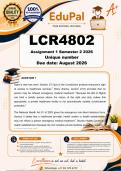
LCR4802
Assignment 1 Semester 2 2026
Unique number
Due date: August 2026
QUESTION 1
Sipho’s view has merit. Section 27(1)(a) of the Constitution protects everyone’s right
of access to healthcare services.1 More directly, section 27(3) provides that no
person may be refused emergency medical treatment.1 Because the Bill of Rights
can bind a juristic person where the nature of the right and duty makes this
appropriate, a private healthcare facility is not automatically outside constitutional
protection.1
The National Health Act 61 of 2003 gives the emergency rule direct statutory force.
Section 5 states that a healthcare provider, health worker or health establishment
may not refuse a person emergency medical treatment.1 Ubuntu Health Centre is a
health establishment because the Act includes private facilities providing inpatient or
outpatient treatment.1
, QUESTION 1
Sipho’s view has merit. Section 27(1)(a) of the Constitution protects everyone’s right
of access to healthcare services.1 More directly, section 27(3) provides that no
person may be refused emergency medical treatment.2 Because the Bill of Rights
can bind a juristic person where the nature of the right and duty makes this
appropriate, a private healthcare facility is not automatically outside constitutional
protection.3
The National Health Act 61 of 2003 gives the emergency rule direct statutory force.
Section 5 states that a healthcare provider, health worker or health establishment
may not refuse a person emergency medical treatment.4 Ubuntu Health Centre is a
health establishment because the Act includes private facilities providing inpatient or
outpatient treatment.5 Mr Khumalo may also fall within the broad definition of a
health worker because he was involved in the process through which health services
were made available to Sipho.6 Although private hospitals normally decide whom
they will admit, the study guide recognises an exception where emergency treatment
is required.7
In Soobramoney v Minister of Health (KwaZulu-Natal), the Constitutional Court
explained that section 27(3) protects a person who suffers a sudden catastrophe
requiring immediate medical attention and should not be turned away where
necessary treatment is available.8 The Court distinguished such an emergency from
continuing treatment for a chronic condition.9 Sipho had just suffered a serious
collision, had a severe neck injury and could not move his legs properly, which
strongly indicates a sudden emergency requiring immediate assessment and
stabilisation. Refusing him because he lacked medical aid or an immediate deposit
therefore conflicts with section 27(3) and section 5 of the National Health Act.10 This
1 Constitution of the Republic of South Africa, 1996 s 27(1)(a).
2 ibid s 27(3).
3 ibid s 8(2).
4 National Health Act 61 of 2003 s 5.
5 ibid s 1 sv ‘health establishment’.
6 ibid s 1 sv ‘health worker’.
7 LC Coetzee and SA Strauss, Medical Law: Only Study Guide for LCR404U (University of South
Africa, revised edn 2008) 12.
8 Soobramoney v Minister of Health (KwaZulu-Natal) [1997] ZACC 17, 1998 (1) SA 765 (CC) [20].
9 ibid [21].
10 Constitution of the Republic of South Africa, 1996 s 27(3); National Health Act 61 of 2003 s 5.
Assignment 1 Semester 2 2026
Unique number
Due date: August 2026
QUESTION 1
Sipho’s view has merit. Section 27(1)(a) of the Constitution protects everyone’s right
of access to healthcare services.1 More directly, section 27(3) provides that no
person may be refused emergency medical treatment.1 Because the Bill of Rights
can bind a juristic person where the nature of the right and duty makes this
appropriate, a private healthcare facility is not automatically outside constitutional
protection.1
The National Health Act 61 of 2003 gives the emergency rule direct statutory force.
Section 5 states that a healthcare provider, health worker or health establishment
may not refuse a person emergency medical treatment.1 Ubuntu Health Centre is a
health establishment because the Act includes private facilities providing inpatient or
outpatient treatment.1
, QUESTION 1
Sipho’s view has merit. Section 27(1)(a) of the Constitution protects everyone’s right
of access to healthcare services.1 More directly, section 27(3) provides that no
person may be refused emergency medical treatment.2 Because the Bill of Rights
can bind a juristic person where the nature of the right and duty makes this
appropriate, a private healthcare facility is not automatically outside constitutional
protection.3
The National Health Act 61 of 2003 gives the emergency rule direct statutory force.
Section 5 states that a healthcare provider, health worker or health establishment
may not refuse a person emergency medical treatment.4 Ubuntu Health Centre is a
health establishment because the Act includes private facilities providing inpatient or
outpatient treatment.5 Mr Khumalo may also fall within the broad definition of a
health worker because he was involved in the process through which health services
were made available to Sipho.6 Although private hospitals normally decide whom
they will admit, the study guide recognises an exception where emergency treatment
is required.7
In Soobramoney v Minister of Health (KwaZulu-Natal), the Constitutional Court
explained that section 27(3) protects a person who suffers a sudden catastrophe
requiring immediate medical attention and should not be turned away where
necessary treatment is available.8 The Court distinguished such an emergency from
continuing treatment for a chronic condition.9 Sipho had just suffered a serious
collision, had a severe neck injury and could not move his legs properly, which
strongly indicates a sudden emergency requiring immediate assessment and
stabilisation. Refusing him because he lacked medical aid or an immediate deposit
therefore conflicts with section 27(3) and section 5 of the National Health Act.10 This
1 Constitution of the Republic of South Africa, 1996 s 27(1)(a).
2 ibid s 27(3).
3 ibid s 8(2).
4 National Health Act 61 of 2003 s 5.
5 ibid s 1 sv ‘health establishment’.
6 ibid s 1 sv ‘health worker’.
7 LC Coetzee and SA Strauss, Medical Law: Only Study Guide for LCR404U (University of South
Africa, revised edn 2008) 12.
8 Soobramoney v Minister of Health (KwaZulu-Natal) [1997] ZACC 17, 1998 (1) SA 765 (CC) [20].
9 ibid [21].
10 Constitution of the Republic of South Africa, 1996 s 27(3); National Health Act 61 of 2003 s 5.



