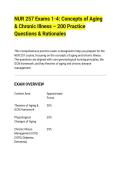
NUR 257 Exams 1-4: Concepts of Aging
& Chronic Illness – 200 Practice
Questions & Rationales
This comprehensive practice exam is designed to help you prepare for the
NUR 257 course, focusing on the concepts of aging and chronic illness.
The questions are aligned with core gerontological nursing principles, the
GCN framework, and key theories of aging and chronic disease
management.
EXAM OVERVIEW
Content Area Approximate
Focus
Theories of Aging & 20%
GCN Framework
Physiological 25%
Changes of Aging
Chronic Illness 25%
Management (CVD,
COPD, Diabetes,
Dementia)
,Psychosocial & 15%
Cultural Aspects of
Aging
Health Promotion & 15%
Resilience
SECTION 1: THEORIES OF AGING & THE GCN
FRAMEWORK
Question 1
What is the primary focus of Geroscience?
A. The study of diseases that only affect the elderly.
B. The investigation of the molecular and cellular mechanisms that link
aging to chronic diseases.
C. The psychological impact of retirement on older adults.
D. The development of new surgical techniques for the elderly.
Answer: B. The investigation of the molecular and cellular mechanisms that
link aging to chronic diseases.
Rationale: Geroscience is a new interdisciplinary field that explores the
fundamental biological processes of aging (like cellular senescence and
inflammation) and how they act as the primary risk factor for most chronic
diseases including cancer, cardiovascular disease, and neurodegenerative
disorders.
Question 2
,The concept of resilience in the context of aging refers to:
A. The ability to completely avoid all age-related diseases.
B. The capacity to resist, adapt, recover, or grow in response to health
challenges and stressors.
C. The financial stability of an individual.
D. The rate at which telomeres shorten.
Answer: B. The capacity to resist, adapt, recover, or grow in response to
health challenges and stressors.
Rationale: Resilience is the ability to bounce back from adversity. In aging, it
encompasses the capacity to maintain or regain a state of optimal health
and function despite the challenges of aging and chronic illness.
Question 3
According to the GCN framework, which concept refers to the "period of life
spent in good health and free from chronic diseases and disabilities"?
A. Chronological Age
B. Life Expectancy
C. Healthspan
D. Longevity
Answer: C. Healthspan
Rationale: The goal of modern aging research is not just to extend life
(longevity) but to extend healthspan—the number of years an individual
lives in good health, free from disease and disability.
Question 4
, Which of the following is a hallmark of biological aging that contributes to
age-related chronic diseases?
A. Increased cellular regeneration.
B. Decreased immune system function (immune senescence).
C. Enhanced DNA repair mechanisms.
D. Improved mitochondrial efficiency.
Answer: B. Decreased immune system function (immune senescence).
Rationale: As people age, their immune systems become less resilient (a
process called immunosenescence), leading to increased vulnerability to
infections and chronic diseases like cancer and cardiovascular disease.
Question 5
"Inflammaging" is a term used to describe:
A. The complete absence of inflammation in older adults.
B. A low-grade, chronic, and systemic inflammation that occurs with aging.
C. An acute inflammatory response to an infection.
D. A diet high in anti-inflammatory foods.
Answer: B. A low-grade, chronic, and systemic inflammation that occurs
with aging.
Rationale: Inflammaging describes the chronic, low-grade inflammation
that develops with age. It is a major contributor to the development of
many chronic diseases, including Alzheimer's disease, cancer, and
osteoarthritis.
Question 6
& Chronic Illness – 200 Practice
Questions & Rationales
This comprehensive practice exam is designed to help you prepare for the
NUR 257 course, focusing on the concepts of aging and chronic illness.
The questions are aligned with core gerontological nursing principles, the
GCN framework, and key theories of aging and chronic disease
management.
EXAM OVERVIEW
Content Area Approximate
Focus
Theories of Aging & 20%
GCN Framework
Physiological 25%
Changes of Aging
Chronic Illness 25%
Management (CVD,
COPD, Diabetes,
Dementia)
,Psychosocial & 15%
Cultural Aspects of
Aging
Health Promotion & 15%
Resilience
SECTION 1: THEORIES OF AGING & THE GCN
FRAMEWORK
Question 1
What is the primary focus of Geroscience?
A. The study of diseases that only affect the elderly.
B. The investigation of the molecular and cellular mechanisms that link
aging to chronic diseases.
C. The psychological impact of retirement on older adults.
D. The development of new surgical techniques for the elderly.
Answer: B. The investigation of the molecular and cellular mechanisms that
link aging to chronic diseases.
Rationale: Geroscience is a new interdisciplinary field that explores the
fundamental biological processes of aging (like cellular senescence and
inflammation) and how they act as the primary risk factor for most chronic
diseases including cancer, cardiovascular disease, and neurodegenerative
disorders.
Question 2
,The concept of resilience in the context of aging refers to:
A. The ability to completely avoid all age-related diseases.
B. The capacity to resist, adapt, recover, or grow in response to health
challenges and stressors.
C. The financial stability of an individual.
D. The rate at which telomeres shorten.
Answer: B. The capacity to resist, adapt, recover, or grow in response to
health challenges and stressors.
Rationale: Resilience is the ability to bounce back from adversity. In aging, it
encompasses the capacity to maintain or regain a state of optimal health
and function despite the challenges of aging and chronic illness.
Question 3
According to the GCN framework, which concept refers to the "period of life
spent in good health and free from chronic diseases and disabilities"?
A. Chronological Age
B. Life Expectancy
C. Healthspan
D. Longevity
Answer: C. Healthspan
Rationale: The goal of modern aging research is not just to extend life
(longevity) but to extend healthspan—the number of years an individual
lives in good health, free from disease and disability.
Question 4
, Which of the following is a hallmark of biological aging that contributes to
age-related chronic diseases?
A. Increased cellular regeneration.
B. Decreased immune system function (immune senescence).
C. Enhanced DNA repair mechanisms.
D. Improved mitochondrial efficiency.
Answer: B. Decreased immune system function (immune senescence).
Rationale: As people age, their immune systems become less resilient (a
process called immunosenescence), leading to increased vulnerability to
infections and chronic diseases like cancer and cardiovascular disease.
Question 5
"Inflammaging" is a term used to describe:
A. The complete absence of inflammation in older adults.
B. A low-grade, chronic, and systemic inflammation that occurs with aging.
C. An acute inflammatory response to an infection.
D. A diet high in anti-inflammatory foods.
Answer: B. A low-grade, chronic, and systemic inflammation that occurs
with aging.
Rationale: Inflammaging describes the chronic, low-grade inflammation
that develops with age. It is a major contributor to the development of
many chronic diseases, including Alzheimer's disease, cancer, and
osteoarthritis.
Question 6