

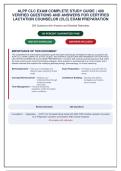
ALPP CLC EXAM COMPLETE STUDY GUIDE | 400
VERIFIED QUESTIONS AND ANSWERS FOR CERTIFIED
LACTATION COUNSELOR (CLC) EXAM PREPARATION
250 Questions with Answers and Detailed Rationales
100 PERCENT GUARANTEED PASS
INSTANT DOWNLOAD ANSWERS INCLUDED
IMPORTANCE OF THIS DOCUMENT
This comprehensive examination preparation guide has been meticulously developed to help you succeed in the
ALPP CLC EXAM COMPLETE STUDY GUIDE | 400 VERIFIED QUESTIONS AND ANSWERS FOR CERTIFIED
LACTATION COUNSELOR (CLC) EXAM PREPARATION. It contains 250 carefully selected questions that reflect
the most current exam content and testing strategies. Each question is accompanied by a correct answer and a
detailed rationale that explains the underlying pathophysiology, pharmacology, or clinical reasoning.
Self-Assessment – Test your knowledge and Exam Preparation – Familiarize yourself with the
identify areas requiring further question format and content
study areas
Concept Reinforcement – Deepen your Confidence Building – Develop test-taking
understanding through strategies and reduce
evidence-based exam anxiety
rationales
Time Management – Practice answering
questions under simulated
exam conditions
Review Summary 250 Questions
Foundations - Application - ALPP CLC Complete Study Guide 400 AND FOR Certified Lactation Counselor
CLC Preparation Lactation Consultation AND Clinical Graduate
All answers with rationales
,Table of Contents
Content Area Questions Key Topics
ALPP CLC Complete Study 1-42 Mother, Breastfeeding, Infant, Engorgement, Maternal
Guide 400 AND FOR Certified
Lactation Counselor CLC
Preparation Lactation
Consultation AND Clinical
Graduate
Breastfeeding 43-84 Mother, Infant, Appropriate, Reports, Likely
Infant 85-126 Mother, Breastfeeding, Reports, Likely, Breast MILK
Likely 127-168 Mother, Breastfeeding, Infant, Reports, Nipple
Reports 169-210 Mother, Breastfeeding, Infant, Likely, Despite
Nipple 211-250 Mother, Infant, Breastfeeding, Supply, Likely
TOTAL 250 All questions include answers and detailed rationales
,Section A - ALPP CLC Complete Study Guide 400 AND
FOR Certified Lactation Counselor CLC Preparation
Lactation Consultation AND Clinical Graduate
Q1.
A postpartum client with gestational diabetes and polycystic ovary syndrome has delayed
lactogenesis II. Which hormonal interplay most directly contributes to this delay?
A. Low insulin sensitivity impairs mammary B. Elevated progesterone from retained
epithelial glucose uptake, reducing lactose placental fragments suppresses prolactin
synthesis and milk volume. receptor expression.
C. Hyperandrogenism from PCOS directly D. High circulating cortisol downregulates
inhibits oxytocin release from the posterior prolactin gene transcription in the anterior
pituitary. pituitary.
Correct: A - Low insulin sensitivity impairs mammary epithelial glucose uptake, reducing
lactose synthesis and milk volume.
Rationale:Insulin is essential for mammary epithelial glucose uptake; insulin resistance
reduces lactose synthesis, decreasing milk volume. Retained placenta causes high
progesterone, but that is not the primary issue in PCOS/GDM. Hyperandrogenism does not
directly inhibit oxytocin, and cortisol's effect on prolactin gene transcription is less directly
implicated.
Q2.
Which pharmacokinetic property most reliably predicts the transfer of a medication into
human milk, and how should clinicians apply this when assessing drug safety?
A. Half-life; longer half-lives require longer B. Molecular weight; drugs <200 Da freely
waiting periods after a dose before pass into milk, while those >800 Da are
breastfeeding. completely excluded.
C. Protein binding; high protein binding D. Lipid solubility; highly lipophilic drugs
reduces milk transfer, but unbound fraction accumulate in milk fat, but clinical effects
still enters milk and must be considered. depend on infant oral bioavailability.
Correct: C - Protein binding; high protein binding reduces milk transfer, but unbound
fraction still enters milk and must be considered.
Rationale:Protein binding determines the free drug concentration available to diffuse into
milk; high binding reduces transfer, but the unbound fraction still crosses. Half-life influences
elimination, not transfer. Molecular weight is a factor but not absolute; >800 Da does not
completely exclude. Lipid solubility affects accumulation but not the primary transfer rate.
Page 3
, Section A - ALPP CLC Complete Study Guide 400 AND FOR Certified Lactation Counselor CLC Preparation Lactation Consultation AND Clinical
Graduate
Q3.
An infant with ankyloglossia has poor latch and ineffective milk transfer. Which
intervention sequence aligns with current evidence-based practice?
A. Immediate frenotomy before any other B. Conservative management with lactation
intervention, as it universally improves support and positioning, followed by
breastfeeding outcomes. frenotomy only if symptoms persist despite
optimized feeding.
C. Use of nipple shields for all feeds to D. Supplementation with formula to maintain
improve latch, deferring frenotomy weight, with frenotomy scheduled only if
indefinitely. weight gain remains inadequate at 2 weeks.
Correct: B - Conservative management with lactation support and positioning, followed by
frenotomy only if symptoms persist despite optimized feeding.
Rationale:Current guidelines recommend a trial of conservative management first, including
lactation support, and reassessment. Frenotomy is not universally indicated; it is considered
when functional impairment persists. Nipple shields are not a substitute for addressing the
cause, and formula supplementation is not a first-line solution.
Q4.
Which finding most strongly indicates that a mother is experiencing primary breast
engorgement rather than physiologic fullness?
A. Bilateral breast warmth and firmness on B. Breasts are hard, tender, and the nipples
day 3 postpartum. are stretched flat, making latch difficult.
C. Temperature of 38.0°C with localized D. Milk ejection reflex is triggered by infant
breast erythema and malaise. crying, causing leaking from the opposite
breast.
Correct: B - Breasts are hard, tender, and the nipples are stretched flat, making latch
difficult.
Rationale:Primary engorgement involves venous and lymphatic congestion, making breasts
hard, tender, and nipples non-protractile; this interferes with latch. Physiologic fullness is
milder and does not flatten nipples. Fever and localized erythema suggest mastitis. Milk
ejection with crying is a normal reflex, not engorgement.
Q5.
A breastfeeding infant is diagnosed with galactosemia. Which metabolic consequence of
this condition directly contraindicates breastfeeding and necessitates a non-lactose
formula?
Page 4
VERIFIED QUESTIONS AND ANSWERS FOR CERTIFIED
LACTATION COUNSELOR (CLC) EXAM PREPARATION
250 Questions with Answers and Detailed Rationales
100 PERCENT GUARANTEED PASS
INSTANT DOWNLOAD ANSWERS INCLUDED
IMPORTANCE OF THIS DOCUMENT
This comprehensive examination preparation guide has been meticulously developed to help you succeed in the
ALPP CLC EXAM COMPLETE STUDY GUIDE | 400 VERIFIED QUESTIONS AND ANSWERS FOR CERTIFIED
LACTATION COUNSELOR (CLC) EXAM PREPARATION. It contains 250 carefully selected questions that reflect
the most current exam content and testing strategies. Each question is accompanied by a correct answer and a
detailed rationale that explains the underlying pathophysiology, pharmacology, or clinical reasoning.
Self-Assessment – Test your knowledge and Exam Preparation – Familiarize yourself with the
identify areas requiring further question format and content
study areas
Concept Reinforcement – Deepen your Confidence Building – Develop test-taking
understanding through strategies and reduce
evidence-based exam anxiety
rationales
Time Management – Practice answering
questions under simulated
exam conditions
Review Summary 250 Questions
Foundations - Application - ALPP CLC Complete Study Guide 400 AND FOR Certified Lactation Counselor
CLC Preparation Lactation Consultation AND Clinical Graduate
All answers with rationales
,Table of Contents
Content Area Questions Key Topics
ALPP CLC Complete Study 1-42 Mother, Breastfeeding, Infant, Engorgement, Maternal
Guide 400 AND FOR Certified
Lactation Counselor CLC
Preparation Lactation
Consultation AND Clinical
Graduate
Breastfeeding 43-84 Mother, Infant, Appropriate, Reports, Likely
Infant 85-126 Mother, Breastfeeding, Reports, Likely, Breast MILK
Likely 127-168 Mother, Breastfeeding, Infant, Reports, Nipple
Reports 169-210 Mother, Breastfeeding, Infant, Likely, Despite
Nipple 211-250 Mother, Infant, Breastfeeding, Supply, Likely
TOTAL 250 All questions include answers and detailed rationales
,Section A - ALPP CLC Complete Study Guide 400 AND
FOR Certified Lactation Counselor CLC Preparation
Lactation Consultation AND Clinical Graduate
Q1.
A postpartum client with gestational diabetes and polycystic ovary syndrome has delayed
lactogenesis II. Which hormonal interplay most directly contributes to this delay?
A. Low insulin sensitivity impairs mammary B. Elevated progesterone from retained
epithelial glucose uptake, reducing lactose placental fragments suppresses prolactin
synthesis and milk volume. receptor expression.
C. Hyperandrogenism from PCOS directly D. High circulating cortisol downregulates
inhibits oxytocin release from the posterior prolactin gene transcription in the anterior
pituitary. pituitary.
Correct: A - Low insulin sensitivity impairs mammary epithelial glucose uptake, reducing
lactose synthesis and milk volume.
Rationale:Insulin is essential for mammary epithelial glucose uptake; insulin resistance
reduces lactose synthesis, decreasing milk volume. Retained placenta causes high
progesterone, but that is not the primary issue in PCOS/GDM. Hyperandrogenism does not
directly inhibit oxytocin, and cortisol's effect on prolactin gene transcription is less directly
implicated.
Q2.
Which pharmacokinetic property most reliably predicts the transfer of a medication into
human milk, and how should clinicians apply this when assessing drug safety?
A. Half-life; longer half-lives require longer B. Molecular weight; drugs <200 Da freely
waiting periods after a dose before pass into milk, while those >800 Da are
breastfeeding. completely excluded.
C. Protein binding; high protein binding D. Lipid solubility; highly lipophilic drugs
reduces milk transfer, but unbound fraction accumulate in milk fat, but clinical effects
still enters milk and must be considered. depend on infant oral bioavailability.
Correct: C - Protein binding; high protein binding reduces milk transfer, but unbound
fraction still enters milk and must be considered.
Rationale:Protein binding determines the free drug concentration available to diffuse into
milk; high binding reduces transfer, but the unbound fraction still crosses. Half-life influences
elimination, not transfer. Molecular weight is a factor but not absolute; >800 Da does not
completely exclude. Lipid solubility affects accumulation but not the primary transfer rate.
Page 3
, Section A - ALPP CLC Complete Study Guide 400 AND FOR Certified Lactation Counselor CLC Preparation Lactation Consultation AND Clinical
Graduate
Q3.
An infant with ankyloglossia has poor latch and ineffective milk transfer. Which
intervention sequence aligns with current evidence-based practice?
A. Immediate frenotomy before any other B. Conservative management with lactation
intervention, as it universally improves support and positioning, followed by
breastfeeding outcomes. frenotomy only if symptoms persist despite
optimized feeding.
C. Use of nipple shields for all feeds to D. Supplementation with formula to maintain
improve latch, deferring frenotomy weight, with frenotomy scheduled only if
indefinitely. weight gain remains inadequate at 2 weeks.
Correct: B - Conservative management with lactation support and positioning, followed by
frenotomy only if symptoms persist despite optimized feeding.
Rationale:Current guidelines recommend a trial of conservative management first, including
lactation support, and reassessment. Frenotomy is not universally indicated; it is considered
when functional impairment persists. Nipple shields are not a substitute for addressing the
cause, and formula supplementation is not a first-line solution.
Q4.
Which finding most strongly indicates that a mother is experiencing primary breast
engorgement rather than physiologic fullness?
A. Bilateral breast warmth and firmness on B. Breasts are hard, tender, and the nipples
day 3 postpartum. are stretched flat, making latch difficult.
C. Temperature of 38.0°C with localized D. Milk ejection reflex is triggered by infant
breast erythema and malaise. crying, causing leaking from the opposite
breast.
Correct: B - Breasts are hard, tender, and the nipples are stretched flat, making latch
difficult.
Rationale:Primary engorgement involves venous and lymphatic congestion, making breasts
hard, tender, and nipples non-protractile; this interferes with latch. Physiologic fullness is
milder and does not flatten nipples. Fever and localized erythema suggest mastitis. Milk
ejection with crying is a normal reflex, not engorgement.
Q5.
A breastfeeding infant is diagnosed with galactosemia. Which metabolic consequence of
this condition directly contraindicates breastfeeding and necessitates a non-lactose
formula?
Page 4


