

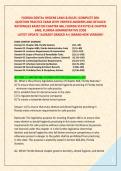
FLORIDA DENTAL HYGIENE LAWS & RULES |COMPLETE 200-
QUESTION PRACTICE EXAM WITH VERIFIED ANSWERS AND DETAILED
RATIONALES BASED ON CHAPTER 466, FLORIDA STATUTES & CHAPTER
64B5, FLORIDA ADMINISTRATIVE CODE
LATEST UPDATE |ALREADY GRADED A+||BRAND NEW VERSION!!
EXAM CONTENT DOMAINS
Domain 01: Chapter 466, Florida Statutes (Q 1–50)
Domain 02: Chapter 64B5, Florida Administrative Code (Q 51–80)
Domain 03: Licensure Requirements & Examination (Q 81–110)
Domain 04: Scope of Practice & Remediable Tasks (Q 111–140)
Domain 05: Supervision Levels (Direct, Indirect, General) (Q 141–160)
Domain 06: Continuing Education Requirements (Q 161–175)
Domain 07: Infection Control & Sterilization (Q 176–185)
Domain 08: Record Keeping & Patient Records Q 186–195)
Domain 09: Prohibited Acts & Disciplinary Actions (Q 196–200)
SECTION 1: CHAPTER 466, FLORIDA STATUTES (Questions 1–50)
Q1. What is the primary legislative purpose of Chapter 466, Florida Statutes?
A) To ensure that every dentist and dental hygienist practicing in Florida meets
minimum requirements for safe practice
B) To establish fees for dental services in the state
C) To regulate dental insurance companies
D) To create a statewide dental school system
Answer: A) To ensure that every dentist and dental hygienist practicing in
Florida meets minimum requirements for safe practice
Rationale: The legislative purpose for enacting Chapter 466 is to ensure that
every dentist or dental hygienist practicing in this state meets minimum
requirements for safe practice without undue clinical interference by persons
not licensed under this chapter. It is the further legislative intent that
dentists and dental hygienists who fall below minimum competency or who
otherwise present a danger to the public shall be prohibited from practicing
in this state. This purpose is explicitly stated in Section 466.001, Florida
Statutes.
Q2. Which Florida Statute chapter governs dentistry, dental hygiene, and dental
1
,laboratories?
A) Chapter 456
B) Chapter 464
C) Chapter 466
D) Chapter 468
Answer: C) Chapter 466
Rationale: Chapter 466 of the Florida Statutes is titled "Dentistry, Dental
Hygiene, and Dental Laboratories." This chapter contains all the laws
governing the practice of dentistry and dental hygiene in Florida. Chapter 456
covers health professions generally, Chapter 464 covers nursing, and Chapter
468 covers miscellaneous professions.
Q3. Who is authorized to administer the Florida Dental Hygiene Licensure
Examination?
A) The Florida Department of Health
B) The Florida Board of Dentistry
C) The American Dental Association (ADA)
D) The Dental Hygiene National Board
Answer: B) The Florida Board of Dentistry
Rationale: According to Section 466.007, Florida Statutes, the Board of
Dentistry has the authority to administer examinations, including the dental
hygiene licensure examination. The Board may also contract with a third-party
testing agency to administer the examination. The Department of Health
provides administrative support, but the Board is the policy-setting body.
Q4. The Florida Board of Dentistry consists of how many members?
A) 5 members
B) 7 members
C) 9 members
D) 11 members
Answer: C) 9 members
Rationale: According to Section 466.004, Florida Statutes, the Board of
2
,Dentistry consists of 9 members. These include:
- 5 licensed dentists
- 1 licensed dental hygienist
- 3 consumer members (non-dentist, non-hygienist members of the public)
Members are appointed by the Governor and confirmed by the Senate.
Q5. What is the term length for a member of the Florida Board of Dentistry?
A) 2 years
B) 3 years
C) 4 years
D) 5 years
Answer: C) 4 years
Rationale: According to Section 466.004, Florida Statutes, each member of the
Board of Dentistry is appointed for a term of 4 years. Members may be
reappointed, but no member may serve more than two consecutive 4-year terms
(8 years total). The terms are staggered to ensure continuity on the Board.
Q6. The Florida Board of Dentistry has the authority to do all of the following
EXCEPT:
A) Adopt rules for the practice of dentistry and dental hygiene
B) Issue and renew licenses for dentists and dental hygienists
C) Set fees for dental services provided to patients
D) Discipline licensees who violate laws or rules
Answer: C) Set fees for dental services provided to patients
Rationale: The Board of Dentistry has the authority to adopt rules, issue and
renew licenses, and discipline licensees. However, the Board does NOT have
the authority to set fees for dental services provided to patients. Fees for
services are determined by individual practitioners and their practices. The
Board sets licensing and examination fees, not patient service fees.
Q7. The Florida Board of Dentistry is housed under which state agency?
A) Florida Department of Education
B) Florida Department of Health
C) Florida Agency for Health Care Administration (AHCA)
3
, D) Florida Department of Business and Professional Regulation
Answer: B) Florida Department of Health
Rationale: The Board of Dentistry is housed under the Florida Department of
Health (DOH). The Department provides administrative support, legal services,
and investigative services to the Board. The Division of Medical Quality
Assurance (MQA) within the DOH oversees the Board's administrative functions.
Q8. What is the maximum number of consecutive terms a Board member may
serve?
A) 1 term
B) 2 terms
C) 3 terms
D) Unlimited terms
Answer: B) 2 terms
Rationale: According to Section 466.004, Florida Statutes, no member of the
Board of Dentistry may serve more than two consecutive 4-year terms. This
limit ensures turnover and fresh perspectives on the Board. A member who
has served two consecutive terms may be reappointed after a break in service.
Q9. The Florida Board of Dentistry must include at least how many consumer
members?
A) 1
B) 2
C) 3
D) 4
Answer: C) 3
Rationale: According to Section 466.004, Florida Statutes, the Board must
include 3 consumer members (lay members) who represent the public interest.
Consumer members are not licensed as dentists or dental hygienists and do
not have any financial interest in the practice of dentistry or dental
hygiene. Their role is to represent the perspective of the public on the
Board.
4
QUESTION PRACTICE EXAM WITH VERIFIED ANSWERS AND DETAILED
RATIONALES BASED ON CHAPTER 466, FLORIDA STATUTES & CHAPTER
64B5, FLORIDA ADMINISTRATIVE CODE
LATEST UPDATE |ALREADY GRADED A+||BRAND NEW VERSION!!
EXAM CONTENT DOMAINS
Domain 01: Chapter 466, Florida Statutes (Q 1–50)
Domain 02: Chapter 64B5, Florida Administrative Code (Q 51–80)
Domain 03: Licensure Requirements & Examination (Q 81–110)
Domain 04: Scope of Practice & Remediable Tasks (Q 111–140)
Domain 05: Supervision Levels (Direct, Indirect, General) (Q 141–160)
Domain 06: Continuing Education Requirements (Q 161–175)
Domain 07: Infection Control & Sterilization (Q 176–185)
Domain 08: Record Keeping & Patient Records Q 186–195)
Domain 09: Prohibited Acts & Disciplinary Actions (Q 196–200)
SECTION 1: CHAPTER 466, FLORIDA STATUTES (Questions 1–50)
Q1. What is the primary legislative purpose of Chapter 466, Florida Statutes?
A) To ensure that every dentist and dental hygienist practicing in Florida meets
minimum requirements for safe practice
B) To establish fees for dental services in the state
C) To regulate dental insurance companies
D) To create a statewide dental school system
Answer: A) To ensure that every dentist and dental hygienist practicing in
Florida meets minimum requirements for safe practice
Rationale: The legislative purpose for enacting Chapter 466 is to ensure that
every dentist or dental hygienist practicing in this state meets minimum
requirements for safe practice without undue clinical interference by persons
not licensed under this chapter. It is the further legislative intent that
dentists and dental hygienists who fall below minimum competency or who
otherwise present a danger to the public shall be prohibited from practicing
in this state. This purpose is explicitly stated in Section 466.001, Florida
Statutes.
Q2. Which Florida Statute chapter governs dentistry, dental hygiene, and dental
1
,laboratories?
A) Chapter 456
B) Chapter 464
C) Chapter 466
D) Chapter 468
Answer: C) Chapter 466
Rationale: Chapter 466 of the Florida Statutes is titled "Dentistry, Dental
Hygiene, and Dental Laboratories." This chapter contains all the laws
governing the practice of dentistry and dental hygiene in Florida. Chapter 456
covers health professions generally, Chapter 464 covers nursing, and Chapter
468 covers miscellaneous professions.
Q3. Who is authorized to administer the Florida Dental Hygiene Licensure
Examination?
A) The Florida Department of Health
B) The Florida Board of Dentistry
C) The American Dental Association (ADA)
D) The Dental Hygiene National Board
Answer: B) The Florida Board of Dentistry
Rationale: According to Section 466.007, Florida Statutes, the Board of
Dentistry has the authority to administer examinations, including the dental
hygiene licensure examination. The Board may also contract with a third-party
testing agency to administer the examination. The Department of Health
provides administrative support, but the Board is the policy-setting body.
Q4. The Florida Board of Dentistry consists of how many members?
A) 5 members
B) 7 members
C) 9 members
D) 11 members
Answer: C) 9 members
Rationale: According to Section 466.004, Florida Statutes, the Board of
2
,Dentistry consists of 9 members. These include:
- 5 licensed dentists
- 1 licensed dental hygienist
- 3 consumer members (non-dentist, non-hygienist members of the public)
Members are appointed by the Governor and confirmed by the Senate.
Q5. What is the term length for a member of the Florida Board of Dentistry?
A) 2 years
B) 3 years
C) 4 years
D) 5 years
Answer: C) 4 years
Rationale: According to Section 466.004, Florida Statutes, each member of the
Board of Dentistry is appointed for a term of 4 years. Members may be
reappointed, but no member may serve more than two consecutive 4-year terms
(8 years total). The terms are staggered to ensure continuity on the Board.
Q6. The Florida Board of Dentistry has the authority to do all of the following
EXCEPT:
A) Adopt rules for the practice of dentistry and dental hygiene
B) Issue and renew licenses for dentists and dental hygienists
C) Set fees for dental services provided to patients
D) Discipline licensees who violate laws or rules
Answer: C) Set fees for dental services provided to patients
Rationale: The Board of Dentistry has the authority to adopt rules, issue and
renew licenses, and discipline licensees. However, the Board does NOT have
the authority to set fees for dental services provided to patients. Fees for
services are determined by individual practitioners and their practices. The
Board sets licensing and examination fees, not patient service fees.
Q7. The Florida Board of Dentistry is housed under which state agency?
A) Florida Department of Education
B) Florida Department of Health
C) Florida Agency for Health Care Administration (AHCA)
3
, D) Florida Department of Business and Professional Regulation
Answer: B) Florida Department of Health
Rationale: The Board of Dentistry is housed under the Florida Department of
Health (DOH). The Department provides administrative support, legal services,
and investigative services to the Board. The Division of Medical Quality
Assurance (MQA) within the DOH oversees the Board's administrative functions.
Q8. What is the maximum number of consecutive terms a Board member may
serve?
A) 1 term
B) 2 terms
C) 3 terms
D) Unlimited terms
Answer: B) 2 terms
Rationale: According to Section 466.004, Florida Statutes, no member of the
Board of Dentistry may serve more than two consecutive 4-year terms. This
limit ensures turnover and fresh perspectives on the Board. A member who
has served two consecutive terms may be reappointed after a break in service.
Q9. The Florida Board of Dentistry must include at least how many consumer
members?
A) 1
B) 2
C) 3
D) 4
Answer: C) 3
Rationale: According to Section 466.004, Florida Statutes, the Board must
include 3 consumer members (lay members) who represent the public interest.
Consumer members are not licensed as dentists or dental hygienists and do
not have any financial interest in the practice of dentistry or dental
hygiene. Their role is to represent the perspective of the public on the
Board.
4


