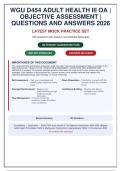
WGU D454 ADULT HEALTH III OA |
OBJECTIVE ASSESSMENT |
QUESTIONS AND ANSWERS 2026
LATEST MOCK PRACTICE SET
100 Questions with Answers and Detailed Rationales
100 PERCENT GUARANTEED PASS
INSTANT DOWNLOAD ANSWERS INCLUDED
IMPORTANCE OF THIS DOCUMENT
This comprehensive examination preparation guide has been meticulously developed to help you succeed in the
WGU D454 ADULT HEALTH III OA | OBJECTIVE ASSESSMENT | QUESTIONS AND ANSWERS 2026
UPDATES. It contains 100 carefully selected questions that reflect the most current exam content and testing
strategies. Each question is accompanied by a correct answer and a detailed rationale that explains the
underlying pathophysiology, pharmacology, or clinical reasoning.
Self-Assessment – Test your knowledge and Exam Preparation – Familiarize yourself with the
identify areas requiring further question format and content
study areas
Concept Reinforcement – Deepen your Confidence Building – Develop test-taking
understanding through strategies and reduce
evidence-based exam anxiety
rationales
Time Management – Practice answering
questions under simulated
exam conditions
Review Summary 100 Questions
Foundations - Application - WGU D454 Adult Health III OA Objective Assessment AND 2026 Updates
Adult Health III Complex CARE & Multisystem Dysfunction Undergraduate YEAR 4 / Pre-licensure BSN
All answers with rationales
,Table of Contents
Content Area Questions Key Topics
Management OF CARE 1-17 Acute, Finding, Medication, Failure, Septic Shock
Safety AND Infection Control 18-34 Acute, Finding, Intervention, Develops, Appropriate
Health Promotion AND 35-51 Acute, Finding, Develops, Respiratory, Chronic
Maintenance
Psychosocial Integrity 52-68 Acute, Finding, Sodium, Syndrome, Appropriate
Basic CARE AND Comfort 69-85 Acute, Finding, Appropriate, Develops, Kidney
Pharmacological Therapies 86-100 Appropriate, Acute, Intervention, Finding, Kidney
TOTAL 100 All questions include answers and detailed rationales
,Section A - Management OF CARE
Q1.
In a patient with septic shock and acute respiratory distress syndrome (ARDS), which
ventilator strategy best balances oxygenation and prevention of further lung injury?
A. Tidal volume 10 mL/kg ideal body weight B. Tidal volume 6 mL/kg ideal body weight
with plateau pressure < 30 cm H2O with positive end-expiratory pressure
(PEEP) titrated to oxygenation and plateau
pressure 30 cm H2O
C. Tidal volume 12 mL/kg ideal body weight D. Tidal volume 6 mL/kg actual body weight
with permissive hypercapnia with PEEP 5 cm H2O and FiO2 100%
Correct: B - Tidal volume 6 mL/kg ideal body weight with positive end-expiratory pressure
(PEEP) titrated to oxygenation and plateau pressure 30 cm H2O
Rationale:Low tidal volume ventilation (6 mL/kg IBW) with limited plateau pressure is the
evidence-based strategy to prevent ventilator-induced lung injury in ARDS. Higher tidal
volumes (10-12 mL/kg) worsen lung injury. Using actual body weight overestimates lung size,
and low PEEP does not optimize recruitment in ARDS.
Q2.
A patient with cirrhosis and refractory ascites develops acute kidney injury (AKI). Which
finding most strongly supports hepatorenal syndrome (HRS) rather than acute tubular
necrosis (ATN)?
A. Urine sodium < 10 mEq/L and fractional B. Urine sodium > 40 mEq/L and muddy
excretion of sodium < 1% brown casts
C. Fractional excretion of urea > 35% D. Urine osmolality < 300 mOsm/kg
Correct: A - Urine sodium < 10 mEq/L and fractional excretion of sodium < 1%
Rationale:HRS is characterized by intense renal vasoconstriction leading to low urine sodium
(<10 mEq/L) and low FeNa (<1%), similar to prerenal azotemia. ATN typically presents with
high urine sodium (>40 mEq/L) and muddy brown casts. High FeUrea (>35%) suggests ATN,
and low urine osmolality indicates tubular damage, not HRS.
Q3.
Which parameter is the most reliable indicator of adequate tissue perfusion during early
goal-directed therapy in a patient with septic shock?
A. Central venous pressure (CVP) of 12 mm B. Mean arterial pressure (MAP) of 65 mm
Hg Hg
Page 3
, Section A - Management OF CARE
C. ScvO2 70% or SvO2 65% D. Lactate clearance of at least 10% within
6 hours
Correct: D - Lactate clearance of at least 10% within 6 hours
Rationale:Lactate clearance is a direct marker of tissue hypoxia and is strongly associated
with mortality; current guidelines recommend resuscitation to normalize lactate or achieve
10% clearance. CVP and MAP are hemodynamic targets but not direct measures of
perfusion. ScvO2 is a surrogate that may be normal in distributive shock despite regional
hypoperfusion.
Q4.
In a patient with severe hyperkalemia (K+ 7.2 mEq/L) and ECG changes (peaked T waves,
absent P waves), which medication should be administered FIRST to stabilize the
myocardium?
A. Sodium polystyrene sulfonate B. Calcium gluconate 10% IV
(Kayexalate)
C. Regular insulin with dextrose D. Sodium bicarbonate
Correct: B - Calcium gluconate 10% IV
Rationale:Calcium gluconate antagonizes the effect of hyperkalemia on the cardiac cell
membrane, reducing the risk of ventricular arrhythmias within minutes. Insulin, bicarbonate,
and Kayexalate lower serum potassium but take longer to act and do not immediately
stabilize the myocardium. In the presence of ECG changes, calcium is the priority.
Q5.
A patient with suspected acute ischemic stroke presents 3.5 hours after symptom onset.
Which finding would contraindicate administration of alteplase?
A. Blood glucose 55 mg/dL B. Systolic blood pressure 180 mm Hg
C. Platelet count 120,000/mm³ D. INR 1.4
Correct: A - Blood glucose 55 mg/dL
Rationale:Hypoglycemia (glucose < 50 mg/dL) is a contraindication to alteplase because it
can mimic stroke symptoms and must be corrected first. Blood pressure 185/110 mm Hg is
acceptable; platelets > 100,000 and INR 1.7 are not contraindications. The window is within
4.5 hours for eligible patients.
Q6.
Which assessment finding in a patient with diabetic ketoacidosis (DKA) indicates
resolution of the hyperglycemic crisis and readiness to transition to subcutaneous
insulin?
Page 4
OBJECTIVE ASSESSMENT |
QUESTIONS AND ANSWERS 2026
LATEST MOCK PRACTICE SET
100 Questions with Answers and Detailed Rationales
100 PERCENT GUARANTEED PASS
INSTANT DOWNLOAD ANSWERS INCLUDED
IMPORTANCE OF THIS DOCUMENT
This comprehensive examination preparation guide has been meticulously developed to help you succeed in the
WGU D454 ADULT HEALTH III OA | OBJECTIVE ASSESSMENT | QUESTIONS AND ANSWERS 2026
UPDATES. It contains 100 carefully selected questions that reflect the most current exam content and testing
strategies. Each question is accompanied by a correct answer and a detailed rationale that explains the
underlying pathophysiology, pharmacology, or clinical reasoning.
Self-Assessment – Test your knowledge and Exam Preparation – Familiarize yourself with the
identify areas requiring further question format and content
study areas
Concept Reinforcement – Deepen your Confidence Building – Develop test-taking
understanding through strategies and reduce
evidence-based exam anxiety
rationales
Time Management – Practice answering
questions under simulated
exam conditions
Review Summary 100 Questions
Foundations - Application - WGU D454 Adult Health III OA Objective Assessment AND 2026 Updates
Adult Health III Complex CARE & Multisystem Dysfunction Undergraduate YEAR 4 / Pre-licensure BSN
All answers with rationales
,Table of Contents
Content Area Questions Key Topics
Management OF CARE 1-17 Acute, Finding, Medication, Failure, Septic Shock
Safety AND Infection Control 18-34 Acute, Finding, Intervention, Develops, Appropriate
Health Promotion AND 35-51 Acute, Finding, Develops, Respiratory, Chronic
Maintenance
Psychosocial Integrity 52-68 Acute, Finding, Sodium, Syndrome, Appropriate
Basic CARE AND Comfort 69-85 Acute, Finding, Appropriate, Develops, Kidney
Pharmacological Therapies 86-100 Appropriate, Acute, Intervention, Finding, Kidney
TOTAL 100 All questions include answers and detailed rationales
,Section A - Management OF CARE
Q1.
In a patient with septic shock and acute respiratory distress syndrome (ARDS), which
ventilator strategy best balances oxygenation and prevention of further lung injury?
A. Tidal volume 10 mL/kg ideal body weight B. Tidal volume 6 mL/kg ideal body weight
with plateau pressure < 30 cm H2O with positive end-expiratory pressure
(PEEP) titrated to oxygenation and plateau
pressure 30 cm H2O
C. Tidal volume 12 mL/kg ideal body weight D. Tidal volume 6 mL/kg actual body weight
with permissive hypercapnia with PEEP 5 cm H2O and FiO2 100%
Correct: B - Tidal volume 6 mL/kg ideal body weight with positive end-expiratory pressure
(PEEP) titrated to oxygenation and plateau pressure 30 cm H2O
Rationale:Low tidal volume ventilation (6 mL/kg IBW) with limited plateau pressure is the
evidence-based strategy to prevent ventilator-induced lung injury in ARDS. Higher tidal
volumes (10-12 mL/kg) worsen lung injury. Using actual body weight overestimates lung size,
and low PEEP does not optimize recruitment in ARDS.
Q2.
A patient with cirrhosis and refractory ascites develops acute kidney injury (AKI). Which
finding most strongly supports hepatorenal syndrome (HRS) rather than acute tubular
necrosis (ATN)?
A. Urine sodium < 10 mEq/L and fractional B. Urine sodium > 40 mEq/L and muddy
excretion of sodium < 1% brown casts
C. Fractional excretion of urea > 35% D. Urine osmolality < 300 mOsm/kg
Correct: A - Urine sodium < 10 mEq/L and fractional excretion of sodium < 1%
Rationale:HRS is characterized by intense renal vasoconstriction leading to low urine sodium
(<10 mEq/L) and low FeNa (<1%), similar to prerenal azotemia. ATN typically presents with
high urine sodium (>40 mEq/L) and muddy brown casts. High FeUrea (>35%) suggests ATN,
and low urine osmolality indicates tubular damage, not HRS.
Q3.
Which parameter is the most reliable indicator of adequate tissue perfusion during early
goal-directed therapy in a patient with septic shock?
A. Central venous pressure (CVP) of 12 mm B. Mean arterial pressure (MAP) of 65 mm
Hg Hg
Page 3
, Section A - Management OF CARE
C. ScvO2 70% or SvO2 65% D. Lactate clearance of at least 10% within
6 hours
Correct: D - Lactate clearance of at least 10% within 6 hours
Rationale:Lactate clearance is a direct marker of tissue hypoxia and is strongly associated
with mortality; current guidelines recommend resuscitation to normalize lactate or achieve
10% clearance. CVP and MAP are hemodynamic targets but not direct measures of
perfusion. ScvO2 is a surrogate that may be normal in distributive shock despite regional
hypoperfusion.
Q4.
In a patient with severe hyperkalemia (K+ 7.2 mEq/L) and ECG changes (peaked T waves,
absent P waves), which medication should be administered FIRST to stabilize the
myocardium?
A. Sodium polystyrene sulfonate B. Calcium gluconate 10% IV
(Kayexalate)
C. Regular insulin with dextrose D. Sodium bicarbonate
Correct: B - Calcium gluconate 10% IV
Rationale:Calcium gluconate antagonizes the effect of hyperkalemia on the cardiac cell
membrane, reducing the risk of ventricular arrhythmias within minutes. Insulin, bicarbonate,
and Kayexalate lower serum potassium but take longer to act and do not immediately
stabilize the myocardium. In the presence of ECG changes, calcium is the priority.
Q5.
A patient with suspected acute ischemic stroke presents 3.5 hours after symptom onset.
Which finding would contraindicate administration of alteplase?
A. Blood glucose 55 mg/dL B. Systolic blood pressure 180 mm Hg
C. Platelet count 120,000/mm³ D. INR 1.4
Correct: A - Blood glucose 55 mg/dL
Rationale:Hypoglycemia (glucose < 50 mg/dL) is a contraindication to alteplase because it
can mimic stroke symptoms and must be corrected first. Blood pressure 185/110 mm Hg is
acceptable; platelets > 100,000 and INR 1.7 are not contraindications. The window is within
4.5 hours for eligible patients.
Q6.
Which assessment finding in a patient with diabetic ketoacidosis (DKA) indicates
resolution of the hyperglycemic crisis and readiness to transition to subcutaneous
insulin?
Page 4