Page 1 of 154
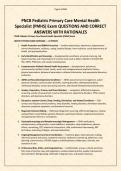
PNCB Pediatric Primary Care Mental Health
Specialist (PMHS) Exam QUESTIONS AND CORRECT
ANSWERS WITH RATIONALES
PNCB Pediatric Primary Care Mental Health Specialist (PMHS) Exam
MOSTLY TESTED EXAM COVERAGE — 10 POINTS
1. Health Promotion and DBMH Prevention — healthy relationships, attachment, temperament,
normal development, resiliency, coping, healthy lifestyle, harm reduction, social determinants of
health, and psychoeducation.
2. Early Identification and Screening — developmental surveillance, universal screening, risk-
based screening, and interpretation of common tools such as ASQ-3, ASQ:SE-2, M-CHAT-R/F,
PSC, SWYC, PHQ tools, and suicide screening tools.
3. Comprehensive Pediatric Mental Health Assessment — developmental, behavioral,
environmental, medical, school, family, social, and multigenerational psychiatric history;
physical examination; behavioral observation; collateral information; and appropriate laboratory
evaluation.
4. ADHD and Neurodevelopmental Conditions — ADHD assessment and management, autism
spectrum disorder, communication disorders, learning disorders, developmental delay,
intellectual disability, sensory processing concerns, and related developmental presentations.
5. Anxiety, Depression, Trauma, and Stress Disorders — recognition, differential diagnosis,
screening, suicide risk assessment, trauma-informed care, adjustment disorders, PTSD, anxiety
disorders, and depressive disorders.
6. Disruptive, Impulse-Control, Sleep, Feeding, Elimination, and Related Conditions — ODD,
conduct and impulse-control problems, sleep disorders, feeding disorders, elimination disorders,
obsessive-compulsive symptoms, and behavioral concerns.
7. Diagnostic Decision-Making — DSM-based diagnostic reasoning, differential diagnosis, medical
and psychiatric comorbidities, genetic influences, psychosocial factors, atypical presentations,
and appropriate referral or consultation.
8. Psychopharmacology and Nonpharmacologic Management — ADHD medications,
antidepressants, antipsychotics, mood stabilizers, anxiolytics, sleep medications, adverse
effects, monitoring, CBT, behavioral interventions, ABA, motivational interviewing, DBT
techniques, parenting strategies, and psychoeducation.
9. Ongoing Management and Care Coordination — treatment goals, shared decision-making,
informed consent and assent, treatment response, medication monitoring, adherence, crisis
planning, school services, IEP/504 support, multidisciplinary collaboration, referrals, and
transition of care.
10. Professional Role, Ethics, and Integrated Care — confidentiality, privacy, cultural sensitivity,
DEI, scope of practice, laws and regulations, evidence-based practice, quality improvement,
documentation, billing/coding, telehealth, integrated care, and patient advocacy.
, Page 2 of 154
Question 1
A school-age child has frequent classroom problems, poor organization, and unfinished work across
several settings. Which assessment is most appropriate initially?
A. Vanderbilt Assessment Scales
B. M-CHAT-R/F
C. Edinburgh Postnatal Depression Scale
D. CRAFFT
Answer: A
Rationale: The Vanderbilt scales help assess ADHD symptoms and related behavioral concerns using
information from caregivers and teachers.
Question 2
A parent reports that a child becomes anxious before school and frequently complains of stomachaches
on school mornings. What should the clinician assess first?
A. Recent academic, social, family, and anxiety-related functioning
B. Serum antipsychotic concentration
, Page 3 of 154
C. Autism diagnostic observation immediately
D. Intellectual disability testing immediately
Answer: A
Rationale: Anxiety assessment should begin with a broad history that identifies symptoms, triggers,
impairment, functioning, and contextual factors.
Question 3
Which finding most strongly suggests that a child's behavioral symptoms may be related to an
environmental stressor rather than ADHD alone?
A. Symptoms began soon after a major family disruption
B. Symptoms have occurred across many developmental stages
C. Symptoms are present consistently at home and school
D. Symptoms have been documented by several teachers
Answer: A
Rationale: A clear temporal relationship between symptoms and a major stressor should prompt
evaluation of psychosocial causes.
, Page 4 of 154
Question 4
A clinician is screening a toddler for possible autism spectrum disorder during routine primary care.
Which tool is most appropriate?
A. M-CHAT-R/F
B. PHQ-9
C. GAD-7
D. CRAFFT
Answer: A
Rationale: The M-CHAT-R/F is designed for autism screening in young children.
Question 5
An adolescent reports feeling hopeless and says, “My family would be better without me.” What is the
clinician's priority?
A. Perform an immediate suicide risk assessment
B. Schedule routine follow-up in six months
C. Begin academic testing first
D. Recommend increased physical activity only
PNCB Pediatric Primary Care Mental Health
Specialist (PMHS) Exam QUESTIONS AND CORRECT
ANSWERS WITH RATIONALES
PNCB Pediatric Primary Care Mental Health Specialist (PMHS) Exam
MOSTLY TESTED EXAM COVERAGE — 10 POINTS
1. Health Promotion and DBMH Prevention — healthy relationships, attachment, temperament,
normal development, resiliency, coping, healthy lifestyle, harm reduction, social determinants of
health, and psychoeducation.
2. Early Identification and Screening — developmental surveillance, universal screening, risk-
based screening, and interpretation of common tools such as ASQ-3, ASQ:SE-2, M-CHAT-R/F,
PSC, SWYC, PHQ tools, and suicide screening tools.
3. Comprehensive Pediatric Mental Health Assessment — developmental, behavioral,
environmental, medical, school, family, social, and multigenerational psychiatric history;
physical examination; behavioral observation; collateral information; and appropriate laboratory
evaluation.
4. ADHD and Neurodevelopmental Conditions — ADHD assessment and management, autism
spectrum disorder, communication disorders, learning disorders, developmental delay,
intellectual disability, sensory processing concerns, and related developmental presentations.
5. Anxiety, Depression, Trauma, and Stress Disorders — recognition, differential diagnosis,
screening, suicide risk assessment, trauma-informed care, adjustment disorders, PTSD, anxiety
disorders, and depressive disorders.
6. Disruptive, Impulse-Control, Sleep, Feeding, Elimination, and Related Conditions — ODD,
conduct and impulse-control problems, sleep disorders, feeding disorders, elimination disorders,
obsessive-compulsive symptoms, and behavioral concerns.
7. Diagnostic Decision-Making — DSM-based diagnostic reasoning, differential diagnosis, medical
and psychiatric comorbidities, genetic influences, psychosocial factors, atypical presentations,
and appropriate referral or consultation.
8. Psychopharmacology and Nonpharmacologic Management — ADHD medications,
antidepressants, antipsychotics, mood stabilizers, anxiolytics, sleep medications, adverse
effects, monitoring, CBT, behavioral interventions, ABA, motivational interviewing, DBT
techniques, parenting strategies, and psychoeducation.
9. Ongoing Management and Care Coordination — treatment goals, shared decision-making,
informed consent and assent, treatment response, medication monitoring, adherence, crisis
planning, school services, IEP/504 support, multidisciplinary collaboration, referrals, and
transition of care.
10. Professional Role, Ethics, and Integrated Care — confidentiality, privacy, cultural sensitivity,
DEI, scope of practice, laws and regulations, evidence-based practice, quality improvement,
documentation, billing/coding, telehealth, integrated care, and patient advocacy.
, Page 2 of 154
Question 1
A school-age child has frequent classroom problems, poor organization, and unfinished work across
several settings. Which assessment is most appropriate initially?
A. Vanderbilt Assessment Scales
B. M-CHAT-R/F
C. Edinburgh Postnatal Depression Scale
D. CRAFFT
Answer: A
Rationale: The Vanderbilt scales help assess ADHD symptoms and related behavioral concerns using
information from caregivers and teachers.
Question 2
A parent reports that a child becomes anxious before school and frequently complains of stomachaches
on school mornings. What should the clinician assess first?
A. Recent academic, social, family, and anxiety-related functioning
B. Serum antipsychotic concentration
, Page 3 of 154
C. Autism diagnostic observation immediately
D. Intellectual disability testing immediately
Answer: A
Rationale: Anxiety assessment should begin with a broad history that identifies symptoms, triggers,
impairment, functioning, and contextual factors.
Question 3
Which finding most strongly suggests that a child's behavioral symptoms may be related to an
environmental stressor rather than ADHD alone?
A. Symptoms began soon after a major family disruption
B. Symptoms have occurred across many developmental stages
C. Symptoms are present consistently at home and school
D. Symptoms have been documented by several teachers
Answer: A
Rationale: A clear temporal relationship between symptoms and a major stressor should prompt
evaluation of psychosocial causes.
, Page 4 of 154
Question 4
A clinician is screening a toddler for possible autism spectrum disorder during routine primary care.
Which tool is most appropriate?
A. M-CHAT-R/F
B. PHQ-9
C. GAD-7
D. CRAFFT
Answer: A
Rationale: The M-CHAT-R/F is designed for autism screening in young children.
Question 5
An adolescent reports feeling hopeless and says, “My family would be better without me.” What is the
clinician's priority?
A. Perform an immediate suicide risk assessment
B. Schedule routine follow-up in six months
C. Begin academic testing first
D. Recommend increased physical activity only