Page 1 of 144
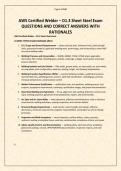
AWS Certified Welder – D1.3 Sheet Steel Exam
QUESTIONS AND CORRECT ANSWERS WITH
RATIONALES
AWS Certified Welder – D1.3 Sheet Steel Exam
10 MOST-TESTED EXAM COVERAGE AREAS
1. D1.3 Scope and General Requirements — sheet and strip steel, thickness limits, yield strength
limits, galvanized material, applicable welding work, terminology, and relationship to other AWS
structural welding codes.
2. Welding Processes and Consumables — SMAW, GMAW, FCAW, GTAW where applicable,
electrodes, filler metals, shielding gases, polarity, amperage, voltage, travel speed, and proper
process selection.
3. Welding Symbols and Joint Details — fillet welds, groove welds, arc spot welds, arc seam welds,
arc plug welds, joint configuration, weld size, spacing, length, and drawing interpretation.
4. Welding Procedure Specifications (WPS) — essential welding variables, qualified procedures,
material thickness, welding position, process, electrode classification, shielding gas, preheat,
interpass temperature, and procedure control.
5. Welder Performance Qualification — qualification tests, test positions, welding process, test
coupons, acceptance requirements, continuity, qualification ranges, and proper documentation.
6. Sheet Steel Welding and Fabrication — fit-up, alignment, tack welding, distortion control, heat
input, welding sequence, galvanized sheet preparation, repairs, and workmanship.
7. Arc Spot and Arc Seam Welds — weld placement, effective weld dimensions, hole or interface
requirements, welding technique, spacing, inspection, and common defects.
8. Structural Design Requirements — load transfer, weld strength, joint design, effective
dimensions, minimum requirements, engineer responsibilities, and proper use of D1.3 design
provisions.
9. Inspection and Weld Acceptance — visual inspection, surface defects, cracks, porosity,
undercut, overlap, incomplete fusion, weld size, workmanship, acceptance criteria, and repair.
10. Safety, Quality Control, and Documentation — welding safety, electrical safety, ventilation,
galvanized coatings, records, WPS/PQR/WPQ documentation, inspection reports, and code
compliance.
1.
, Page 2 of 144
Which type of material is primarily covered by AWS D1.3 when the structural sheet steel meets the
specified code limits?
A. Heavy pressure-vessel plate
B. Structural sheet and strip steel
C. Copper electrical tubing
D. Aluminum aircraft plate
Answer: B
Rationale: D1.3 addresses structural sheet and strip steels, including cold-formed members, within its
specified material limits. (AWS Pubs)
2.
A welder is preparing to weld structural sheet steel with a specified yield point of 70 ksi. Which
statement best describes the material?
A. It exceeds the normal D1.3 yield-strength limit.
B. It falls within the D1.3 yield-strength limit.
C. It must always be welded under D1.1 only.
D. It cannot be welded using arc welding.
, Page 3 of 144
Answer: B
Rationale: D1.3 covers sheet steel having a minimum specified yield point no greater than 80 ksi.
(American Welding Society)
3.
Why must a welder carefully control heat when welding thin sheet steel during structural fabrication
work?
A. Thin steel can easily distort or burn through from excessive heat.
B. Thin steel always requires very high heat input.
C. Thin steel cannot conduct welding heat.
D. Heat has no effect on thin sheet steel.
Answer: A
Rationale: Thin sheet can distort, warp, or burn through when excessive heat is concentrated in a small
area.
4.
, Page 4 of 144
Which document normally gives the welder the approved welding variables and instructions for making
production welds?
A. Material purchase order
B. Welding Procedure Specification
C. Shipping receipt
D. Inspection invoice
Answer: B
Rationale: A WPS provides controlled welding instructions and applicable variables for production
welding.
5.
Before starting production welding, what should a welder do when the required WPS is unclear or
missing important information?
A. Guess the missing values from experience.
B. Start welding and record the settings later.
C. Ask the responsible welding authority for clarification.
D. Change the joint design without permission.
AWS Certified Welder – D1.3 Sheet Steel Exam
QUESTIONS AND CORRECT ANSWERS WITH
RATIONALES
AWS Certified Welder – D1.3 Sheet Steel Exam
10 MOST-TESTED EXAM COVERAGE AREAS
1. D1.3 Scope and General Requirements — sheet and strip steel, thickness limits, yield strength
limits, galvanized material, applicable welding work, terminology, and relationship to other AWS
structural welding codes.
2. Welding Processes and Consumables — SMAW, GMAW, FCAW, GTAW where applicable,
electrodes, filler metals, shielding gases, polarity, amperage, voltage, travel speed, and proper
process selection.
3. Welding Symbols and Joint Details — fillet welds, groove welds, arc spot welds, arc seam welds,
arc plug welds, joint configuration, weld size, spacing, length, and drawing interpretation.
4. Welding Procedure Specifications (WPS) — essential welding variables, qualified procedures,
material thickness, welding position, process, electrode classification, shielding gas, preheat,
interpass temperature, and procedure control.
5. Welder Performance Qualification — qualification tests, test positions, welding process, test
coupons, acceptance requirements, continuity, qualification ranges, and proper documentation.
6. Sheet Steel Welding and Fabrication — fit-up, alignment, tack welding, distortion control, heat
input, welding sequence, galvanized sheet preparation, repairs, and workmanship.
7. Arc Spot and Arc Seam Welds — weld placement, effective weld dimensions, hole or interface
requirements, welding technique, spacing, inspection, and common defects.
8. Structural Design Requirements — load transfer, weld strength, joint design, effective
dimensions, minimum requirements, engineer responsibilities, and proper use of D1.3 design
provisions.
9. Inspection and Weld Acceptance — visual inspection, surface defects, cracks, porosity,
undercut, overlap, incomplete fusion, weld size, workmanship, acceptance criteria, and repair.
10. Safety, Quality Control, and Documentation — welding safety, electrical safety, ventilation,
galvanized coatings, records, WPS/PQR/WPQ documentation, inspection reports, and code
compliance.
1.
, Page 2 of 144
Which type of material is primarily covered by AWS D1.3 when the structural sheet steel meets the
specified code limits?
A. Heavy pressure-vessel plate
B. Structural sheet and strip steel
C. Copper electrical tubing
D. Aluminum aircraft plate
Answer: B
Rationale: D1.3 addresses structural sheet and strip steels, including cold-formed members, within its
specified material limits. (AWS Pubs)
2.
A welder is preparing to weld structural sheet steel with a specified yield point of 70 ksi. Which
statement best describes the material?
A. It exceeds the normal D1.3 yield-strength limit.
B. It falls within the D1.3 yield-strength limit.
C. It must always be welded under D1.1 only.
D. It cannot be welded using arc welding.
, Page 3 of 144
Answer: B
Rationale: D1.3 covers sheet steel having a minimum specified yield point no greater than 80 ksi.
(American Welding Society)
3.
Why must a welder carefully control heat when welding thin sheet steel during structural fabrication
work?
A. Thin steel can easily distort or burn through from excessive heat.
B. Thin steel always requires very high heat input.
C. Thin steel cannot conduct welding heat.
D. Heat has no effect on thin sheet steel.
Answer: A
Rationale: Thin sheet can distort, warp, or burn through when excessive heat is concentrated in a small
area.
4.
, Page 4 of 144
Which document normally gives the welder the approved welding variables and instructions for making
production welds?
A. Material purchase order
B. Welding Procedure Specification
C. Shipping receipt
D. Inspection invoice
Answer: B
Rationale: A WPS provides controlled welding instructions and applicable variables for production
welding.
5.
Before starting production welding, what should a welder do when the required WPS is unclear or
missing important information?
A. Guess the missing values from experience.
B. Start welding and record the settings later.
C. Ask the responsible welding authority for clarification.
D. Change the joint design without permission.