

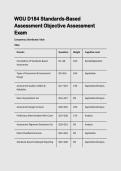
WGU D184 Standards-Based
Assessment Objective Assessment
Exam
Competency Distribution Table
Table
Domain Questions Weight Cognitive Level
Foundations of Standards-Based Q1–Q8 16% Recall/Application
Assessment
Types of Assessment & Assessment Q9–Q16 16% Application
Design
Assessment Quality, Validity & Q17–Q23 14% Application/Analysis
Reliability
Data Interpretation Set Q24–Q27 8% Application/Analysis
Assessment Design Scenario Q28–Q32 10% Application/Analysis
Proficiency Determination Mini-Cases Q33–Q38 12% Analysis
Assessment Alignment Evaluation Set Q39–Q41 6% Analysis
Rubric/Feedback Scenario Q42–Q44 6% Application
Standards-Based Grading & Reporting Q45–Q48 8% Application/Analysis
, Domain Questions Weight Cognitive Level
Special Populations & Standardized Q49–Q50 4% Application
Testing
Total: 50 Questions
Q1
Which of the following best describes the primary purpose of assessment FOR learning?
A. To assign final grades at the end of a grading period
B. To diagnose student readiness before instruction begins
C. To provide ongoing feedback that informs instruction and supports student growth
D. To compare student performance against national percentile rankings
Correct Answer: C [CORRECT]
Rationale: Assessment FOR learning (formative assessment) is designed to provide continuous
feedback to both teachers and students during the learning process, enabling instructional
adjustments and supporting student progress toward standards. This contrasts with assessment
OF learning (summative) and assessment AS learning (self-monitoring).
Q2
In a standards-based grading system, what is the primary distinction between accommodations
and modifications?
A. Accommodations change the learning target; modifications change how the target is
measured
B. Accommodations provide equal access without changing the standard; modifications alter
the standard's complexity or expectations
C. Accommodations are only for students with IEPs; modifications are only for students with 504
plans
D. Accommodations are temporary supports; modifications are permanent changes to
curriculum
Correct Answer: B [CORRECT]
, Rationale: In standards-based assessment, accommodations (e.g., extended time, read-aloud)
allow students to access grade-level standards without altering the learning target, whereas
modifications (e.g., reduced complexity, alternate standards) change the expected level of
performance or the standard itself.
Q3
Which cognitive level of Webb's Depth of Knowledge (DOK) requires students to engage in
strategic thinking over an extended period, often involving complex reasoning and planning?
A. DOK 1 — Recall
B. DOK 2 — Skill/Concept
C. DOK 3 — Strategic Thinking
D. DOK 4 — Extended Thinking
Correct Answer: D [CORRECT]
Rationale: DOK 4 (Extended Thinking) requires complex reasoning, planning, and execution over
an extended time period, often involving real-world application and synthesis of multiple
concepts. DOK 3 involves strategic thinking but typically within a shorter, more defined context.
Q4
Under the Every Student Succeeds Act (ESSA), which of the following testing requirements
applies to states?
A. Annual testing in reading and mathematics for students in grades K–12
B. Annual testing in reading and mathematics for students in grades 3–8 and once in high school
C. Biennial testing in science for all students regardless of grade level
D. Mandatory standardized testing for students in grades 1–2 to establish baseline data
Correct Answer: B [CORRECT]
Rationale: ESSA maintains the requirement for annual statewide assessments in
reading/language arts and mathematics for students in grades 3 through 8 and once in high
school, while providing states with increased flexibility in accountability measures compared to
NCLB.
Q5
Assessment Objective Assessment
Exam
Competency Distribution Table
Table
Domain Questions Weight Cognitive Level
Foundations of Standards-Based Q1–Q8 16% Recall/Application
Assessment
Types of Assessment & Assessment Q9–Q16 16% Application
Design
Assessment Quality, Validity & Q17–Q23 14% Application/Analysis
Reliability
Data Interpretation Set Q24–Q27 8% Application/Analysis
Assessment Design Scenario Q28–Q32 10% Application/Analysis
Proficiency Determination Mini-Cases Q33–Q38 12% Analysis
Assessment Alignment Evaluation Set Q39–Q41 6% Analysis
Rubric/Feedback Scenario Q42–Q44 6% Application
Standards-Based Grading & Reporting Q45–Q48 8% Application/Analysis
, Domain Questions Weight Cognitive Level
Special Populations & Standardized Q49–Q50 4% Application
Testing
Total: 50 Questions
Q1
Which of the following best describes the primary purpose of assessment FOR learning?
A. To assign final grades at the end of a grading period
B. To diagnose student readiness before instruction begins
C. To provide ongoing feedback that informs instruction and supports student growth
D. To compare student performance against national percentile rankings
Correct Answer: C [CORRECT]
Rationale: Assessment FOR learning (formative assessment) is designed to provide continuous
feedback to both teachers and students during the learning process, enabling instructional
adjustments and supporting student progress toward standards. This contrasts with assessment
OF learning (summative) and assessment AS learning (self-monitoring).
Q2
In a standards-based grading system, what is the primary distinction between accommodations
and modifications?
A. Accommodations change the learning target; modifications change how the target is
measured
B. Accommodations provide equal access without changing the standard; modifications alter
the standard's complexity or expectations
C. Accommodations are only for students with IEPs; modifications are only for students with 504
plans
D. Accommodations are temporary supports; modifications are permanent changes to
curriculum
Correct Answer: B [CORRECT]
, Rationale: In standards-based assessment, accommodations (e.g., extended time, read-aloud)
allow students to access grade-level standards without altering the learning target, whereas
modifications (e.g., reduced complexity, alternate standards) change the expected level of
performance or the standard itself.
Q3
Which cognitive level of Webb's Depth of Knowledge (DOK) requires students to engage in
strategic thinking over an extended period, often involving complex reasoning and planning?
A. DOK 1 — Recall
B. DOK 2 — Skill/Concept
C. DOK 3 — Strategic Thinking
D. DOK 4 — Extended Thinking
Correct Answer: D [CORRECT]
Rationale: DOK 4 (Extended Thinking) requires complex reasoning, planning, and execution over
an extended time period, often involving real-world application and synthesis of multiple
concepts. DOK 3 involves strategic thinking but typically within a shorter, more defined context.
Q4
Under the Every Student Succeeds Act (ESSA), which of the following testing requirements
applies to states?
A. Annual testing in reading and mathematics for students in grades K–12
B. Annual testing in reading and mathematics for students in grades 3–8 and once in high school
C. Biennial testing in science for all students regardless of grade level
D. Mandatory standardized testing for students in grades 1–2 to establish baseline data
Correct Answer: B [CORRECT]
Rationale: ESSA maintains the requirement for annual statewide assessments in
reading/language arts and mathematics for students in grades 3 through 8 and once in high
school, while providing states with increased flexibility in accountability measures compared to
NCLB.
Q5


