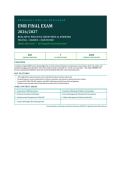
EMERGENCY MEDICAL RESPONDER
EMR FINAL EXAM
2026/2027
REALISTIC PRACTICE QUESTIONS & ANSWERS
PRACTICAL • RIGOROUS • EXAM-FOCUSED
Edition 2026/2027 • 205 Original Practice Questions
205 7 2025
ORIGINAL QUESTIONS FOCUSED SECTIONS CURRENT CORE GUIDANCE
O VE RVI E W
A realistic, original EMR review bank aligned to current national education, examination, resuscitation, first-aid, safety, and
incident-management authorities. The seven study sections crosswalk to—but do not reproduce—the official NREMT five-
domain examination blueprint. State law and local medical direction control actual practice.
K E Y F E A T U RE S
• 205 original four-option questions with randomized, balanced answer placement
• Restated answers, concise authoritative citations, rationales, and option-by-option distractor analysis
• Current 2025 AHA CPR/ECC updates and 2024 AHA/American Red Cross first-aid guidance
• National scope concepts clearly separated from state and local authorization
CO RE C O N T E N T A RE A S
1. Preparatory & EMS Operations 2. Anatomy, Physiology & Medical Terminology
3. Patient Assessment & Vital Signs 4. Airway Management & Respiratory Emergencies
5. Cardiovascular Emergencies & CPR/AED 6. Medical Emergencies & Behavioral Health
7. Trauma, Bleeding & Shock Management
National Registry of Emergency Medical Technicians (NREMT) / applicable State EMS Authority
, EMR FINAL EXAM • NREMT / APPLICABLE STATE EMS AUTHORITY • 2026/2027
SECTION 1 • 30 QUESTIONS
Preparatory & EMS Operations
Professional practice, responder safety, communication, incident operations, and transport readiness
1. An EMR arrives at a home where blood is pooled beside an injured patient. What
should the responder do before making patient contact?
A. Wait until active bleeding is confirmed before using PPE
B. Cover the blood with a towel and enter without gloves
C. Apply appropriate gloves and other task-specific PPE before entering the blood-
contaminated area
D. Ask a family member whether the patient has an infection
Correct Answer: C. Apply appropriate gloves and other task-specific PPE before entering the
blood-contaminated area
Citation: OSHA, 29 CFR 1910.1030, Bloodborne Pathogens Standard—universal precautions, PPE, and
postexposure follow-up.
Rationale: Blood is treated as potentially infectious. PPE must be selected and applied before the anticipated
exposure whenever the scene permits.
Why A is incorrect: Exposure can occur from pooled blood even when active bleeding is not visible.
Why B is incorrect: A towel is not an exposure-control barrier and does not replace PPE.
Why D is incorrect: Universal precautions do not depend on a known diagnosis or family report.
2. Which PPE combination is most appropriate when controlling spurting arterial
bleeding with a risk of splash to the face?
A. Gloves only because bloodborne pathogens cannot enter through the eyes
B. Gloves plus eye and face protection, with protective clothing as exposure risk warrants
C. A surgical mask only because hand contact is harmless
D. No PPE if the patient is a close relative
Correct Answer: B. Gloves plus eye and face protection, with protective clothing as exposure
risk warrants
Citation: OSHA, 29 CFR 1910.1030, Bloodborne Pathogens Standard—universal precautions, PPE, and
postexposure follow-up.
Rationale: Task-specific PPE should protect the hands, eyes, nose, mouth, and clothing when splashing or
spraying blood is reasonably anticipated.
Why A is incorrect: Mucous membranes of the eyes, nose, and mouth are recognized exposure routes.
Why C is incorrect: A mask alone leaves the hands and eyes unprotected from blood exposure.
Why D is incorrect: Universal precautions apply regardless of the responder’s relationship to the patient.
Page 2 • NREMT / applicable State EMS Authority Registry/Board
, EMR FINAL EXAM • NREMT / APPLICABLE STATE EMS AUTHORITY • 2026/2027
3. After using a disposable needle found at a scene, which action best follows
bloodborne-pathogen safety practice?
A. Recap it using both hands before disposal
B. Break the needle so it will fit in a trash bag
C. Leave it on a counter for the transport crew
D. Place it immediately into an approved sharps container without bending or recapping it
Correct Answer: D. Place it immediately into an approved sharps container without bending
or recapping it
Citation: OSHA, 29 CFR 1910.1030, Bloodborne Pathogens Standard—universal precautions, PPE, and
postexposure follow-up.
Rationale: Immediate disposal in a closable, puncture-resistant sharps container reduces preventable needlestick
injuries.
Why A is incorrect: Two-handed recapping creates an avoidable needlestick hazard.
Why B is incorrect: Breaking or shearing contaminated sharps is unsafe and generally prohibited.
Why C is incorrect: An unattended contaminated sharp exposes patients, responders, and bystanders.
4. An EMR sustains a needlestick from a contaminated sharp. What is the best immediate
course of action?
A. Wash the area, report the exposure promptly, and begin the agency’s confidential
postexposure process
B. Squeeze the wound aggressively and finish the shift without reporting it
C. Apply bleach directly to the puncture site
D. Wait for symptoms before notifying the supervisor
Correct Answer: A. Wash the area, report the exposure promptly, and begin the agency’s
confidential postexposure process
Citation: OSHA, 29 CFR 1910.1030, Bloodborne Pathogens Standard—universal precautions, PPE, and
postexposure follow-up.
Rationale: Prompt cleansing, reporting, documentation, and medical evaluation allow time-sensitive
postexposure decisions.
Why B is incorrect: Aggressive squeezing is not a substitute for cleansing and delays required follow-up.
Why C is incorrect: Caustic chemicals can injure tissue and are not recommended wound care.
Why D is incorrect: Postexposure evaluation should begin promptly, not after illness develops.
5. At a nighttime roadway crash, where should the EMR position whenever possible
while beginning the scene size-up?
A. Between two damaged vehicles so both patients are close
B. In the travel lane with a flashlight pointed at oncoming drivers
C. Downhill from a leaking vehicle so the spill can be observed
D. In a protected area visible to traffic and away from moving lanes and unstable vehicles
Correct Answer: D. In a protected area visible to traffic and away from moving lanes and
unstable vehicles
Citation: NREMT EMR Examination Specifications (effective Spring 2025), Scene Size-up and Safety domain.
Rationale: The responder must identify traffic, vehicle, fire, and environmental hazards before committing to
patient contact.
Why A is incorrect: Damaged vehicles can shift, ignite, or be struck by traffic.
Why B is incorrect: Standing in a live lane exposes the responder to a high-energy secondary collision.
Why C is incorrect: Liquids and vapors may move downhill and create a hazardous exposure zone.
Page 3 • NREMT / applicable State EMS Authority Registry/Board
, EMR FINAL EXAM • NREMT / APPLICABLE STATE EMS AUTHORITY • 2026/2027
6. During scene size-up, the EMR finds three injured people instead of the single patient
reported. What should happen first?
A. Cancel incoming units until each patient receives a complete exam
B. Request additional EMS resources early and continue identifying immediate hazards
C. Transport the first person in a private vehicle
D. Complete paperwork before telling dispatch about the added patients
Correct Answer: B. Request additional EMS resources early and continue identifying
immediate hazards
Citation: NREMT EMR Examination Specifications (effective Spring 2025), Scene Size-up and Safety domain.
Rationale: Early resource requests reduce delays when patient count or scene complexity exceeds the initial
dispatch information.
Why A is incorrect: Delaying the request can leave multiple patients without timely care.
Why C is incorrect: Uncoordinated private transport may be unsafe and disrupt incident accountability.
Why D is incorrect: Resource needs and hazards are time-critical; documentation follows operational
notification.
7. Which Incident Command System principle means each responder reports to only one
designated supervisor?
A. Unity of command
B. Span of control
C. Resource typing
D. Modular organization
Correct Answer: A. Unity of command
Citation: FEMA, National Incident Management System, 3rd ed. (2017), Command and Coordination /
Incident Command System.
Rationale: Unity of command prevents conflicting orders by giving each individual one identified supervisor
within the incident structure.
Why B is incorrect: Span of control concerns how many individuals or resources a supervisor can effectively
manage.
Why C is incorrect: Resource typing classifies capabilities rather than assigning a single supervisor.
Why D is incorrect: Modular organization expands or contracts the structure but does not define one-supervisor
reporting.
8. An ICS supervisor is directly managing 12 individual responders and communication
is deteriorating. What is the best correction?
A. Have all 12 responders transmit at the same time
B. Eliminate incident command so responders can self-assign
C. Create additional supervisory groups or divisions to restore a manageable span of control
D. Transfer every responder to the public information officer
Correct Answer: C. Create additional supervisory groups or divisions to restore a
manageable span of control
Citation: FEMA, National Incident Management System, 3rd ed. (2017), Command and Coordination /
Incident Command System.
Rationale: NIMS identifies five subordinates as optimal and three to seven as a generally manageable span,
adjusted for incident complexity.
Why A is incorrect: Simultaneous communication worsens channel congestion and accountability.
Why B is incorrect: Self-deployment undermines command, coordination, and safety.
Why D is incorrect: The public information role is not an operational supervision solution.
Page 4 • NREMT / applicable State EMS Authority Registry/Board
EMR FINAL EXAM
2026/2027
REALISTIC PRACTICE QUESTIONS & ANSWERS
PRACTICAL • RIGOROUS • EXAM-FOCUSED
Edition 2026/2027 • 205 Original Practice Questions
205 7 2025
ORIGINAL QUESTIONS FOCUSED SECTIONS CURRENT CORE GUIDANCE
O VE RVI E W
A realistic, original EMR review bank aligned to current national education, examination, resuscitation, first-aid, safety, and
incident-management authorities. The seven study sections crosswalk to—but do not reproduce—the official NREMT five-
domain examination blueprint. State law and local medical direction control actual practice.
K E Y F E A T U RE S
• 205 original four-option questions with randomized, balanced answer placement
• Restated answers, concise authoritative citations, rationales, and option-by-option distractor analysis
• Current 2025 AHA CPR/ECC updates and 2024 AHA/American Red Cross first-aid guidance
• National scope concepts clearly separated from state and local authorization
CO RE C O N T E N T A RE A S
1. Preparatory & EMS Operations 2. Anatomy, Physiology & Medical Terminology
3. Patient Assessment & Vital Signs 4. Airway Management & Respiratory Emergencies
5. Cardiovascular Emergencies & CPR/AED 6. Medical Emergencies & Behavioral Health
7. Trauma, Bleeding & Shock Management
National Registry of Emergency Medical Technicians (NREMT) / applicable State EMS Authority
, EMR FINAL EXAM • NREMT / APPLICABLE STATE EMS AUTHORITY • 2026/2027
SECTION 1 • 30 QUESTIONS
Preparatory & EMS Operations
Professional practice, responder safety, communication, incident operations, and transport readiness
1. An EMR arrives at a home where blood is pooled beside an injured patient. What
should the responder do before making patient contact?
A. Wait until active bleeding is confirmed before using PPE
B. Cover the blood with a towel and enter without gloves
C. Apply appropriate gloves and other task-specific PPE before entering the blood-
contaminated area
D. Ask a family member whether the patient has an infection
Correct Answer: C. Apply appropriate gloves and other task-specific PPE before entering the
blood-contaminated area
Citation: OSHA, 29 CFR 1910.1030, Bloodborne Pathogens Standard—universal precautions, PPE, and
postexposure follow-up.
Rationale: Blood is treated as potentially infectious. PPE must be selected and applied before the anticipated
exposure whenever the scene permits.
Why A is incorrect: Exposure can occur from pooled blood even when active bleeding is not visible.
Why B is incorrect: A towel is not an exposure-control barrier and does not replace PPE.
Why D is incorrect: Universal precautions do not depend on a known diagnosis or family report.
2. Which PPE combination is most appropriate when controlling spurting arterial
bleeding with a risk of splash to the face?
A. Gloves only because bloodborne pathogens cannot enter through the eyes
B. Gloves plus eye and face protection, with protective clothing as exposure risk warrants
C. A surgical mask only because hand contact is harmless
D. No PPE if the patient is a close relative
Correct Answer: B. Gloves plus eye and face protection, with protective clothing as exposure
risk warrants
Citation: OSHA, 29 CFR 1910.1030, Bloodborne Pathogens Standard—universal precautions, PPE, and
postexposure follow-up.
Rationale: Task-specific PPE should protect the hands, eyes, nose, mouth, and clothing when splashing or
spraying blood is reasonably anticipated.
Why A is incorrect: Mucous membranes of the eyes, nose, and mouth are recognized exposure routes.
Why C is incorrect: A mask alone leaves the hands and eyes unprotected from blood exposure.
Why D is incorrect: Universal precautions apply regardless of the responder’s relationship to the patient.
Page 2 • NREMT / applicable State EMS Authority Registry/Board
, EMR FINAL EXAM • NREMT / APPLICABLE STATE EMS AUTHORITY • 2026/2027
3. After using a disposable needle found at a scene, which action best follows
bloodborne-pathogen safety practice?
A. Recap it using both hands before disposal
B. Break the needle so it will fit in a trash bag
C. Leave it on a counter for the transport crew
D. Place it immediately into an approved sharps container without bending or recapping it
Correct Answer: D. Place it immediately into an approved sharps container without bending
or recapping it
Citation: OSHA, 29 CFR 1910.1030, Bloodborne Pathogens Standard—universal precautions, PPE, and
postexposure follow-up.
Rationale: Immediate disposal in a closable, puncture-resistant sharps container reduces preventable needlestick
injuries.
Why A is incorrect: Two-handed recapping creates an avoidable needlestick hazard.
Why B is incorrect: Breaking or shearing contaminated sharps is unsafe and generally prohibited.
Why C is incorrect: An unattended contaminated sharp exposes patients, responders, and bystanders.
4. An EMR sustains a needlestick from a contaminated sharp. What is the best immediate
course of action?
A. Wash the area, report the exposure promptly, and begin the agency’s confidential
postexposure process
B. Squeeze the wound aggressively and finish the shift without reporting it
C. Apply bleach directly to the puncture site
D. Wait for symptoms before notifying the supervisor
Correct Answer: A. Wash the area, report the exposure promptly, and begin the agency’s
confidential postexposure process
Citation: OSHA, 29 CFR 1910.1030, Bloodborne Pathogens Standard—universal precautions, PPE, and
postexposure follow-up.
Rationale: Prompt cleansing, reporting, documentation, and medical evaluation allow time-sensitive
postexposure decisions.
Why B is incorrect: Aggressive squeezing is not a substitute for cleansing and delays required follow-up.
Why C is incorrect: Caustic chemicals can injure tissue and are not recommended wound care.
Why D is incorrect: Postexposure evaluation should begin promptly, not after illness develops.
5. At a nighttime roadway crash, where should the EMR position whenever possible
while beginning the scene size-up?
A. Between two damaged vehicles so both patients are close
B. In the travel lane with a flashlight pointed at oncoming drivers
C. Downhill from a leaking vehicle so the spill can be observed
D. In a protected area visible to traffic and away from moving lanes and unstable vehicles
Correct Answer: D. In a protected area visible to traffic and away from moving lanes and
unstable vehicles
Citation: NREMT EMR Examination Specifications (effective Spring 2025), Scene Size-up and Safety domain.
Rationale: The responder must identify traffic, vehicle, fire, and environmental hazards before committing to
patient contact.
Why A is incorrect: Damaged vehicles can shift, ignite, or be struck by traffic.
Why B is incorrect: Standing in a live lane exposes the responder to a high-energy secondary collision.
Why C is incorrect: Liquids and vapors may move downhill and create a hazardous exposure zone.
Page 3 • NREMT / applicable State EMS Authority Registry/Board
, EMR FINAL EXAM • NREMT / APPLICABLE STATE EMS AUTHORITY • 2026/2027
6. During scene size-up, the EMR finds three injured people instead of the single patient
reported. What should happen first?
A. Cancel incoming units until each patient receives a complete exam
B. Request additional EMS resources early and continue identifying immediate hazards
C. Transport the first person in a private vehicle
D. Complete paperwork before telling dispatch about the added patients
Correct Answer: B. Request additional EMS resources early and continue identifying
immediate hazards
Citation: NREMT EMR Examination Specifications (effective Spring 2025), Scene Size-up and Safety domain.
Rationale: Early resource requests reduce delays when patient count or scene complexity exceeds the initial
dispatch information.
Why A is incorrect: Delaying the request can leave multiple patients without timely care.
Why C is incorrect: Uncoordinated private transport may be unsafe and disrupt incident accountability.
Why D is incorrect: Resource needs and hazards are time-critical; documentation follows operational
notification.
7. Which Incident Command System principle means each responder reports to only one
designated supervisor?
A. Unity of command
B. Span of control
C. Resource typing
D. Modular organization
Correct Answer: A. Unity of command
Citation: FEMA, National Incident Management System, 3rd ed. (2017), Command and Coordination /
Incident Command System.
Rationale: Unity of command prevents conflicting orders by giving each individual one identified supervisor
within the incident structure.
Why B is incorrect: Span of control concerns how many individuals or resources a supervisor can effectively
manage.
Why C is incorrect: Resource typing classifies capabilities rather than assigning a single supervisor.
Why D is incorrect: Modular organization expands or contracts the structure but does not define one-supervisor
reporting.
8. An ICS supervisor is directly managing 12 individual responders and communication
is deteriorating. What is the best correction?
A. Have all 12 responders transmit at the same time
B. Eliminate incident command so responders can self-assign
C. Create additional supervisory groups or divisions to restore a manageable span of control
D. Transfer every responder to the public information officer
Correct Answer: C. Create additional supervisory groups or divisions to restore a
manageable span of control
Citation: FEMA, National Incident Management System, 3rd ed. (2017), Command and Coordination /
Incident Command System.
Rationale: NIMS identifies five subordinates as optimal and three to seven as a generally manageable span,
adjusted for incident complexity.
Why A is incorrect: Simultaneous communication worsens channel congestion and accountability.
Why B is incorrect: Self-deployment undermines command, coordination, and safety.
Why D is incorrect: The public information role is not an operational supervision solution.
Page 4 • NREMT / applicable State EMS Authority Registry/Board