

Written by students who passed Immediately available after payment Read online or as PDF Wrong document? Swap it for free 4.6 TrustPilot
logo-home
Document preview thumbnail
Preview 1 out of 4 pages
Exam (elaborations)

NHA CCMA National Exam Study Guide 2026/2027 – 15+ Questions & Answers, Abdominal Quadrants, Body Planes & Patient Positions

Document preview thumbnail
Preview 1 out of 4 pages

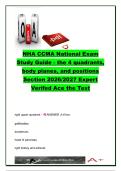
This focused NHA CCMA National Exam Study Guide 2026/2027 provides 15+ questions, answers, and key review points across 4 pages covering three high-yield anatomy and clinical-assisting areas: the four abdominal quadrants, anatomical body planes, and patient examination positions. Designed for Certified Clinical Medical Assistant exam preparation, the guide offers concise definitions that help students identify the location of major abdominal organs, understand how anatomical planes divide the human body, and distinguish commonly used clinical positions. The cover on page 1 specifically identifies the resource as the “4 quadrants, body planes, and positions” section, making its exam-review focus clear. The abdominal quadrants section reviews the Right Upper Quadrant (RUQ), Left Upper Quadrant (LUQ), Right Lower Quadrant (RLQ), and Left Lower Quadrant (LLQ), together with the principal organs and structures associated with each region. The RUQ content includes the liver, gallbladder, duodenum, head of the pancreas, right kidney and adrenal gland, hepatic flexure, and portions of the ascending and transverse colon. The LUQ reviews the stomach, spleen, left lobe of the liver, body of the pancreas, left kidney and adrenal gland, splenic flexure, and portions of the transverse and descending colon. The lower quadrants cover structures including the cecum, appendix, sigmoid and descending colon, ureters, ovaries and uterine tubes, and spermatic cords. The guide next addresses the three fundamental anatomical body planes frequently encountered in medical terminology and clinical practice. The sagittal plane divides the body into left and right portions, the coronal/frontal plane separates anterior and posterior portions, and the transverse plane divides the body into superior and inferior portions. Understanding these directional divisions supports broader CCMA learning in anatomy, diagnostic procedures, physical examination, imaging, and accurate communication of anatomical locations. The final section provides concentrated review of patient positioning for physical examinations and clinical procedures. Positions covered include supine, prone, Sims, knee-chest, dorsal recumbent, standing, lithotomy, Fowler's, squatting, and sitting. The guide distinguishes these positions by the orientation of the patient's trunk, extremities, knees, and head; for example, Fowler's is described as a semi-sitting position with the head of the bed elevated approximately 45–60 degrees, while lithotomy places the patient supine with the legs elevated and feet supported in stirrups. For deeper academic preparation, students can supplement this guide with a current comprehensive medical-assisting textbook such as Kinn's The Medical Assistant: An Applied Learning Approach, particularly its material on anatomy, medical terminology, physical examinations, and patient positioning. A standard anatomy and physiology reference such as Anatomy & Physiology by OpenStax can also reinforce anatomical planes, directional terminology, abdominal regions, and organ locations. Candidates should additionally consult the current NHA CCMA test plan and official study resources to ensure their preparation reflects the latest certification competencies. These are supporting references rather than sources explicitly cited within the uploaded study guide. Relevant Students: NHA CCMA candidates, Certified Clinical Medical Assistant students, medical assistant students, clinical medical assisting students, allied health students, medical assisting program students, healthcare certification candidates, anatomy and physiology students, medical terminology students, students preparing for the NHA National CCMA examination Keywords: NHA CCMA National Exam Study Guide, NHA CCMA exam , CCMA national exam questions and answers, Certified Clinical Medical Assistant study guide, NHA CCMA anatomy review, abdominal quadrants, four abdominal quadrants, RUQ organs, LUQ organs, RLQ organs, LLQ organs, abdominal quadrant anatomy, body planes anatomy, sagittal plane, coronal plane, transverse plane, anatomical planes, patient positions, examination positions, supine position, prone position, Sims position, knee chest position, dorsal recumbent position, lithotomy position, Fowlers position, sitting position, medical assistant anatomy, CCMA patient positioning, NHA certification exam, CCMA study guide 2026, medical assisting exam preparation

Content preview

NHA CCMA National Exam
Study Guide - the 4 quadrants,
body planes, and positions
Section 2026/2027 Expert
Verifed Ace the Test


right upper quadrant - ANSWER ✔✔liver,


gallbladder,

duodenum,

head of pancreas,

right kidney and adrenal,

Document information

Uploaded on
August 12, 2026
Number of pages
4
Written in
2026/2027
Type
Exam (elaborations)
Contains
Questions & answers
$20.99

Wrong document? Swap it for free Within 14 days of purchase and before downloading, you can choose a different document. You can simply spend the amount again.
Written by students who passed
Immediately available after payment
Read online or as PDF

Seller avatar
Reputation scores are based on the amount of documents a seller has sold for a fee and the reviews they have received for those documents. There are three levels: Bronze, Silver and Gold. The better the reputation, the more your can rely on the quality of the sellers work.
JOSHCLAY
3.5
(82)
Sold
383
Followers
16
Items
20324
Last sold
2 days ago


Why students choose Stuvia

Created by fellow students, verified by reviews

Quality you can trust: written by students who passed their tests and reviewed by others who've used these notes.

Didn't get what you expected? Choose another document

No worries! You can instantly pick a different document that better fits what you're looking for.

Pay as you like, start learning right away

No subscription, no commitments. Pay the way you're used to via credit card and download your PDF document instantly.

Student with book image

“Bought, downloaded, and aced it. It really can be that simple.”

Alisha Student

Working on your references?

Create accurate citations in APA, MLA and Harvard with our free citation generator.

Working on your references?

Frequently asked questions

