

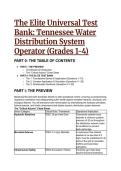
The Elite Universal Test
Bank: Tennessee Water
Distribution System
Operator (Grades 1-4)
PART 0: THE TABLE OF CONTENTS
● PART I: THE PREVIEW
○ The Mission & Introduction
○ The "Critical Axioms" Cheat Sheet
● PART II: THE ELITE TEST BANK
○ Tier 1: Foundational Syntax & Application (Questions 1–10)
○ Tier 2: Complex Application & Simulation (Questions 11–20)
○ Tier 3: Grandmaster Synthesis (Questions 21–30)
PART I: THE PREVIEW
Mastering this test bank translates directly to elite operational control, ensuring uncompromising
regulatory compliance and safeguarding public health against complex hydraulic, structural, and
biological failures. You will transcend rote memorization by internalizing the hydraulic principles,
federal statutes, and kinetic phenomena that dictate dynamic distribution system behavior.
The "Critical Axioms" Cheat Sheet:
Axiom Category Critical Rule / Framework Operational Implication
Hydraulic Baselines TDEC 20-psi Hard Deck Community systems must
maintain a minimum positive
pressure of 20 psi throughout
the distribution network under
all conditions to prevent
back-siphonage.
Microbial Defense TDEC 0.2 mg/L Mandate A continuous free chlorine
residual of no less than 0.2
mg/L must be maintained in all
parts of the grid to neutralize
biofilms and secondary
pathogens.
Infrastructure Safety OSHA Excavation Trifecta Trenches \ge 5 feet deep
require structural protection;
,Axiom Category Critical Rule / Framework Operational Implication
egress ladders must be within
25 lateral feet; spoil piles
require a strict 2-foot setback.
Federal Compliance EPA LCRI 10-Year Directive The Lead Action Level is strictly
lowered to 10 ppb. Utilities
must achieve 100% mandatory
replacement of all lead service
lines within 10 years and utilize
1st/5th-liter sampling.
Asset Disinfection AWWA C651 Continuous-Feed Requires an initial chlorine
dose of 25 mg/L with a
mandatory minimum residual of
10 mg/L remaining after a
24-hour contact period.
Cross-Connection RP vs. DC Applications Reduced Pressure (RP)
assemblies isolate high-hazard
(toxic) cross-connections;
Double Check (DC) valves are
legally restricted to low-hazard
(pollutant) threats.
PART II: THE ELITE TEST BANK
Tier 1: Foundational Syntax & Application
Q1: According to the Tennessee Department of Environment and Conservation (TDEC)
regulations, a distribution system experiences a severe hydraulic failure leading to widespread
pressure loss across multiple elevation zones. To protect public health from contaminant
intrusion, what is the ABSOLUTE MINIMUM positive pressure that must be maintained
throughout the distribution system under all operating conditions?
A) 15 psi B) 20 psi C) 30 psi D) 35 psi
● Answer: B (20 psi)
● Distractor Analysis:
○ A is incorrect: Permitting system pressure to drop to 15 psi is a critical violation of
the regulatory threshold, drastically increasing the immediate risk of
back-siphonage through unprotected cross-connections and micro-fractures in
aging infrastructure.
○ C is incorrect: While 30 psi is a commonly recommended operational target for
standard domestic service delivery to ensure adequate flow at the tap, it is not the
regulatory hard-deck minimum for health protection.
○ D is incorrect: 35 psi is routinely cited as a minimum for standard operating
pressure during peak hourly demand in standard engineering design criteria, not
the absolute legal minimum during emergencies.
The Mentor's Analysis: TDEC Rule 0400-45-01-.17 strictly dictates that all community water
systems must be operated and maintained to provide a minimum positive pressure of 20 psi.
Falling below this threshold legally mandates immediate corrective actions, including
low-pressure cut-offs for booster pumps and potential system-wide boil water advisories.
, Professional/Academic Intuition: Never compromise the 20-psi hard deck; it is the
fundamental physical barrier against back-siphonage and catastrophic pathogen
intrusion.
Q2: A Grade 2 operator is reviewing the daily chlorine residual logs for the far extremities of a
branching distribution system, specifically targeting dead-end mains. Per TDEC requirements,
what is the MINIMUM acceptable free chlorine residual that must be continuously maintained in
all parts of the distribution system?
A) 0.1 mg/L B) 0.2 mg/L C) 0.5 mg/L D) 1.0 mg/L
● Answer: B (0.2 mg/L)
● Distractor Analysis:
○ A is incorrect: A residual of 0.1 mg/L is an outdated metric or a standard-specific
minimum used in alternative state jurisdictions, but it violates current TDEC
requirements and provides inadequate defense against rapid biofilm consumption.
○ C is incorrect: A reading of 0.5 mg/L is an excellent operational target for treated
water leaving the primary facility, but it is not the legal minimum at the network
extremities.
○ D is incorrect: A 1.0 mg/L residual represents a highly robust concentration often
utilized strategically to combat active nitrification or excessively high water age, not
a regulatory floor.
The Mentor's Analysis: Maintaining a measurable, active disinfectant residual prevents biofilm
proliferation and secondary pathogen growth as water travels miles from the treatment plant.
TDEC mandates a continuous free chlorine residual of not less than 0.2 mg/L throughout the
entire distribution network. Professional/Academic Intuition: Regulatory compliance is
measured at the weakest link—the dead-end main. Always operate with a sufficient
kinetic buffer above 0.2 mg/L.
Q3: The EPA's recent Lead and Copper Rule Improvements (LCRI) mandate stringent new
testing and operational parameters for all public water systems. Under the finalized LCRI
framework established for implementation by 2027, which specific Action Level triggers
mandatory Tier 1 public notification and accelerated mitigation protocols?
A) 15 parts per billion (ppb) B) 10 parts per billion (ppb) C) 5 parts per billion (ppb) D) 0 parts
per billion (ppb)
● Answer: B (10 parts per billion (ppb))
● Distractor Analysis:
○ A is incorrect: 15 ppb is the legacy action level under the original 1991 Lead and
Copper Rule and the intermediate 2021 LCRR; relying on this outdated metric will
result in severe federal non-compliance.
○ C is incorrect: 5 ppb is commonly utilized as a highly conservative internal
operational trigger or a specific state-mandated threshold (e.g., FDA bottled water
limits), but it is not the federal EPA LCRI Action Level for municipal systems.
○ D is incorrect: While the Maximum Contaminant Level Goal (MCLG) for lead is
inherently zero due to its extreme neurotoxicity, the enforceable regulatory Action
Level is 10 ppb.
The Mentor's Analysis: The LCRI lowered the lead action level from 15 ppb to 10 ppb to
compel earlier utility intervention, requiring systems with exceedances to aggressively optimize
corrosion control, issue rapid public notification, and distribute certified point-of-use filters.
Professional/Academic Intuition: The 10 ppb threshold radically redefines compliance;
exceeding it immediately triggers a cascade of mandatory public health responses and
filter distribution protocols.
Bank: Tennessee Water
Distribution System
Operator (Grades 1-4)
PART 0: THE TABLE OF CONTENTS
● PART I: THE PREVIEW
○ The Mission & Introduction
○ The "Critical Axioms" Cheat Sheet
● PART II: THE ELITE TEST BANK
○ Tier 1: Foundational Syntax & Application (Questions 1–10)
○ Tier 2: Complex Application & Simulation (Questions 11–20)
○ Tier 3: Grandmaster Synthesis (Questions 21–30)
PART I: THE PREVIEW
Mastering this test bank translates directly to elite operational control, ensuring uncompromising
regulatory compliance and safeguarding public health against complex hydraulic, structural, and
biological failures. You will transcend rote memorization by internalizing the hydraulic principles,
federal statutes, and kinetic phenomena that dictate dynamic distribution system behavior.
The "Critical Axioms" Cheat Sheet:
Axiom Category Critical Rule / Framework Operational Implication
Hydraulic Baselines TDEC 20-psi Hard Deck Community systems must
maintain a minimum positive
pressure of 20 psi throughout
the distribution network under
all conditions to prevent
back-siphonage.
Microbial Defense TDEC 0.2 mg/L Mandate A continuous free chlorine
residual of no less than 0.2
mg/L must be maintained in all
parts of the grid to neutralize
biofilms and secondary
pathogens.
Infrastructure Safety OSHA Excavation Trifecta Trenches \ge 5 feet deep
require structural protection;
,Axiom Category Critical Rule / Framework Operational Implication
egress ladders must be within
25 lateral feet; spoil piles
require a strict 2-foot setback.
Federal Compliance EPA LCRI 10-Year Directive The Lead Action Level is strictly
lowered to 10 ppb. Utilities
must achieve 100% mandatory
replacement of all lead service
lines within 10 years and utilize
1st/5th-liter sampling.
Asset Disinfection AWWA C651 Continuous-Feed Requires an initial chlorine
dose of 25 mg/L with a
mandatory minimum residual of
10 mg/L remaining after a
24-hour contact period.
Cross-Connection RP vs. DC Applications Reduced Pressure (RP)
assemblies isolate high-hazard
(toxic) cross-connections;
Double Check (DC) valves are
legally restricted to low-hazard
(pollutant) threats.
PART II: THE ELITE TEST BANK
Tier 1: Foundational Syntax & Application
Q1: According to the Tennessee Department of Environment and Conservation (TDEC)
regulations, a distribution system experiences a severe hydraulic failure leading to widespread
pressure loss across multiple elevation zones. To protect public health from contaminant
intrusion, what is the ABSOLUTE MINIMUM positive pressure that must be maintained
throughout the distribution system under all operating conditions?
A) 15 psi B) 20 psi C) 30 psi D) 35 psi
● Answer: B (20 psi)
● Distractor Analysis:
○ A is incorrect: Permitting system pressure to drop to 15 psi is a critical violation of
the regulatory threshold, drastically increasing the immediate risk of
back-siphonage through unprotected cross-connections and micro-fractures in
aging infrastructure.
○ C is incorrect: While 30 psi is a commonly recommended operational target for
standard domestic service delivery to ensure adequate flow at the tap, it is not the
regulatory hard-deck minimum for health protection.
○ D is incorrect: 35 psi is routinely cited as a minimum for standard operating
pressure during peak hourly demand in standard engineering design criteria, not
the absolute legal minimum during emergencies.
The Mentor's Analysis: TDEC Rule 0400-45-01-.17 strictly dictates that all community water
systems must be operated and maintained to provide a minimum positive pressure of 20 psi.
Falling below this threshold legally mandates immediate corrective actions, including
low-pressure cut-offs for booster pumps and potential system-wide boil water advisories.
, Professional/Academic Intuition: Never compromise the 20-psi hard deck; it is the
fundamental physical barrier against back-siphonage and catastrophic pathogen
intrusion.
Q2: A Grade 2 operator is reviewing the daily chlorine residual logs for the far extremities of a
branching distribution system, specifically targeting dead-end mains. Per TDEC requirements,
what is the MINIMUM acceptable free chlorine residual that must be continuously maintained in
all parts of the distribution system?
A) 0.1 mg/L B) 0.2 mg/L C) 0.5 mg/L D) 1.0 mg/L
● Answer: B (0.2 mg/L)
● Distractor Analysis:
○ A is incorrect: A residual of 0.1 mg/L is an outdated metric or a standard-specific
minimum used in alternative state jurisdictions, but it violates current TDEC
requirements and provides inadequate defense against rapid biofilm consumption.
○ C is incorrect: A reading of 0.5 mg/L is an excellent operational target for treated
water leaving the primary facility, but it is not the legal minimum at the network
extremities.
○ D is incorrect: A 1.0 mg/L residual represents a highly robust concentration often
utilized strategically to combat active nitrification or excessively high water age, not
a regulatory floor.
The Mentor's Analysis: Maintaining a measurable, active disinfectant residual prevents biofilm
proliferation and secondary pathogen growth as water travels miles from the treatment plant.
TDEC mandates a continuous free chlorine residual of not less than 0.2 mg/L throughout the
entire distribution network. Professional/Academic Intuition: Regulatory compliance is
measured at the weakest link—the dead-end main. Always operate with a sufficient
kinetic buffer above 0.2 mg/L.
Q3: The EPA's recent Lead and Copper Rule Improvements (LCRI) mandate stringent new
testing and operational parameters for all public water systems. Under the finalized LCRI
framework established for implementation by 2027, which specific Action Level triggers
mandatory Tier 1 public notification and accelerated mitigation protocols?
A) 15 parts per billion (ppb) B) 10 parts per billion (ppb) C) 5 parts per billion (ppb) D) 0 parts
per billion (ppb)
● Answer: B (10 parts per billion (ppb))
● Distractor Analysis:
○ A is incorrect: 15 ppb is the legacy action level under the original 1991 Lead and
Copper Rule and the intermediate 2021 LCRR; relying on this outdated metric will
result in severe federal non-compliance.
○ C is incorrect: 5 ppb is commonly utilized as a highly conservative internal
operational trigger or a specific state-mandated threshold (e.g., FDA bottled water
limits), but it is not the federal EPA LCRI Action Level for municipal systems.
○ D is incorrect: While the Maximum Contaminant Level Goal (MCLG) for lead is
inherently zero due to its extreme neurotoxicity, the enforceable regulatory Action
Level is 10 ppb.
The Mentor's Analysis: The LCRI lowered the lead action level from 15 ppb to 10 ppb to
compel earlier utility intervention, requiring systems with exceedances to aggressively optimize
corrosion control, issue rapid public notification, and distribute certified point-of-use filters.
Professional/Academic Intuition: The 10 ppb threshold radically redefines compliance;
exceeding it immediately triggers a cascade of mandatory public health responses and
filter distribution protocols.


