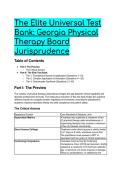
The Elite Universal Test
Bank: Georgia Physical
Therapy Board
Jurisprudence
Table of Contents
● Part I: The Preview
○ The Critical Axioms
● Part II: The Elite Test Bank
○ Tier 1: Foundational Syntax & Application (Questions 1–10)
○ Tier 2: Complex Application & Simulation (Questions 11–20)
○ Tier 3: Grandmaster Synthesis (Questions 21–30)
Part I: The Preview
The mastery of physical therapy jurisprudence bridges the gap between clinical capability and
absolute professional immunity. The meticulous execution of this test bank forges the cognitive
reflexes required to navigate complex regulatory environments, ensuring the practitioner's
academic mastery translates directly into elite compliance and patient safety.
The Critical Axioms
Regulatory Domain Core Standard & Statutory Limit
Supervision Metrics A licensee may supervise a maximum of two
(2) physical therapy aides simultaneously. A
supervising therapist may oversee a maximum
of two (2) trainees concurrently.
Direct Access Ceilings Treatment under direct access is strictly limited
to 21 days or 8 visits, whichever occurs first.
The practitioner must possess a DPT or
equivalent and two years of clinical experience.
Continuing Competence Licensees must accrue 30 Continuing
Competence Hours (CCH) per biennium, strictly
capped at a maximum of 10 CCH per calendar
day. A minimum of 4 hours must be in Georgia
Ethics & Jurisprudence, or satisfied by the
,Regulatory Domain Core Standard & Statutory Limit
GA-JAM.
PT Licensure Compact A Compact Privilege requires an
unencumbered license in the Home State. If
adverse action is taken, the privilege is lost until
the license is restored and an additional two (2)
years have elapsed.
Telehealth Mandates Jurisdiction is dictated by the physical location
of the patient at the time of the encounter. The
provision of telehealth requires the practitioner
to hold a valid Georgia license or a Georgia
Compact Privilege.
Part II: The Elite Test Bank
Tier 1: Foundational Syntax & Application
Q1: A newly appointed member of the Georgia State Board of Physical Therapy is preparing for
their first administrative cycle. Based on the statutory composition of the Board, which
configuration MOST ACCURATELY reflects the required membership outlined in the Georgia
Physical Therapy Practice Act? A) Seven physical therapists, one physical therapist assistant,
and two public members. B) Six physical therapists, one physical therapist assistant, and one
public member with no business connection to the profession. C) Five physical therapists, two
physical therapist assistants, and one physician. D) Six physical therapists, two public members,
and the division director.
● Answer: B (Six physical therapists, one physical therapist assistant, and one public
member with no business connection to the profession.)
● Distractor Analysis:
○ A is incorrect: The board consists of exactly eight members, not ten. Inflating the
board size dilutes the specific voting power designated by the legislature.
○ C is incorrect: There is no requirement for a physician on the Board, and the statute
strictly requires exactly one physical therapist assistant and one public member.
○ D is incorrect: The statute limits public representation to a single eighth member to
maintain clinical voting superiority.
The Mentor's Analysis: The architectural foundation of regulatory enforcement relies on peer
review balanced by precise public accountability. When analyzing the composition of the Board,
the immediate priority is understanding the statutory weighting of clinical expertise. By utilizing
an eight-member structure, the statute ensures that clinical standards are governed by actively
practicing experts, while the singular public member acts as an independent guardian of
consumer welfare. Professional/Academic Intuition: Statutory governance boards are
universally weighted toward active practitioners to ensure that disciplinary and licensing
standards accurately reflect current clinical realities.
Q2: A licensed physical therapist is organizing their daily schedule in a busy outpatient clinic.
The therapist delegates the cleaning of treatment tables and the escorting of patients to a
physical therapy aide. Regarding the oversight of this aide, which condition is MANDATORY? A)
The aide must receive direct supervision on the premises and be immediately available at all
times. B) The aide may operate under general supervision if the physical therapist is reachable
via telecommunications. C) The physical therapist assistant may serve as the sole supervisor for
, the aide when the physical therapist is off-site. D) The aide may perform basic therapeutic
exercises independently provided the physical therapist is in the same building.
● Answer: A (The aide must receive direct supervision on the premises and be immediately
available at all times.)
● Distractor Analysis:
○ B is incorrect: Physical therapy aides strictly require direct supervision, defined as
on the premises and immediately available. Telecommunication applies only to
general supervision of licensed assistants in specific environments.
○ C is incorrect: A physical therapy aide must be directed on the premises at all times
by a licensee, but ultimate clinical responsibility cannot exist with the physical
therapist off-site if the aide is assisting in patient care elements.
○ D is incorrect: Aides may only perform designated and supervised routine tasks,
never independent therapeutic exercises, regardless of the physical therapist's
proximity.
The Mentor's Analysis: Delegation is a transfer of task, not a transfer of liability. When facing
the utilization of unlicensed personnel, the immediate priority is understanding the legal
definition of direct supervision. By utilizing strict line-of-sight and immediate physical availability,
the clinician bypasses the common trap of unauthorized practice and patient endangerment.
Professional/Academic Intuition: An aide is an extension of the licensee's physical
presence, not an extension of their clinical judgment.
Q3: During a licensure renewal audit, a physical therapist realizes they completed 12
Continuing Competence Hours (CCH) on a single Saturday through an intensive seminar.
Based on the rules of the Georgia State Board, how many of these hours are VALID toward the
biennial requirement? A) All 12 hours are valid because they were obtained within the correct
biennium. B) 10 hours are valid, as licensees are strictly capped at 10 credit hours per calendar
day. C) 0 hours are valid, as intensive weekend courses require prior Board approval. D) 6
hours are valid, representing the standard maximum for a single continuous session.
● Answer: B (10 hours are valid, as licensees are strictly capped at 10 credit hours per
calendar day.)
● Distractor Analysis:
○ A is incorrect: The Board explicitly prohibits claiming more than 10 CCH per
calendar day to prevent cognitive fatigue and ensure true competence acquisition.
○ C is incorrect: The Board does not pre-approve courses, placing the burden of
selecting appropriate, relevant content entirely on the licensee.
○ D is incorrect: This is a fabricated threshold; the statutory daily limit is strictly and
universally 10 hours.
The Mentor's Analysis: Adult learning theory dictates that cognitive absorption degrades over
time. When facing licensure renewal planning, the immediate priority is pacing educational
activities to match statutory caps. By utilizing the 10-hour daily cap, the Board ensures that
Continuing Competence remains an exercise in meaningful professional development rather
than a marathon of regulatory compliance. Professional/Academic Intuition: Regulatory
bodies limit daily continuing education accrual to mandate sustained, distributed
professional learning over the biennium.
Q4: A physical therapist licensed in Georgia wishes to perform dry needling on a patient with
myofascial trigger points. The therapist has completed an initial 20-hour specialized coursework
module in dry needling. Which action is the MOST APPROPRIATE under Georgia rules? A) The
therapist may practice dry needling indefinitely, as 20 hours is the total required standard. B)
The therapist may utilize dry needling for a period not to exceed 12 months, during which they
Bank: Georgia Physical
Therapy Board
Jurisprudence
Table of Contents
● Part I: The Preview
○ The Critical Axioms
● Part II: The Elite Test Bank
○ Tier 1: Foundational Syntax & Application (Questions 1–10)
○ Tier 2: Complex Application & Simulation (Questions 11–20)
○ Tier 3: Grandmaster Synthesis (Questions 21–30)
Part I: The Preview
The mastery of physical therapy jurisprudence bridges the gap between clinical capability and
absolute professional immunity. The meticulous execution of this test bank forges the cognitive
reflexes required to navigate complex regulatory environments, ensuring the practitioner's
academic mastery translates directly into elite compliance and patient safety.
The Critical Axioms
Regulatory Domain Core Standard & Statutory Limit
Supervision Metrics A licensee may supervise a maximum of two
(2) physical therapy aides simultaneously. A
supervising therapist may oversee a maximum
of two (2) trainees concurrently.
Direct Access Ceilings Treatment under direct access is strictly limited
to 21 days or 8 visits, whichever occurs first.
The practitioner must possess a DPT or
equivalent and two years of clinical experience.
Continuing Competence Licensees must accrue 30 Continuing
Competence Hours (CCH) per biennium, strictly
capped at a maximum of 10 CCH per calendar
day. A minimum of 4 hours must be in Georgia
Ethics & Jurisprudence, or satisfied by the
,Regulatory Domain Core Standard & Statutory Limit
GA-JAM.
PT Licensure Compact A Compact Privilege requires an
unencumbered license in the Home State. If
adverse action is taken, the privilege is lost until
the license is restored and an additional two (2)
years have elapsed.
Telehealth Mandates Jurisdiction is dictated by the physical location
of the patient at the time of the encounter. The
provision of telehealth requires the practitioner
to hold a valid Georgia license or a Georgia
Compact Privilege.
Part II: The Elite Test Bank
Tier 1: Foundational Syntax & Application
Q1: A newly appointed member of the Georgia State Board of Physical Therapy is preparing for
their first administrative cycle. Based on the statutory composition of the Board, which
configuration MOST ACCURATELY reflects the required membership outlined in the Georgia
Physical Therapy Practice Act? A) Seven physical therapists, one physical therapist assistant,
and two public members. B) Six physical therapists, one physical therapist assistant, and one
public member with no business connection to the profession. C) Five physical therapists, two
physical therapist assistants, and one physician. D) Six physical therapists, two public members,
and the division director.
● Answer: B (Six physical therapists, one physical therapist assistant, and one public
member with no business connection to the profession.)
● Distractor Analysis:
○ A is incorrect: The board consists of exactly eight members, not ten. Inflating the
board size dilutes the specific voting power designated by the legislature.
○ C is incorrect: There is no requirement for a physician on the Board, and the statute
strictly requires exactly one physical therapist assistant and one public member.
○ D is incorrect: The statute limits public representation to a single eighth member to
maintain clinical voting superiority.
The Mentor's Analysis: The architectural foundation of regulatory enforcement relies on peer
review balanced by precise public accountability. When analyzing the composition of the Board,
the immediate priority is understanding the statutory weighting of clinical expertise. By utilizing
an eight-member structure, the statute ensures that clinical standards are governed by actively
practicing experts, while the singular public member acts as an independent guardian of
consumer welfare. Professional/Academic Intuition: Statutory governance boards are
universally weighted toward active practitioners to ensure that disciplinary and licensing
standards accurately reflect current clinical realities.
Q2: A licensed physical therapist is organizing their daily schedule in a busy outpatient clinic.
The therapist delegates the cleaning of treatment tables and the escorting of patients to a
physical therapy aide. Regarding the oversight of this aide, which condition is MANDATORY? A)
The aide must receive direct supervision on the premises and be immediately available at all
times. B) The aide may operate under general supervision if the physical therapist is reachable
via telecommunications. C) The physical therapist assistant may serve as the sole supervisor for
, the aide when the physical therapist is off-site. D) The aide may perform basic therapeutic
exercises independently provided the physical therapist is in the same building.
● Answer: A (The aide must receive direct supervision on the premises and be immediately
available at all times.)
● Distractor Analysis:
○ B is incorrect: Physical therapy aides strictly require direct supervision, defined as
on the premises and immediately available. Telecommunication applies only to
general supervision of licensed assistants in specific environments.
○ C is incorrect: A physical therapy aide must be directed on the premises at all times
by a licensee, but ultimate clinical responsibility cannot exist with the physical
therapist off-site if the aide is assisting in patient care elements.
○ D is incorrect: Aides may only perform designated and supervised routine tasks,
never independent therapeutic exercises, regardless of the physical therapist's
proximity.
The Mentor's Analysis: Delegation is a transfer of task, not a transfer of liability. When facing
the utilization of unlicensed personnel, the immediate priority is understanding the legal
definition of direct supervision. By utilizing strict line-of-sight and immediate physical availability,
the clinician bypasses the common trap of unauthorized practice and patient endangerment.
Professional/Academic Intuition: An aide is an extension of the licensee's physical
presence, not an extension of their clinical judgment.
Q3: During a licensure renewal audit, a physical therapist realizes they completed 12
Continuing Competence Hours (CCH) on a single Saturday through an intensive seminar.
Based on the rules of the Georgia State Board, how many of these hours are VALID toward the
biennial requirement? A) All 12 hours are valid because they were obtained within the correct
biennium. B) 10 hours are valid, as licensees are strictly capped at 10 credit hours per calendar
day. C) 0 hours are valid, as intensive weekend courses require prior Board approval. D) 6
hours are valid, representing the standard maximum for a single continuous session.
● Answer: B (10 hours are valid, as licensees are strictly capped at 10 credit hours per
calendar day.)
● Distractor Analysis:
○ A is incorrect: The Board explicitly prohibits claiming more than 10 CCH per
calendar day to prevent cognitive fatigue and ensure true competence acquisition.
○ C is incorrect: The Board does not pre-approve courses, placing the burden of
selecting appropriate, relevant content entirely on the licensee.
○ D is incorrect: This is a fabricated threshold; the statutory daily limit is strictly and
universally 10 hours.
The Mentor's Analysis: Adult learning theory dictates that cognitive absorption degrades over
time. When facing licensure renewal planning, the immediate priority is pacing educational
activities to match statutory caps. By utilizing the 10-hour daily cap, the Board ensures that
Continuing Competence remains an exercise in meaningful professional development rather
than a marathon of regulatory compliance. Professional/Academic Intuition: Regulatory
bodies limit daily continuing education accrual to mandate sustained, distributed
professional learning over the biennium.
Q4: A physical therapist licensed in Georgia wishes to perform dry needling on a patient with
myofascial trigger points. The therapist has completed an initial 20-hour specialized coursework
module in dry needling. Which action is the MOST APPROPRIATE under Georgia rules? A) The
therapist may practice dry needling indefinitely, as 20 hours is the total required standard. B)
The therapist may utilize dry needling for a period not to exceed 12 months, during which they