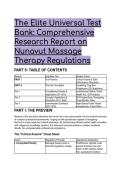
The Elite Universal Test
Bank: Comprehensive
Research Report on
Nunavut Massage
Therapy Regulations
PART 0: TABLE OF CONTENTS
Section Cognitive Tier Subject Focus
PART I The Preview Critical Axioms & Elite
Performance Directives
PART II The Elite Test Bank Escalating Cognitive
Progression (30 Questions)
Tier 1 Foundational Syntax & Jurisdictional Status, Public
Application (Q1–Q10) Health Act, IQ Principles
Tier 2 Complex Application & EHO Inspections, Receipting,
Simulation (Q11–Q20) Cross-Border Titles
Tier 3 Grandmaster Synthesis High-Stakes Public Health
(Q21–Q30) Emergencies, Fraud Risks
PART I: THE PREVIEW
Mastery of this test bank transitions the novice from rote memorization into the tactical execution
of complex jurisdictional frameworks, forging an elite practitioner capable of navigating
Nunavut's unique legal and cultural landscape. By synthesizing Western public health mandates
with indigenous knowledge systems, this document ensures academic mastery translates
directly into unimpeachable professional competence.
The "Critical Axioms" Cheat Sheet
Axiom Regulatory Principle Operational Implication
I. Unregulated Reality Massage therapy lacks a Practitioners operate under
territorial regulatory college. general business law and
public health statutes rather
than specialized medical
,Axiom Regulatory Principle Operational Implication
boards.
II. Personal Service Law The Public Health Act Subjects practitioners to
categorizes massage as a stringent territorial sanitation
"personal service". and communicable disease
infection control mandates.
III. Title & Receipt Paradox Regulated titles (e.g., RMT) are Billing third-party insurance for
geographically bound to their regulated services in an
issuing province. unregulated territory constitutes
compliance violation and
potential fraud.
IV. EHO Absolute Authority Environmental Health Officers EHOs hold the power to order
conduct warrantless immediate closures and levy
inspections. corporate fines up to
$1,000,000 for health hazards.
V. IQ Integration Inuit Qaujimajatuqangit (IQ) Clinical environments must
forms the ethical bedrock of actively embody
practice. Inuuqatigiitsiarniq (respect) and
Piliriqatigiinniq (collaborative
care).
PART II: THE ELITE TEST BANK
Tier 1: Foundational Syntax & Application
Q1: A newly graduated practitioner relocates from Manitoba to Iqaluit, Nunavut, to establish a
therapeutic massage clinic. The individual contacts the territorial government to apply for a
massage therapy license. Based on the current jurisdictional framework of Canada, which
outcome is MOST ACCURATE regarding their application? A) The practitioner will be directed
to the College of Massage Therapists of Nunavut to complete board examinations. B) The
practitioner will be issued a health care provider license under the territorial Health Professions
Act. C) The practitioner will be informed that massage therapy is currently an unregulated
profession in the territory, and no formal territorial massage license is issued. D) The practitioner
will be required to register federally with the Federation of Massage Therapy Regulatory
Authorities of Canada (FOMTRAC) before practicing.
● Answer: C (The practitioner will be informed that massage therapy is currently an
unregulated profession in the territory, and no formal territorial massage license is issued.)
● Distractor Analysis:
○ A is incorrect: There is no College of Massage Therapists of Nunavut, as the
territory has not enacted legislation to self-regulate the profession.
○ B is incorrect: The Health Professions Act and Medical Profession Act in Nunavut
regulate professions such as nursing, medicine, and dentistry, but do not currently
include massage therapy.
○ D is incorrect: FOMTRAC is a national organization for existing provincial
regulators, not a licensing body for individual practitioners, as healthcare regulation
remains a strict provincial and territorial responsibility.
The Mentor's Analysis: Novices often mistakenly assume healthcare regulation is federally
uniform. In Canada, massage therapy regulation is strictly provincial or territorial. Because
, Nunavut has not established a regulatory college for massage therapy, the practice defaults to
an unregulated status, shifting the burden of legal compliance from a specific College to general
public health laws and business licensing. Professional/Academic Intuition: Jurisdictional
awareness dictates legal liability; the existence of a regulatory body must always be
verified before assuming scope of practice protections.
Q2: Under the Nunavut Public Health Act (S.Nu. 2016, c. 13), a massage therapy clinic is
legally classified under a specific regulatory definition. Which classification MOST
ACCURATELY dictates the environmental and operational standards the clinic must follow? A)
Regulated Health Care Facility B) Personal Service C) Complementary Alternative Medicine
(CAM) Outpost D) General Commercial Enterprise
● Answer: B (Personal Service)
● Distractor Analysis:
○ A is incorrect: Because massage therapists are not regulated health professionals
in Nunavut, their clinics are not classified as regulated health care facilities under
territorial medical acts.
○ C is incorrect: While massage functions as a complementary therapy, the Public
Health Act relies on a highly specific legal taxonomy where "CAM Outpost" holds no
statutory meaning.
○ D is incorrect: General commercial enterprise laws do not comprehensively cover
the specific infection control, sanitation mandates, and biohazard protocols required
for facilities that physically interact with the public's bodies.
The Mentor's Analysis: The Public Health Act explicitly categorizes acupuncture, massage,
tattooing, and hairdressing as personal services. This legal classification functions as the
primary mechanism through which the territorial government enforces sanitation and infection
control protocols in the absence of a dedicated massage therapy regulatory board.
Professional/Academic Intuition: The legal definition of a service dictates the statutory
authority that governs it; in Nunavut, the designation of "personal service" immediately
triggers the absolute oversight of Environmental Health Officers.
Q3: A practitioner registered as a Registered Massage Therapist (RMT) with the College of
Massage Therapists of Ontario (CMTO) travels to Nunavut for a two-month working vacation.
The individual advertises services in local Nunavut media as an "RMT." According to
cross-jurisdictional compliance rules, which statement is the MOST ACCURATE? A) The
practitioner acts legally, as "RMT" represents a federally protected trademark applicable in all
territories. B) The practitioner may use the title "RMT" in Nunavut, provided all local clients are
billed under the Nunavut territorial health insurance plan. C) The practitioner must adhere to the
rules, standards, and policies of their home provincial regulatory College even when practicing
in an unregulated territory. D) The practitioner immediately forfeits their Ontario registration upon
practicing in an unregulated jurisdiction.
● Answer: C (The practitioner must adhere to the rules, standards, and policies of their
home provincial regulatory College even when practicing in an unregulated territory.)
● Distractor Analysis:
○ A is incorrect: "RMT" is a provincially protected title, not a federal one. While the
CMTO protects the title in Ontario, utilizing that title to imply the provision of
regulated massage therapy in an unregulated province constitutes professional
misconduct.
○ B is incorrect: Nunavut's territorial health insurance plan does not cover unregulated
complementary therapies like massage.
○ D is incorrect: Practicing in an unregulated territory does not automatically void a
Bank: Comprehensive
Research Report on
Nunavut Massage
Therapy Regulations
PART 0: TABLE OF CONTENTS
Section Cognitive Tier Subject Focus
PART I The Preview Critical Axioms & Elite
Performance Directives
PART II The Elite Test Bank Escalating Cognitive
Progression (30 Questions)
Tier 1 Foundational Syntax & Jurisdictional Status, Public
Application (Q1–Q10) Health Act, IQ Principles
Tier 2 Complex Application & EHO Inspections, Receipting,
Simulation (Q11–Q20) Cross-Border Titles
Tier 3 Grandmaster Synthesis High-Stakes Public Health
(Q21–Q30) Emergencies, Fraud Risks
PART I: THE PREVIEW
Mastery of this test bank transitions the novice from rote memorization into the tactical execution
of complex jurisdictional frameworks, forging an elite practitioner capable of navigating
Nunavut's unique legal and cultural landscape. By synthesizing Western public health mandates
with indigenous knowledge systems, this document ensures academic mastery translates
directly into unimpeachable professional competence.
The "Critical Axioms" Cheat Sheet
Axiom Regulatory Principle Operational Implication
I. Unregulated Reality Massage therapy lacks a Practitioners operate under
territorial regulatory college. general business law and
public health statutes rather
than specialized medical
,Axiom Regulatory Principle Operational Implication
boards.
II. Personal Service Law The Public Health Act Subjects practitioners to
categorizes massage as a stringent territorial sanitation
"personal service". and communicable disease
infection control mandates.
III. Title & Receipt Paradox Regulated titles (e.g., RMT) are Billing third-party insurance for
geographically bound to their regulated services in an
issuing province. unregulated territory constitutes
compliance violation and
potential fraud.
IV. EHO Absolute Authority Environmental Health Officers EHOs hold the power to order
conduct warrantless immediate closures and levy
inspections. corporate fines up to
$1,000,000 for health hazards.
V. IQ Integration Inuit Qaujimajatuqangit (IQ) Clinical environments must
forms the ethical bedrock of actively embody
practice. Inuuqatigiitsiarniq (respect) and
Piliriqatigiinniq (collaborative
care).
PART II: THE ELITE TEST BANK
Tier 1: Foundational Syntax & Application
Q1: A newly graduated practitioner relocates from Manitoba to Iqaluit, Nunavut, to establish a
therapeutic massage clinic. The individual contacts the territorial government to apply for a
massage therapy license. Based on the current jurisdictional framework of Canada, which
outcome is MOST ACCURATE regarding their application? A) The practitioner will be directed
to the College of Massage Therapists of Nunavut to complete board examinations. B) The
practitioner will be issued a health care provider license under the territorial Health Professions
Act. C) The practitioner will be informed that massage therapy is currently an unregulated
profession in the territory, and no formal territorial massage license is issued. D) The practitioner
will be required to register federally with the Federation of Massage Therapy Regulatory
Authorities of Canada (FOMTRAC) before practicing.
● Answer: C (The practitioner will be informed that massage therapy is currently an
unregulated profession in the territory, and no formal territorial massage license is issued.)
● Distractor Analysis:
○ A is incorrect: There is no College of Massage Therapists of Nunavut, as the
territory has not enacted legislation to self-regulate the profession.
○ B is incorrect: The Health Professions Act and Medical Profession Act in Nunavut
regulate professions such as nursing, medicine, and dentistry, but do not currently
include massage therapy.
○ D is incorrect: FOMTRAC is a national organization for existing provincial
regulators, not a licensing body for individual practitioners, as healthcare regulation
remains a strict provincial and territorial responsibility.
The Mentor's Analysis: Novices often mistakenly assume healthcare regulation is federally
uniform. In Canada, massage therapy regulation is strictly provincial or territorial. Because
, Nunavut has not established a regulatory college for massage therapy, the practice defaults to
an unregulated status, shifting the burden of legal compliance from a specific College to general
public health laws and business licensing. Professional/Academic Intuition: Jurisdictional
awareness dictates legal liability; the existence of a regulatory body must always be
verified before assuming scope of practice protections.
Q2: Under the Nunavut Public Health Act (S.Nu. 2016, c. 13), a massage therapy clinic is
legally classified under a specific regulatory definition. Which classification MOST
ACCURATELY dictates the environmental and operational standards the clinic must follow? A)
Regulated Health Care Facility B) Personal Service C) Complementary Alternative Medicine
(CAM) Outpost D) General Commercial Enterprise
● Answer: B (Personal Service)
● Distractor Analysis:
○ A is incorrect: Because massage therapists are not regulated health professionals
in Nunavut, their clinics are not classified as regulated health care facilities under
territorial medical acts.
○ C is incorrect: While massage functions as a complementary therapy, the Public
Health Act relies on a highly specific legal taxonomy where "CAM Outpost" holds no
statutory meaning.
○ D is incorrect: General commercial enterprise laws do not comprehensively cover
the specific infection control, sanitation mandates, and biohazard protocols required
for facilities that physically interact with the public's bodies.
The Mentor's Analysis: The Public Health Act explicitly categorizes acupuncture, massage,
tattooing, and hairdressing as personal services. This legal classification functions as the
primary mechanism through which the territorial government enforces sanitation and infection
control protocols in the absence of a dedicated massage therapy regulatory board.
Professional/Academic Intuition: The legal definition of a service dictates the statutory
authority that governs it; in Nunavut, the designation of "personal service" immediately
triggers the absolute oversight of Environmental Health Officers.
Q3: A practitioner registered as a Registered Massage Therapist (RMT) with the College of
Massage Therapists of Ontario (CMTO) travels to Nunavut for a two-month working vacation.
The individual advertises services in local Nunavut media as an "RMT." According to
cross-jurisdictional compliance rules, which statement is the MOST ACCURATE? A) The
practitioner acts legally, as "RMT" represents a federally protected trademark applicable in all
territories. B) The practitioner may use the title "RMT" in Nunavut, provided all local clients are
billed under the Nunavut territorial health insurance plan. C) The practitioner must adhere to the
rules, standards, and policies of their home provincial regulatory College even when practicing
in an unregulated territory. D) The practitioner immediately forfeits their Ontario registration upon
practicing in an unregulated jurisdiction.
● Answer: C (The practitioner must adhere to the rules, standards, and policies of their
home provincial regulatory College even when practicing in an unregulated territory.)
● Distractor Analysis:
○ A is incorrect: "RMT" is a provincially protected title, not a federal one. While the
CMTO protects the title in Ontario, utilizing that title to imply the provision of
regulated massage therapy in an unregulated province constitutes professional
misconduct.
○ B is incorrect: Nunavut's territorial health insurance plan does not cover unregulated
complementary therapies like massage.
○ D is incorrect: Practicing in an unregulated territory does not automatically void a