

Series 6 Exam 2026 Latest Comprehensive Study
Guide with Practice Questions
Instructions
This practice exam contains 100 of the official FINRA Series 6 (Investment
Company and Variable Contracts Products Representative) exam.
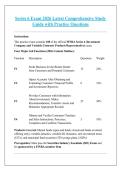
Four Major Job Functions (2026 Content Outline):
Function Description Questions Weight
Seeks Business for the Broker-Dealer
F1 12 24%
from Customers and Potential Customers
Opens Accounts After Obtaining and
F2 Evaluating Customers' Financial Profile 8 16%
and Investment Objectives
Provides Customers with Information
About Investments, Makes
F3 25 50%
Recommendations, Transfers Assets and
Maintains Appropriate Records
Obtains and Verifies Customers' Purchase
F4 and Sales Instructions; Processes, 5 10%
Completes and Confirms Transactions
Products Covered: Mutual funds (open-end funds; closed-end funds on initial
offering only), variable annuities, variable life insurance, unit investment trusts
(UITs), and municipal fund securities (529 savings plans, LGIPs).
Prerequisites: Must pass the Securities Industry Essentials (SIE) Exam and
be sponsored by a FINRA member firm.
,SECTION 1: FUNCTION 1 — SEEKS BUSINESS FOR THE BROKER-
DEALER (24%) (Questions 1-24)
Question 1
Under FINRA Rule 2210, which of the following is considered a "retail
communication"?
A) A communication distributed to 25 or fewer institutional investors within a 30-
day period
B) A communication distributed to more than 25 retail investors within a 30-day
period
C) A communication that is solely internal to the broker-dealer
D) A one-on-one conversation with a prospective client
Correct Answer: B
Rationale: Under FINRA Rule 2210, a retail communication is any written
(including electronic) communication that is distributed to more than 25 retail
investors within any 30-calendar-day period. Communications to 25 or fewer
retail investors are considered correspondence (not retail communications) and are
subject to different approval requirements. Internal communications (C) are not
considered retail communications. One-on-one conversations (D) are not written
communications subject to Rule 2210.
Question 2
A registered representative sends an email to 15 existing clients describing a new
mutual fund. Under FINRA rules, this communication is classified as:
A) Retail communication
B) Correspondence
C) Institutional communication
D) Public appearance
Correct Answer: B
Rationale: Under FINRA Rule 2210, any written communication directed to 25 or
fewer retail investors within a 30-calendar-day period is classified
,as correspondence. Since the representative is sending to 15 clients (fewer than
25), this is correspondence, not retail communication. Correspondence must be
reviewed by a principal if it recommends a specific investment or contains a
recommendation.
Question 3
Under the Securities Act of 1933, Section 5 prohibits:
A) The sale of unregistered securities without an exemption
B) The use of misleading advertising by broker-dealers
C) Insider trading by corporate officers
D) The short sale of equity securities
Correct Answer: A
Rationale: Section 5 of the Securities Act of 1933 prohibits the sale of
unregistered securities through interstate commerce or the mails unless an
exemption applies. This is the core registration requirement of the 1933 Act.
Misleading advertising (B) is addressed by other rules and the anti-fraud
provisions. Insider trading (C) is addressed by the Securities Exchange Act of
1934. Short sales (D) are regulated under other rules.
Question 4
Which of the following statements about a "public appearance" is TRUE under
FINRA rules?
A) A public appearance does not require a principal's prior approval
B) A public appearance is subject to the same pre-approval requirements as retail
communications
C) A public appearance must be filed with FINRA 10 days in advance
D) A public appearance can only be made by a registered principal
Correct Answer: A
Rationale: Under FINRA Rule 2210, a public appearance (such as a seminar,
lecture, or television/radio interview) does not require a principal's prior
approval. However, the representative must have a reasonable basis for any
, statements made. Public appearances are not subject to the same pre-approval
requirements as retail communications. They do not require filing with FINRA (C)
and can be made by any registered representative, not just principals (D).
Question 5
A broker-dealer wants to use a mutual fund's ranking in a retail communication.
Under FINRA Rule 2212, which of the following is required?
A) The ranking must be from a source that is independent and not affiliated with
the fund
B) The ranking must be the most recent ranking available
C) The communication must disclose the ranking criteria and the fund's category
D) All of the above
Correct Answer: D
Rationale: FINRA Rule 2212 governs the use of investment company rankings
in retail communications. Requirements include: the ranking must be from
an independent source not affiliated with the fund (A); the most recent
ranking must be used (B); and the communication must disclose the ranking
criteria, the fund's category, and the number of funds in the category (C). All
of these are required.
Question 6
Under FINRA Rule 2211, communications about variable life insurance and
variable annuities must:
A) Be approved by a principal before use
B) Clearly identify the product as a variable product
C) Disclose that investment returns are not guaranteed
D) All of the above
Correct Answer: D
Rationale: FINRA Rule 2211 specifically addresses communications with the
public about variable life insurance and variable annuities. Requirements
include: principal approval before use (A), clear identification of the product as
Guide with Practice Questions
Instructions
This practice exam contains 100 of the official FINRA Series 6 (Investment
Company and Variable Contracts Products Representative) exam.
Four Major Job Functions (2026 Content Outline):
Function Description Questions Weight
Seeks Business for the Broker-Dealer
F1 12 24%
from Customers and Potential Customers
Opens Accounts After Obtaining and
F2 Evaluating Customers' Financial Profile 8 16%
and Investment Objectives
Provides Customers with Information
About Investments, Makes
F3 25 50%
Recommendations, Transfers Assets and
Maintains Appropriate Records
Obtains and Verifies Customers' Purchase
F4 and Sales Instructions; Processes, 5 10%
Completes and Confirms Transactions
Products Covered: Mutual funds (open-end funds; closed-end funds on initial
offering only), variable annuities, variable life insurance, unit investment trusts
(UITs), and municipal fund securities (529 savings plans, LGIPs).
Prerequisites: Must pass the Securities Industry Essentials (SIE) Exam and
be sponsored by a FINRA member firm.
,SECTION 1: FUNCTION 1 — SEEKS BUSINESS FOR THE BROKER-
DEALER (24%) (Questions 1-24)
Question 1
Under FINRA Rule 2210, which of the following is considered a "retail
communication"?
A) A communication distributed to 25 or fewer institutional investors within a 30-
day period
B) A communication distributed to more than 25 retail investors within a 30-day
period
C) A communication that is solely internal to the broker-dealer
D) A one-on-one conversation with a prospective client
Correct Answer: B
Rationale: Under FINRA Rule 2210, a retail communication is any written
(including electronic) communication that is distributed to more than 25 retail
investors within any 30-calendar-day period. Communications to 25 or fewer
retail investors are considered correspondence (not retail communications) and are
subject to different approval requirements. Internal communications (C) are not
considered retail communications. One-on-one conversations (D) are not written
communications subject to Rule 2210.
Question 2
A registered representative sends an email to 15 existing clients describing a new
mutual fund. Under FINRA rules, this communication is classified as:
A) Retail communication
B) Correspondence
C) Institutional communication
D) Public appearance
Correct Answer: B
Rationale: Under FINRA Rule 2210, any written communication directed to 25 or
fewer retail investors within a 30-calendar-day period is classified
,as correspondence. Since the representative is sending to 15 clients (fewer than
25), this is correspondence, not retail communication. Correspondence must be
reviewed by a principal if it recommends a specific investment or contains a
recommendation.
Question 3
Under the Securities Act of 1933, Section 5 prohibits:
A) The sale of unregistered securities without an exemption
B) The use of misleading advertising by broker-dealers
C) Insider trading by corporate officers
D) The short sale of equity securities
Correct Answer: A
Rationale: Section 5 of the Securities Act of 1933 prohibits the sale of
unregistered securities through interstate commerce or the mails unless an
exemption applies. This is the core registration requirement of the 1933 Act.
Misleading advertising (B) is addressed by other rules and the anti-fraud
provisions. Insider trading (C) is addressed by the Securities Exchange Act of
1934. Short sales (D) are regulated under other rules.
Question 4
Which of the following statements about a "public appearance" is TRUE under
FINRA rules?
A) A public appearance does not require a principal's prior approval
B) A public appearance is subject to the same pre-approval requirements as retail
communications
C) A public appearance must be filed with FINRA 10 days in advance
D) A public appearance can only be made by a registered principal
Correct Answer: A
Rationale: Under FINRA Rule 2210, a public appearance (such as a seminar,
lecture, or television/radio interview) does not require a principal's prior
approval. However, the representative must have a reasonable basis for any
, statements made. Public appearances are not subject to the same pre-approval
requirements as retail communications. They do not require filing with FINRA (C)
and can be made by any registered representative, not just principals (D).
Question 5
A broker-dealer wants to use a mutual fund's ranking in a retail communication.
Under FINRA Rule 2212, which of the following is required?
A) The ranking must be from a source that is independent and not affiliated with
the fund
B) The ranking must be the most recent ranking available
C) The communication must disclose the ranking criteria and the fund's category
D) All of the above
Correct Answer: D
Rationale: FINRA Rule 2212 governs the use of investment company rankings
in retail communications. Requirements include: the ranking must be from
an independent source not affiliated with the fund (A); the most recent
ranking must be used (B); and the communication must disclose the ranking
criteria, the fund's category, and the number of funds in the category (C). All
of these are required.
Question 6
Under FINRA Rule 2211, communications about variable life insurance and
variable annuities must:
A) Be approved by a principal before use
B) Clearly identify the product as a variable product
C) Disclose that investment returns are not guaranteed
D) All of the above
Correct Answer: D
Rationale: FINRA Rule 2211 specifically addresses communications with the
public about variable life insurance and variable annuities. Requirements
include: principal approval before use (A), clear identification of the product as


