

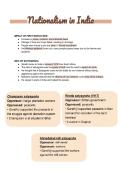
Nationalism in India
IMPACT OF FIRST WORLD WAR
● Increase in prices, customs, and individual taxes
● Storage of food and crops failed, resulting in shortage
● People were forced to join the army — forced recruitment
● An influenza epidemic broke out; many people passed away due to the famine and
epidemic.
IDEA OF SATYAGRAHA
● Gandhi came to India in January 1915 from South Africa.
● The idea of satyagraha was the power of truth and the need to search for truth.
● He thought that a Satyagrahi could win the battle by non-violence without being
aggressive against the oppressors.
● Mahatma Gandhi believed that the dharma of non-violence could unite all the Indians.
● He stayed in parts of India and helped the people.
, THE ROWLATT ACT (1919)
★ Imperial Legislative Council passed it (Britain)
The Rowlatt Act gave power to the government:
● To restrain political activities
● To detain political prisoners without a trial for 2 years
( power the government had )
● Gandhiji initiated a nationwide satyagraha (hartal) against the Rowlatt Act on 6th April
1919
● Rallies were organized, workers were on strike and scared by the actions taken by the
people, British administration decided to suppress nationalists
● Gandhiji was restricted from Delhi and local leaders from Amritsar were picked
● On April 10, police in Amritsar fired upon a peaceful procession
JALLIANWALA BAGH MASSACRE (13th April 1919)
● A large crowd gathered in the enclosed ground of Jallianwala Bagh, some came to
protest against government's new repressive measures, others came to attend the
annual Baisakhi fair
● Villagers outside the city was unaware about the martial law imposed by General Dyer
● Dyer entered blocked the exit and opened fire on the crowd, killing hundreds
● His object was to produce a "moral effect to create a feeling to create a feeling of awe
and terror in the minds of satyagrahis
After Jallianwala Bagh:
● People went on strikes, clashed with police and attacked government buildings
● Mahatma Gandhi had to call off the movement (the nonviolent civil disobedience
movement) because it turned violent
KHILAFAT MOVEMENT
● Rowlatt satyagraha was limited to towns and cities so Gandhi now wanted a more
broad-based movement
● He wanted participation from different communities so he decided to support khilafat
movement to gain Muslim community's support
(Before khilafat movement)
● A harsh treaty was to be imposed on the spiritual head of the Muslims, the ottoman
emperor post WW1
● Ali brothers discussed with Gandhi on a possible united mass movement against this
issue
● In Calcutta Session of Congress in 1920, Gandhi convinced other leaders of the need to
start a noncooperation movement
IMPACT OF FIRST WORLD WAR
● Increase in prices, customs, and individual taxes
● Storage of food and crops failed, resulting in shortage
● People were forced to join the army — forced recruitment
● An influenza epidemic broke out; many people passed away due to the famine and
epidemic.
IDEA OF SATYAGRAHA
● Gandhi came to India in January 1915 from South Africa.
● The idea of satyagraha was the power of truth and the need to search for truth.
● He thought that a Satyagrahi could win the battle by non-violence without being
aggressive against the oppressors.
● Mahatma Gandhi believed that the dharma of non-violence could unite all the Indians.
● He stayed in parts of India and helped the people.
, THE ROWLATT ACT (1919)
★ Imperial Legislative Council passed it (Britain)
The Rowlatt Act gave power to the government:
● To restrain political activities
● To detain political prisoners without a trial for 2 years
( power the government had )
● Gandhiji initiated a nationwide satyagraha (hartal) against the Rowlatt Act on 6th April
1919
● Rallies were organized, workers were on strike and scared by the actions taken by the
people, British administration decided to suppress nationalists
● Gandhiji was restricted from Delhi and local leaders from Amritsar were picked
● On April 10, police in Amritsar fired upon a peaceful procession
JALLIANWALA BAGH MASSACRE (13th April 1919)
● A large crowd gathered in the enclosed ground of Jallianwala Bagh, some came to
protest against government's new repressive measures, others came to attend the
annual Baisakhi fair
● Villagers outside the city was unaware about the martial law imposed by General Dyer
● Dyer entered blocked the exit and opened fire on the crowd, killing hundreds
● His object was to produce a "moral effect to create a feeling to create a feeling of awe
and terror in the minds of satyagrahis
After Jallianwala Bagh:
● People went on strikes, clashed with police and attacked government buildings
● Mahatma Gandhi had to call off the movement (the nonviolent civil disobedience
movement) because it turned violent
KHILAFAT MOVEMENT
● Rowlatt satyagraha was limited to towns and cities so Gandhi now wanted a more
broad-based movement
● He wanted participation from different communities so he decided to support khilafat
movement to gain Muslim community's support
(Before khilafat movement)
● A harsh treaty was to be imposed on the spiritual head of the Muslims, the ottoman
emperor post WW1
● Ali brothers discussed with Gandhi on a possible united mass movement against this
issue
● In Calcutta Session of Congress in 1920, Gandhi convinced other leaders of the need to
start a noncooperation movement


