

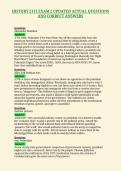
HISTORY 2111 EXAM 2 UPDATED ACTUAL QUESTIONS
AND CORRECT ANSWERS
Question:
Alexander Hamilton
Answer:
-1755-1804 -Federalist -Five Point Plan: Pay off the national debt from the
American Revolution; Create new national debt by selling bonds; create a
Bank of the United States with a national currency; tariffs, a tax on imported
foreign goods to encourage American manufacturing; Tax on production of
Whiskey (most unpopular) -Youngest of the Founding Father's, probably one
of the most hated due to his strong belief in a federal government -Nation's
first Secretary of Treasury alongside George Washington (basically his "Right
Hand Man"); laid foundation of American capitalism -co-author of "The
Federalist Papers" (he wrote 59/85... MAN, the man is NON-STOP) -VP, Aaron
Burr shot and killed him in a duel
Question:
Alien and Sedition Acts
Answer:
-1978 -A series of laws designed to crack down on opposition to the president
(Sedition) also immigration (Alien) -Previously, immigrants only had to wait 5
years before becoming eligible to vote, but these acts raised it to 14 years. Also,
gave permission to deport any immigrant who was from a country that was
seen as "dangerous" -The Sedition Acts made it illegal to print negative things
about the government, also made it illegal to hold rallies specifically to talk
about the negative aspects of the government. -The Sedition Act clearly
violated individual protections under the first amendment of the Constitution
(freedom of press, speech, and right to assembly)
Question:
Andrew Jackson
Answer:
-1829-1837 -very successful military career As president, he worked to enable
the "common man" to play a greater role in the political arena -vetoed the
rechartering of the second national bank and reduced federal spending
-passed a "force bill" that would authorize him to use the army to compel the
state to comply with the tariffs. -forced eastern Indians to move West of the
Mississippi River so their lands could be used by white settlers.
Question:
Anti-Federalists
Answer:
-Favor strong state governments -suspicious of government tyranny, president
might turn into a monarch -favor rule by the people -Thomas Jefferson
-opposed the ratification of the 1787 constitution, because the Articles of
Confederation gave the states most of the powers
, Question:
Articles of Confederation
Answer:
-1781-1788 -"A firm league of friendship" -weak central authority -Legislative
branch only, no executive/judicial branch -No power to tax or raise money
-Can declare war and conduct foreign diplomacy -All states get 1 vote
regardless of size; 13 individual political views (Republic) - Very inefficient
-----> "successful republics have to be small or else they fail" Problems with the
AOC: -Essentially bankrupt- need states to give money; no faith in financial
system- just printing more money when they ran out; it was so bad that metal
coins ended up having zero value basically
Question:
Bank of the United States
Answer:
-1791 -National bank responsible for holding and transferring federal
government funds, making business loans, and issuing a national currency
-Alexander Hamilton's idea -Madison and Jefferson led the opposition because
the constitution said nothing about creating a national bank
Question:
Barbary War
Answer:
-1801-1804 -North African Pirates attack American ships now that they are no
longer colonies of England (England pays a pretty big bribe so that the pirates
let their ships go unharmed, BUT America is a new country that has lots of war
debts and literally is digging its own grave financially so paying a huge bribe is
not a fun time) -First War America waged themselves -Thomas Jefferson ain't
no bitch so he decided that he wasn't gonna pay the bribe, so instead he sent
the US Naval fleet to attack the pirates -American Victory, wahoo!!!
Question:
Battle of Lexington and Concord
Answer:
-April 19, 1775 -"The shot heard round the world": the first shots fired in the
Revolutionary War -Prescott makes it to Concord to warn the colonists to hide
ammunition -colonists at Lexington are literally just stalling -Americans forced
to retreat at Lexington
Question:
Battle of New Orleans
Answer:
-1815 -Final major battle in the War of 1812 -The Americans under General
Andrew Jackson unexpectedly and decisively countered the British attempt to
seize the port of New Orleans, Louisiana -Major naval/army win, however it
was post peace treaty (Treaty of Ghent) and therefore doesn't count
Question:
Battle of Saratoga
Answer:
-October 17, 1777 -Failed two front attack by British (Burgoyne and Howe);
AND CORRECT ANSWERS
Question:
Alexander Hamilton
Answer:
-1755-1804 -Federalist -Five Point Plan: Pay off the national debt from the
American Revolution; Create new national debt by selling bonds; create a
Bank of the United States with a national currency; tariffs, a tax on imported
foreign goods to encourage American manufacturing; Tax on production of
Whiskey (most unpopular) -Youngest of the Founding Father's, probably one
of the most hated due to his strong belief in a federal government -Nation's
first Secretary of Treasury alongside George Washington (basically his "Right
Hand Man"); laid foundation of American capitalism -co-author of "The
Federalist Papers" (he wrote 59/85... MAN, the man is NON-STOP) -VP, Aaron
Burr shot and killed him in a duel
Question:
Alien and Sedition Acts
Answer:
-1978 -A series of laws designed to crack down on opposition to the president
(Sedition) also immigration (Alien) -Previously, immigrants only had to wait 5
years before becoming eligible to vote, but these acts raised it to 14 years. Also,
gave permission to deport any immigrant who was from a country that was
seen as "dangerous" -The Sedition Acts made it illegal to print negative things
about the government, also made it illegal to hold rallies specifically to talk
about the negative aspects of the government. -The Sedition Act clearly
violated individual protections under the first amendment of the Constitution
(freedom of press, speech, and right to assembly)
Question:
Andrew Jackson
Answer:
-1829-1837 -very successful military career As president, he worked to enable
the "common man" to play a greater role in the political arena -vetoed the
rechartering of the second national bank and reduced federal spending
-passed a "force bill" that would authorize him to use the army to compel the
state to comply with the tariffs. -forced eastern Indians to move West of the
Mississippi River so their lands could be used by white settlers.
Question:
Anti-Federalists
Answer:
-Favor strong state governments -suspicious of government tyranny, president
might turn into a monarch -favor rule by the people -Thomas Jefferson
-opposed the ratification of the 1787 constitution, because the Articles of
Confederation gave the states most of the powers
, Question:
Articles of Confederation
Answer:
-1781-1788 -"A firm league of friendship" -weak central authority -Legislative
branch only, no executive/judicial branch -No power to tax or raise money
-Can declare war and conduct foreign diplomacy -All states get 1 vote
regardless of size; 13 individual political views (Republic) - Very inefficient
-----> "successful republics have to be small or else they fail" Problems with the
AOC: -Essentially bankrupt- need states to give money; no faith in financial
system- just printing more money when they ran out; it was so bad that metal
coins ended up having zero value basically
Question:
Bank of the United States
Answer:
-1791 -National bank responsible for holding and transferring federal
government funds, making business loans, and issuing a national currency
-Alexander Hamilton's idea -Madison and Jefferson led the opposition because
the constitution said nothing about creating a national bank
Question:
Barbary War
Answer:
-1801-1804 -North African Pirates attack American ships now that they are no
longer colonies of England (England pays a pretty big bribe so that the pirates
let their ships go unharmed, BUT America is a new country that has lots of war
debts and literally is digging its own grave financially so paying a huge bribe is
not a fun time) -First War America waged themselves -Thomas Jefferson ain't
no bitch so he decided that he wasn't gonna pay the bribe, so instead he sent
the US Naval fleet to attack the pirates -American Victory, wahoo!!!
Question:
Battle of Lexington and Concord
Answer:
-April 19, 1775 -"The shot heard round the world": the first shots fired in the
Revolutionary War -Prescott makes it to Concord to warn the colonists to hide
ammunition -colonists at Lexington are literally just stalling -Americans forced
to retreat at Lexington
Question:
Battle of New Orleans
Answer:
-1815 -Final major battle in the War of 1812 -The Americans under General
Andrew Jackson unexpectedly and decisively countered the British attempt to
seize the port of New Orleans, Louisiana -Major naval/army win, however it
was post peace treaty (Treaty of Ghent) and therefore doesn't count
Question:
Battle of Saratoga
Answer:
-October 17, 1777 -Failed two front attack by British (Burgoyne and Howe);


