Critical Thinking and Scientific Scepticism
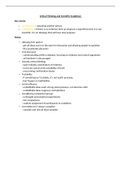
Key words:
o Ad Hominem = attacking another person
o Falsifiability = if there is no evidence that can disprove a hypothesis then it is not
scientific, it is an ideology that will have slow progress
Notes:
Allowing free speech
- get all ideas out in to the open for discussion and allowing people to question
- this accelerates discovery
Civil discourse
- communicating civilly in debates, focusing on evidence and central arguments
- ad hominem is discouraged
Socratic critical thinking
- open minded, examination of evidence
- not to be cynical of the possibility of truth
- overcoming confirmation biases
Testability
- if something isn’t testable, it’s not worth pursuing
- Karl Popper on falsifiability
Social influence
- unfalsifiable ideas exert strong social pressure, can become cultic
- unfalsifiable ideas suppress contradictions
Considering comparison groups
- in thought and empirical experiments
- fair comparisons
- random assignment of participants to conditions
Correlation isn’t always causation
- consider and test all third variables
Key words:
o Ad Hominem = attacking another person
o Falsifiability = if there is no evidence that can disprove a hypothesis then it is not
scientific, it is an ideology that will have slow progress
Notes:
Allowing free speech
- get all ideas out in to the open for discussion and allowing people to question
- this accelerates discovery
Civil discourse
- communicating civilly in debates, focusing on evidence and central arguments
- ad hominem is discouraged
Socratic critical thinking
- open minded, examination of evidence
- not to be cynical of the possibility of truth
- overcoming confirmation biases
Testability
- if something isn’t testable, it’s not worth pursuing
- Karl Popper on falsifiability
Social influence
- unfalsifiable ideas exert strong social pressure, can become cultic
- unfalsifiable ideas suppress contradictions
Considering comparison groups
- in thought and empirical experiments
- fair comparisons
- random assignment of participants to conditions
Correlation isn’t always causation
- consider and test all third variables