New Research
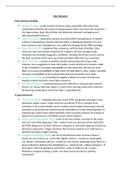
False Memory Findings:
Wing et al (2020): a false and true memory study using fMRI, when there was
coordination between the cortex and hippocampus there were less false memories =
the hippocampus helps discriminate and determine between overlapping and
detecting detailed memory.
Favre et al (2020): using false memory word lists (DRM) schizophrenics vs healthy
controls, schizophrenics showed reduced ability to distinguish between true and
false memories and schizophrenics use a different strategy for the DRM paradigm.
Oeberst et al (2021): implanted false memories, with the help of families, false
memories were successfully implanted (at a higher rate than average) under
minimally and massively suggestive conditions. Methods were then used to reverse
the false memories which were successful and didn’t affect the true memories.
Kloft et al (2021): a review of whether alcohol and psychoactive drugs make
someone more suggestive to false information. Found alcohol and cannabis, under
certain conditions, increased susceptibility to false memories. Alcohol was most
likely to increase susceptibility at high levels of intoxication or after a delay. Cannabis
increases susceptibility at acute intoxication but not necessarily once sober.
Kersten et al (2021): p’s remembered negative actions more than neutral ones,
negative actions also led to more false memories.
Schopen et al (2021): a forewarning was more effective in reducing false memory
levels in 11-12year olds than adults. P’s were more accurate when they received a
forewarning compared to when they didn’t, using DRM lists.
Trauma Research:
Thome et al (2020): individuals who don’t have PTSD had greater activation in the
prefrontal medial cortex = helps retrieval monitoring. PTSD p’s showed more
activation in the posteromedial cortex =enables visual imagery processing, reduced
activation of the prefrontal cortices may be interpreted as a bias towards greater re-
experiencing, where more salient elements of the traumatic memory are relived as
opposed to retrieved in a controlled manner (meta-analysis).
Payton Jones’ Dissertation (2021): some of the least violent countries in the world
have the most PTSD diagnoses. USA – violent crime has decreased from 2002-2012
but PTSD diagnoses increased. What we categorise as traumatic depends onwhat we
have been exposed to. Trigger warnings often increase anxiety so it could have no
benefit to provide a trigger warning.
Campbell & Mannings (2018): the rise of victimhood culture. Honour cultures =
insults are very serious e.g., south USA, dignity cultures = insults are meaningless
e.g., Britain, victimhood cultures = insults are very serious (especially when there is a
power imbalance between the individuals) e.g., online forums, college campuses. “if
the world is full of perpetrators and victims, surely it’s better to be a victim”.
Reduction in stigma of being a victim, are there social rewards for claiming
victimhood?
False Memory Findings:
Wing et al (2020): a false and true memory study using fMRI, when there was
coordination between the cortex and hippocampus there were less false memories =
the hippocampus helps discriminate and determine between overlapping and
detecting detailed memory.
Favre et al (2020): using false memory word lists (DRM) schizophrenics vs healthy
controls, schizophrenics showed reduced ability to distinguish between true and
false memories and schizophrenics use a different strategy for the DRM paradigm.
Oeberst et al (2021): implanted false memories, with the help of families, false
memories were successfully implanted (at a higher rate than average) under
minimally and massively suggestive conditions. Methods were then used to reverse
the false memories which were successful and didn’t affect the true memories.
Kloft et al (2021): a review of whether alcohol and psychoactive drugs make
someone more suggestive to false information. Found alcohol and cannabis, under
certain conditions, increased susceptibility to false memories. Alcohol was most
likely to increase susceptibility at high levels of intoxication or after a delay. Cannabis
increases susceptibility at acute intoxication but not necessarily once sober.
Kersten et al (2021): p’s remembered negative actions more than neutral ones,
negative actions also led to more false memories.
Schopen et al (2021): a forewarning was more effective in reducing false memory
levels in 11-12year olds than adults. P’s were more accurate when they received a
forewarning compared to when they didn’t, using DRM lists.
Trauma Research:
Thome et al (2020): individuals who don’t have PTSD had greater activation in the
prefrontal medial cortex = helps retrieval monitoring. PTSD p’s showed more
activation in the posteromedial cortex =enables visual imagery processing, reduced
activation of the prefrontal cortices may be interpreted as a bias towards greater re-
experiencing, where more salient elements of the traumatic memory are relived as
opposed to retrieved in a controlled manner (meta-analysis).
Payton Jones’ Dissertation (2021): some of the least violent countries in the world
have the most PTSD diagnoses. USA – violent crime has decreased from 2002-2012
but PTSD diagnoses increased. What we categorise as traumatic depends onwhat we
have been exposed to. Trigger warnings often increase anxiety so it could have no
benefit to provide a trigger warning.
Campbell & Mannings (2018): the rise of victimhood culture. Honour cultures =
insults are very serious e.g., south USA, dignity cultures = insults are meaningless
e.g., Britain, victimhood cultures = insults are very serious (especially when there is a
power imbalance between the individuals) e.g., online forums, college campuses. “if
the world is full of perpetrators and victims, surely it’s better to be a victim”.
Reduction in stigma of being a victim, are there social rewards for claiming
victimhood?