On Her Blindness (Adam Thorpe)
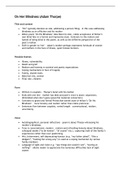
Title and context
• “On” typically denotes an ode, addressing a person/thing – in this case addressing
blindness as an affliction and his mother
• Milton poem ‘On His Blindness’ describes his stoic, noble acceptance of Milton’s
own blind fate in a formal and impressive style. Contrasts to the realism and
hatred of being blind in this poem, as well as the different perspective of the
poet’s mother.
• Shift in gender to ‘her’ – Adam’s mother perhaps represents fortitude of women
and mothers in the face of illness, quiet female heroism.
Possible themes
• Illness, vulnerability
• Death and grief
• Realism and honesty vs societal and poetic expectations
• Coping mechanisms in face of tragedy
• Family, shared traits
• Maternal role, women
• Filial role, children
Form
• Written in couplets – Thorpe’s bond with his mother
• Ends with one line – mother has died and poet’s voice is alone, separation,
diminished when she’s gone (powerful maternal connection)
• Contrasts to grand and formal Petrarchan sonnet style of Milton’s ‘On His
Blindness’ – more honesty and realism rather than noble pretences
• Sentences flow between couplets, varied length – conversational, realism,
uncertainty
Voice
• Autobiographical, personal reflections – poem is about Thorpe witnessing his
mother’s blindness.
• Tone is conversational, modern – realism and refreshing honesty about blindness,
colloquial asides (“to be honest”, “of course” etc.), capturing truth of the family’s
experiences rather than over-poeticising
• Wry, bittersweet, self-deprecating humour (e.g. “my father joked”, “like a
dodgem”, “looking the wrong way”) is used as a coping mechanism by various
family members
• Language of sight and vision e.g. “saw things she couldn’t see”, “staring at
nothing” – allows reader to appreciate the numerous difficulties lack of sight
causes
Title and context
• “On” typically denotes an ode, addressing a person/thing – in this case addressing
blindness as an affliction and his mother
• Milton poem ‘On His Blindness’ describes his stoic, noble acceptance of Milton’s
own blind fate in a formal and impressive style. Contrasts to the realism and
hatred of being blind in this poem, as well as the different perspective of the
poet’s mother.
• Shift in gender to ‘her’ – Adam’s mother perhaps represents fortitude of women
and mothers in the face of illness, quiet female heroism.
Possible themes
• Illness, vulnerability
• Death and grief
• Realism and honesty vs societal and poetic expectations
• Coping mechanisms in face of tragedy
• Family, shared traits
• Maternal role, women
• Filial role, children
Form
• Written in couplets – Thorpe’s bond with his mother
• Ends with one line – mother has died and poet’s voice is alone, separation,
diminished when she’s gone (powerful maternal connection)
• Contrasts to grand and formal Petrarchan sonnet style of Milton’s ‘On His
Blindness’ – more honesty and realism rather than noble pretences
• Sentences flow between couplets, varied length – conversational, realism,
uncertainty
Voice
• Autobiographical, personal reflections – poem is about Thorpe witnessing his
mother’s blindness.
• Tone is conversational, modern – realism and refreshing honesty about blindness,
colloquial asides (“to be honest”, “of course” etc.), capturing truth of the family’s
experiences rather than over-poeticising
• Wry, bittersweet, self-deprecating humour (e.g. “my father joked”, “like a
dodgem”, “looking the wrong way”) is used as a coping mechanism by various
family members
• Language of sight and vision e.g. “saw things she couldn’t see”, “staring at
nothing” – allows reader to appreciate the numerous difficulties lack of sight
causes