Nucleic acids and Protein
Synthesis
Nucleic Structure
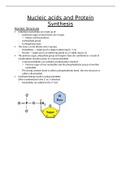
Individual nucleotides are made up of:
A pentose sugar of which there are 2 types
Ribose and deoxyribose
A phosphate group
A nitrogenous base
The bases can be divides onto 5 groups
Pyrimidines made up of a single 6-sided ring (C, T, U)
Purines made up of a 6-sided ring joined to a 5-sided ring (A, G)
The pentose sugar, phosphate group and organic base are combined as a result of
condensation reactions given to a mononucleotide
2 mononucleotides can combine (condensation reaction)
Pentose sugar of one nucleotide and the phosphodiester group of another
nucleotide
The strong covalent bond is called a phosphodiester bond. the new structure is
called a dinucleotide
Continual linking results in polynucleotides
DNA is synthesised in the 51 to 31 direction
Nucleotides are added to the 31 end
Synthesis
Nucleic Structure
Individual nucleotides are made up of:
A pentose sugar of which there are 2 types
Ribose and deoxyribose
A phosphate group
A nitrogenous base
The bases can be divides onto 5 groups
Pyrimidines made up of a single 6-sided ring (C, T, U)
Purines made up of a 6-sided ring joined to a 5-sided ring (A, G)
The pentose sugar, phosphate group and organic base are combined as a result of
condensation reactions given to a mononucleotide
2 mononucleotides can combine (condensation reaction)
Pentose sugar of one nucleotide and the phosphodiester group of another
nucleotide
The strong covalent bond is called a phosphodiester bond. the new structure is
called a dinucleotide
Continual linking results in polynucleotides
DNA is synthesised in the 51 to 31 direction
Nucleotides are added to the 31 end