

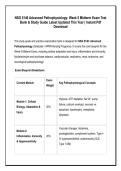
NSG 5140 Advanced Pathophysiology: Week 5 Midterm Exam Test
Bank & Study Guide Latest Updated This Year | Instant Pdf
Download
This study guide and practice examination bank is designed for NSG 5140: Advanced
Pathophysiology (Graduate / APRN Nursing Programs). It covers the core blueprint for the
Week 5 Midterm Exam, including cellular adaptation and injury, inflammation and immunity,
fluid/electrolyte and acid-base balance, cardiovascular, respiratory, renal, endocrine, and
neurological pathophysiology.
Exam Blueprint Breakdown
Exam
Content Module Key Pathophysiological Concepts
Weight
Hypoxia, ATP depletion, Na⁺/K⁺ pump
Module 1: Cellular
failure, calcium overload, necrosis vs.
Biology, Adaptation & 20%
apoptosis, hypertrophy, metaplasia,
Injury
dysplasia
Vascular changes, histamine,
Module 2:
prostaglandins, complement system, Type I–
Inflammation, Immunity 20%
IV hypersensitivities, autoimmunity (SLE,
& Hypersensitivity
Type 1 DM)
, Exam
Content Module Key Pathophysiological Concepts
Weight
Module 3: Fluid, Osmotic/oncotic fluid shifts, RAAS, ADH,
Electrolyte & Acid- 15% hyponatremia/hypernatremia, hypokalemia
Base Balance (ECG changes), ABG interpretation
Module 4:
Atherosclerosis, plaque rupture, MI, heart
Cardiovascular &
25% failure remodeling, shock states, COPD,
Respiratory
asthma, ARDS, pulmonary embolism
Pathophysiology
Module 5: Renal,
AKI (prerenal, intrinsic, postrenal), CKD,
Endocrine &
20% DKA vs. HHS, thyroid dysfunction, stroke,
Neurologic
ICP/Cushing's triad, status epilepticus
Pathophysiology
SECTION 1: Cellular Biology, Adaptation, Injury & Death (Q1–Q40)
Question 1
What is the primary mechanism of cellular injury in hypoxic conditions?
A) Direct mutation of nuclear DNA
, B) ATP depletion leading to failure of the Na⁺/K⁺ ATPase pump and cell
swelling ✔
C) Lysosomal enzyme inactivation
D) Extracellular calcium depletion
Rationale: Hypoxia impairs mitochondrial oxidative phosphorylation, reducing ATP
production. Without ATP, the Na⁺/K⁺ ATPase pump fails, causing intracellular sodium
accumulation, water influx, cellular swelling, and membrane rupture.
Question 2
A 62-year-old patient with long-standing uncontrolled primary hypertension exhibits left
ventricular wall thickening on an echocardiogram. Which cellular adaptive process is taking
place?
A) Atrophy
B) Hyperplasia
C) Hypertrophy ✔
D) Metaplasia
Rationale: Cardiac myocytes are terminally differentiated cells that cannot divide via mitosis
(hyperplasia). In response to increased afterload, myocytes increase in physical size
(hypertrophy) by synthesizing contractile proteins.
Question 3
Chronic exposure to gastric acid in the lower esophagus causes normal stratified squamous
epithelium to be replaced by simple columnar epithelium (Barrett's esophagus). This
process is termed:
, A) Dysplasia
B) Metaplasia ✔
C) Anaplasia
D) Hyperplasia
Rationale: Metaplasia is the reversible replacement of one fully differentiated cell type by
another differentiated cell type better suited to withstand chronic environmental stress.
Question 4
In ischemic brain tissue, dead cells undergo enzymatic digestion by lysosomal enzymes,
resulting in soft, liquid-filled cystic lesions. What type of necrosis is this?
A) Coagulative necrosis
B) Liquefactive necrosis ✔
C) Caseous necrosis
D) Fat necrosis
Rationale: Liquefactive necrosis is characteristic of ischemic brain injury because neural
tissue is rich in hydrolytic enzymes and lipids, leading to rapid autolysis and tissue
liquefaction.
Question 5
Reperfusion injury following ischemic tissue injury is mediated primarily by:
A) Activation of ATP production
B) Generation of reactive oxygen species (ROS) and intracellular calcium
overload ✔
C) Rapid efflux of potassium ions
Bank & Study Guide Latest Updated This Year | Instant Pdf
Download
This study guide and practice examination bank is designed for NSG 5140: Advanced
Pathophysiology (Graduate / APRN Nursing Programs). It covers the core blueprint for the
Week 5 Midterm Exam, including cellular adaptation and injury, inflammation and immunity,
fluid/electrolyte and acid-base balance, cardiovascular, respiratory, renal, endocrine, and
neurological pathophysiology.
Exam Blueprint Breakdown
Exam
Content Module Key Pathophysiological Concepts
Weight
Hypoxia, ATP depletion, Na⁺/K⁺ pump
Module 1: Cellular
failure, calcium overload, necrosis vs.
Biology, Adaptation & 20%
apoptosis, hypertrophy, metaplasia,
Injury
dysplasia
Vascular changes, histamine,
Module 2:
prostaglandins, complement system, Type I–
Inflammation, Immunity 20%
IV hypersensitivities, autoimmunity (SLE,
& Hypersensitivity
Type 1 DM)
, Exam
Content Module Key Pathophysiological Concepts
Weight
Module 3: Fluid, Osmotic/oncotic fluid shifts, RAAS, ADH,
Electrolyte & Acid- 15% hyponatremia/hypernatremia, hypokalemia
Base Balance (ECG changes), ABG interpretation
Module 4:
Atherosclerosis, plaque rupture, MI, heart
Cardiovascular &
25% failure remodeling, shock states, COPD,
Respiratory
asthma, ARDS, pulmonary embolism
Pathophysiology
Module 5: Renal,
AKI (prerenal, intrinsic, postrenal), CKD,
Endocrine &
20% DKA vs. HHS, thyroid dysfunction, stroke,
Neurologic
ICP/Cushing's triad, status epilepticus
Pathophysiology
SECTION 1: Cellular Biology, Adaptation, Injury & Death (Q1–Q40)
Question 1
What is the primary mechanism of cellular injury in hypoxic conditions?
A) Direct mutation of nuclear DNA
, B) ATP depletion leading to failure of the Na⁺/K⁺ ATPase pump and cell
swelling ✔
C) Lysosomal enzyme inactivation
D) Extracellular calcium depletion
Rationale: Hypoxia impairs mitochondrial oxidative phosphorylation, reducing ATP
production. Without ATP, the Na⁺/K⁺ ATPase pump fails, causing intracellular sodium
accumulation, water influx, cellular swelling, and membrane rupture.
Question 2
A 62-year-old patient with long-standing uncontrolled primary hypertension exhibits left
ventricular wall thickening on an echocardiogram. Which cellular adaptive process is taking
place?
A) Atrophy
B) Hyperplasia
C) Hypertrophy ✔
D) Metaplasia
Rationale: Cardiac myocytes are terminally differentiated cells that cannot divide via mitosis
(hyperplasia). In response to increased afterload, myocytes increase in physical size
(hypertrophy) by synthesizing contractile proteins.
Question 3
Chronic exposure to gastric acid in the lower esophagus causes normal stratified squamous
epithelium to be replaced by simple columnar epithelium (Barrett's esophagus). This
process is termed:
, A) Dysplasia
B) Metaplasia ✔
C) Anaplasia
D) Hyperplasia
Rationale: Metaplasia is the reversible replacement of one fully differentiated cell type by
another differentiated cell type better suited to withstand chronic environmental stress.
Question 4
In ischemic brain tissue, dead cells undergo enzymatic digestion by lysosomal enzymes,
resulting in soft, liquid-filled cystic lesions. What type of necrosis is this?
A) Coagulative necrosis
B) Liquefactive necrosis ✔
C) Caseous necrosis
D) Fat necrosis
Rationale: Liquefactive necrosis is characteristic of ischemic brain injury because neural
tissue is rich in hydrolytic enzymes and lipids, leading to rapid autolysis and tissue
liquefaction.
Question 5
Reperfusion injury following ischemic tissue injury is mediated primarily by:
A) Activation of ATP production
B) Generation of reactive oxygen species (ROS) and intracellular calcium
overload ✔
C) Rapid efflux of potassium ions


