

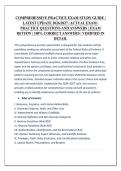
COMPREHENSIVE PRACTICE EXAM STUDY GUIDE |
LATEST UPDATE 2026/2027 | ACTUAL EXAM |
PRACTICE QUESTIONS AND ANSWERS | EXAM
REVIEW | 100% CORRECT ANSWERS | VERIFIED IN
DETAIL
This comprehensive practice examination is designed for law students and bar
candidates seeking an exhaustive assessment of the Federal Rules of Evidence. It
consolidates 150 advanced multiple-choice questions spanning every major
doctrinal area: relevance and its limits, character evidence and other acts,
impeachment, hearsay and its exceptions, authentication, the Best Evidence Rule,
expert and lay opinion, privileges, and constitutional constraints. Each question is
crafted to mirror the complexity of modern evidence examinations, with dense fact
patterns requiring precise rule application and careful distinction between closely
related doctrines. Detailed answer rationales dissect the correct choice and explain
why each alternative fails. Updated for the 2026–2027 cycle, this resource
provides verified solutions for comprehensive review and self-assessment,
enabling you to identify weaknesses and build mastery of the law of evidence.
• Table of Contents
I. Relevance, Prejudice, and Limited Admissibility
II. Character Evidence, Habit, and Other Acts
III. Impeachment and Witness Credibility
IV. Hearsay Definition and Non-Hearsay Categories
V. Hearsay Exceptions (Rule 803)
VI. Hearsay Exceptions (Rule 804)
VII. Authentication, Identification, and the Best Evidence Rule
VIII. Opinion Testimony, Expert Witnesses, and Scientific Evidence
IX. Privileges, Public Policy Exclusions, and Constitutional Limitations
X. Judicial Notice, Presumptions, and Burdens
,Page 1 of 8
1. A plaintiff sues a store after slipping on a wet floor. She offers testimony
that another customer complained about the spill 20 minutes earlier. The
store objects on hearsay grounds. How should the court rule?
A) Admit as present sense impression
B) Admit as excited utterance
C) Exclude as hearsay
D) Admit not for truth, but to prove notice
Correct Answer: D
The statement is offered to show the store had notice of a dangerous condition,
not to prove the floor was wet. When an out-of-court statement is offered for a
purpose other than its truth, it is not hearsay. Notice is an element of premises
liability, and the customer's complaint is circumstantial evidence of that
knowledge. Options A and B are hearsay exceptions that would apply only if the
statement were offered for its truth. Therefore, the court should admit the
statement for the limited non-hearsay purpose of notice.
2. In a robbery trial, the prosecution offers evidence that the defendant
purchased a ski mask and crowbar the day before. The defendant objects
on relevance grounds. The evidence is:
A) Inadmissible because it does not directly prove robbery
B) Admissible because it makes preparation more probable
C) Inadmissible character evidence under Rule 404
D) Admissible only if defendant testifies
Correct Answer: B
Evidence of preparatory acts is relevant under Rule 401 because it tends to make
the existence of a consequential fact—the defendant's involvement—more
probable. Purchasing items commonly used in a robbery is circumstantial evidence
of planning and preparation. It is not character evidence; it is specific conduct
related to the charged crime. Direct proof is not required. Thus, the evidence is
relevant and admissible.
, 3. A plaintiff in an auto accident case offers evidence that the defendant paid
the plaintiff's medical bills. The defendant objects under Rule 409. The
court should:
A) Admit as admission of liability
B) Exclude because Rule 409 bars evidence of paying medical expenses to
prove fault
C) Admit to show defendant's wealth
D) Exclude as hearsay
Correct Answer: B
Rule 409 prohibits the use of evidence of paying, offering, or promising to pay
medical expenses to prove liability for the injury. The policy encourages
humanitarian gestures. Option A is exactly what the rule forbids. Option C is
irrelevant. Option D is incorrect because payment is conduct, not a statement.
Thus, the evidence is inadmissible for proving fault.
4. A defendant is on trial for assault. The prosecution calls a witness to testify
that the defendant has a reputation for violence. The defendant has not
introduced character evidence. The court should:
A) Admit as reputation evidence under Rule 405
B) Exclude because prosecution may not initiate bad character evidence
C) Admit with advance notice
D) Exclude because reputation evidence is never admissible
Correct Answer: B
Rule 404(a)(1) prohibits the prosecution from introducing evidence of a
defendant's character trait to prove action in conformity therewith, unless the
defendant first introduces evidence of good character. The defendant has not
opened the door, so the evidence is impermissible character evidence. Options A,
C, and D misstate the rule.
5. A prosecution witness testifies she saw the defendant flee. On cross,
defense asks about her pending civil lawsuit against the defendant. The
prosecutor objects. The question is:
A) Improper because irrelevant
, B) Proper because evidence of bias is always relevant
C) Improper unless witness denies bias
D) Proper only with extrinsic evidence
Correct Answer: B
Bias is always relevant to credibility and may be developed on cross-examination.
A pending lawsuit against the defendant shows a financial motive to testify
adversely. No foundation of denial is needed; extrinsic evidence is also permissible.
Thus, the question is proper.
6. A plaintiff in a contract action testifies the defendant orally agreed to
deliver goods. The defendant objects, demanding the written contract
under the Best Evidence Rule. The plaintiff says the original was destroyed
in a flood. The court should:
A) Exclude the testimony
B) Admit testimony upon showing loss not in bad faith
C) Exclude unless defendant admits terms
D) Admit only if a copy exists
Correct Answer: B
Under Rule 1004(a), an original is not required if it was lost or destroyed and not
by the proponent acting in bad faith. The plaintiff's testimony, if credited, satisfies
the exception. Options A, C, and D are not required. Thus, the testimony is
admissible.
7. A prosecutor offers a witness's prior photo array identification. The witness
testifies but cannot remember the identification. The statement is
admissible as substantive evidence under:
A) Rule 803(5) recorded recollection
B) Rule 801(d)(1)(C) prior identification
C) Rule 801(d)(1)(A) prior inconsistent statement
D) Inadmissible hearsay
Correct Answer: B
Rule 801(d)(1)(C) specifically provides that a prior statement of identification is not
LATEST UPDATE 2026/2027 | ACTUAL EXAM |
PRACTICE QUESTIONS AND ANSWERS | EXAM
REVIEW | 100% CORRECT ANSWERS | VERIFIED IN
DETAIL
This comprehensive practice examination is designed for law students and bar
candidates seeking an exhaustive assessment of the Federal Rules of Evidence. It
consolidates 150 advanced multiple-choice questions spanning every major
doctrinal area: relevance and its limits, character evidence and other acts,
impeachment, hearsay and its exceptions, authentication, the Best Evidence Rule,
expert and lay opinion, privileges, and constitutional constraints. Each question is
crafted to mirror the complexity of modern evidence examinations, with dense fact
patterns requiring precise rule application and careful distinction between closely
related doctrines. Detailed answer rationales dissect the correct choice and explain
why each alternative fails. Updated for the 2026–2027 cycle, this resource
provides verified solutions for comprehensive review and self-assessment,
enabling you to identify weaknesses and build mastery of the law of evidence.
• Table of Contents
I. Relevance, Prejudice, and Limited Admissibility
II. Character Evidence, Habit, and Other Acts
III. Impeachment and Witness Credibility
IV. Hearsay Definition and Non-Hearsay Categories
V. Hearsay Exceptions (Rule 803)
VI. Hearsay Exceptions (Rule 804)
VII. Authentication, Identification, and the Best Evidence Rule
VIII. Opinion Testimony, Expert Witnesses, and Scientific Evidence
IX. Privileges, Public Policy Exclusions, and Constitutional Limitations
X. Judicial Notice, Presumptions, and Burdens
,Page 1 of 8
1. A plaintiff sues a store after slipping on a wet floor. She offers testimony
that another customer complained about the spill 20 minutes earlier. The
store objects on hearsay grounds. How should the court rule?
A) Admit as present sense impression
B) Admit as excited utterance
C) Exclude as hearsay
D) Admit not for truth, but to prove notice
Correct Answer: D
The statement is offered to show the store had notice of a dangerous condition,
not to prove the floor was wet. When an out-of-court statement is offered for a
purpose other than its truth, it is not hearsay. Notice is an element of premises
liability, and the customer's complaint is circumstantial evidence of that
knowledge. Options A and B are hearsay exceptions that would apply only if the
statement were offered for its truth. Therefore, the court should admit the
statement for the limited non-hearsay purpose of notice.
2. In a robbery trial, the prosecution offers evidence that the defendant
purchased a ski mask and crowbar the day before. The defendant objects
on relevance grounds. The evidence is:
A) Inadmissible because it does not directly prove robbery
B) Admissible because it makes preparation more probable
C) Inadmissible character evidence under Rule 404
D) Admissible only if defendant testifies
Correct Answer: B
Evidence of preparatory acts is relevant under Rule 401 because it tends to make
the existence of a consequential fact—the defendant's involvement—more
probable. Purchasing items commonly used in a robbery is circumstantial evidence
of planning and preparation. It is not character evidence; it is specific conduct
related to the charged crime. Direct proof is not required. Thus, the evidence is
relevant and admissible.
, 3. A plaintiff in an auto accident case offers evidence that the defendant paid
the plaintiff's medical bills. The defendant objects under Rule 409. The
court should:
A) Admit as admission of liability
B) Exclude because Rule 409 bars evidence of paying medical expenses to
prove fault
C) Admit to show defendant's wealth
D) Exclude as hearsay
Correct Answer: B
Rule 409 prohibits the use of evidence of paying, offering, or promising to pay
medical expenses to prove liability for the injury. The policy encourages
humanitarian gestures. Option A is exactly what the rule forbids. Option C is
irrelevant. Option D is incorrect because payment is conduct, not a statement.
Thus, the evidence is inadmissible for proving fault.
4. A defendant is on trial for assault. The prosecution calls a witness to testify
that the defendant has a reputation for violence. The defendant has not
introduced character evidence. The court should:
A) Admit as reputation evidence under Rule 405
B) Exclude because prosecution may not initiate bad character evidence
C) Admit with advance notice
D) Exclude because reputation evidence is never admissible
Correct Answer: B
Rule 404(a)(1) prohibits the prosecution from introducing evidence of a
defendant's character trait to prove action in conformity therewith, unless the
defendant first introduces evidence of good character. The defendant has not
opened the door, so the evidence is impermissible character evidence. Options A,
C, and D misstate the rule.
5. A prosecution witness testifies she saw the defendant flee. On cross,
defense asks about her pending civil lawsuit against the defendant. The
prosecutor objects. The question is:
A) Improper because irrelevant
, B) Proper because evidence of bias is always relevant
C) Improper unless witness denies bias
D) Proper only with extrinsic evidence
Correct Answer: B
Bias is always relevant to credibility and may be developed on cross-examination.
A pending lawsuit against the defendant shows a financial motive to testify
adversely. No foundation of denial is needed; extrinsic evidence is also permissible.
Thus, the question is proper.
6. A plaintiff in a contract action testifies the defendant orally agreed to
deliver goods. The defendant objects, demanding the written contract
under the Best Evidence Rule. The plaintiff says the original was destroyed
in a flood. The court should:
A) Exclude the testimony
B) Admit testimony upon showing loss not in bad faith
C) Exclude unless defendant admits terms
D) Admit only if a copy exists
Correct Answer: B
Under Rule 1004(a), an original is not required if it was lost or destroyed and not
by the proponent acting in bad faith. The plaintiff's testimony, if credited, satisfies
the exception. Options A, C, and D are not required. Thus, the testimony is
admissible.
7. A prosecutor offers a witness's prior photo array identification. The witness
testifies but cannot remember the identification. The statement is
admissible as substantive evidence under:
A) Rule 803(5) recorded recollection
B) Rule 801(d)(1)(C) prior identification
C) Rule 801(d)(1)(A) prior inconsistent statement
D) Inadmissible hearsay
Correct Answer: B
Rule 801(d)(1)(C) specifically provides that a prior statement of identification is not


